

Share this article:
.svg)


.svg)
.svg)

Key Takeaways from this article
- AI in construction automates repetitive tasks — Construction site photos are automatically analyzed, defects identified and reports generated, saving 5-7 hours of administrative work per week
- Generative Design Optimizes Planning Processes — AI in construction generates hundreds of design variants in minutes and enables up to 6% more usable space with better daylight efficiency
- Project Management with AI Warns of Problems for 2-4 Weeks — Preventive rather than reactive management through early identification of delays, material bottlenecks and budget overruns
- Drones + AI are revolutionizing construction site monitoring — Automatic evaluation of aerial images reduces inspection time from half a day to an hour and immediately detects safety breaches
- ROI is 107-386% in the first year — Investments of 65,000-175,000 EUR result in measurable savings of 300,000-850,000 EUR through time savings and error reduction
- Successful implementation takes 12-18 months — Realistic schedule includes pilot project, training (AI in construction seminar), data strategy and phased roll-out
- Continuing education in construction is a mandatory investment — Without qualified teams, 70% of AI projects fail; two-day workshops cost 800-1,200 EUR per person and pay for themselves in weeks
- BIM + AI + robotics are shaping the future of the construction industry — By 2032, the market for the use of artificial intelligence in construction will grow to over $15 billion, led by project and risk management
18 percent shorter construction time. 15 percent lower costs. Sounds like wishful thinking? A Norwegian construction company achieved exactly that—not through harder-working employees, but through AI in construction.
While the industry discusses skilled labor shortages, Artificial intelligence implementation Is already changing the rules of the game. Not in Future Visions, but on Real Construction Sites. The crucial question is no longer “whether,” but “how quickly can we catch up?”
Because the Future of Construction Won't be shaped by those who wait. It will be defined by companies that understand: AI in the construction industry Isn't a replacement for expertise—it's an amplifier. Site Managers document in minutes instead of hours. Architects review hundreds of design variants in the time that previously allowed for one. Project managers recognize risks weeks before they occur.
What distinguishes successful implementations from failed ones? This article shows you—without theory overload, with concrete numbers.
Why AI in Construction Matters Right Now
The Future of Construction Is taking shape before our eyes. AI in construction Isn't science fiction anymore—it's already working on job sites, in design offices, and within project management teams. But what does this mean for you as a Site Manager, Architect, or Project Lead?
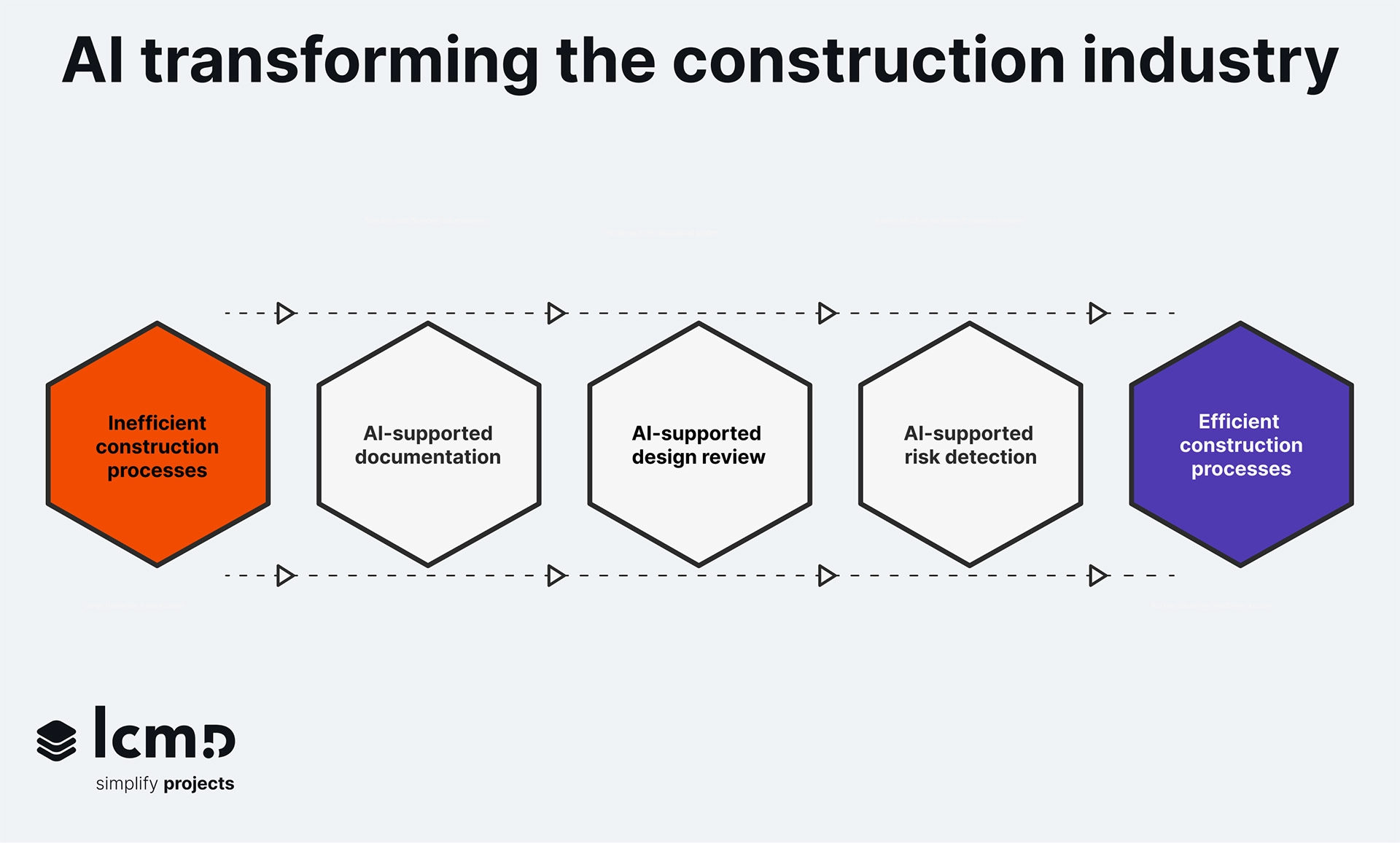
Artificial intelligence implementation Starts where repetitive tasks steal your time and errors creep in. Picture this: Your site photos get analyzed automatically, defects marked and categorized—while you focus on decisions that actually need your expertise.
AI in the construction industry Isn't a magic bullet. It's a tool that makes your work more efficient when you use it right. Let's explore where it makes sense to deploy and what practical steps you can take today.
What Exactly Is AI in Construction?
Behind the term AI construction, there's a straightforward idea: software that learns from data and recognizes patterns. Unlike classic programs that follow rigid rules, it adapts.
Three Technologies Shape Daily Operations
Image Recognition Evaluates photos from your construction site. The software spots missing safety equipment, improperly stored materials, or quality defects. What you used to check manually now runs partially automated.
Text analysis Scours through documents, sorts of information, and generates reports. Your notes from the site visit become structured protocols. Objections get categorized, priorities set.
Data evaluation Turns project histories into actionable forecasts. Will this project stay on budget? Where are delays looming? The software compares thousands of parameters and warns you early.
The difference from conventional software: AI in construction Gets better over time. The more projects you complete, the more precise the predictions become.
AI in Design: From Planning to Execution
How AI in construction is changing the design phase
Do you remember the last planning phase? Countless variants, manual calculations, iterative adjustments. AI construction radically accelerates this process.
Generative design works like a tireless assistant. You define your requirements: budget, plot of land, usable space, static requirements. The software generates hundreds of designs in minutes, evaluates them according to your criteria and shows the optimal solutions.
A Scandinavian real estate project used this technology and gained 6% more living space with better daylight at the same time. The apartment buildings received up to six hours more sunlight per day. That wasn't magic — just intelligent optimization of building orientation, window areas and building heights.
But beware: The software does not replace your expertise. It expands them. It provides options that you might have missed. The final decision — taking into account aesthetics, context and user experience — is still made by humans.
The role of the AI architect: Man and machine in balance
The question “Will AI replace the architect?” pops up regularly. The answer is differentiated. AI Architect is not autonomous software, but a tool in your hand.
What the technology does:
- Routine calculations for structural and material requirements
- Test for compliance with standards and building regulations
- Variant tests for different scenarios
- Documentation and technical drawings
What remains with humans:
- Creative design and architectural vision
- Understanding user behavior and perception of space
- Communication with builders and stakeholders
- Decisions with social and cultural dimensions
The best results come from collaboration. They use AI in construction for what they are good at — quick calculations and optimizations. And you focus on what only people can do: contextual, empathetic and visionary design.
Project Management with AI: Early Detection Instead of Crisis Management
How often have you identified project risks too late? A trade is delayed, materials are becoming scarce, the budget is in trouble. Classic project management reacts to problems when they are already there.
AI in construction enables a different approach: preventive management. The software continuously analyses project data and recognizes patterns that indicate upcoming problems.
A Norwegian construction company used AI-based project planning and had the software calculate 300 alternative scenarios for a construction project. Seven variants were superior to the original plan. The result: 18% shorter construction time, 15% lower costs. The savings did not come from wage cuts, but from optimized resource planning and better timing of the trades.
What does that mean for your everyday life? The software alerts you to actual issues for 2-4 weeks. In the dashboard, you can see that Material Y will be scarce in three weeks or that Subcontractor Z will probably not be able to meet his deadline. They have time to react instead of falling into hustle and bustle.
Construction site monitoring: When drones and AI work together
The classic construction site inspection is time-consuming. They document with a camera, note down deficiencies, and prepare the report later. AI in the construction industry automates parts of this process.
Drones fly over the construction site and take hundreds of photos. The software automatically evaluates them: Is the excavation pit properly secured? Is there a lack of protective equipment somewhere? Is construction progress in line with the plan? Are materials stored correctly?
The results end up directly in your project management system — categorized, prioritized, with location markers. What used to take half a day can now be done in an hour.
An important note: The technology does not replace your expertise during an on-site check. It pre-filters. Instead of running out every square meter, you can focus on the areas that really need your attention.
Software tested in practice: Build GPT and project management tools
Bau GPT: Artificial intelligence for texts and documentation
You know that: construction site notes become reports, meeting minutes become task lists, objections become structured documents. Bau GPT and similar language models do this work for you.
The technology is based on machine learning with texts. You enter key points and the software creates a complete report — with correct terminology, logical structure and appropriate formatting.
Practical example: After a construction site inspection, you dictate your observations into the app. The software detects deficiencies, categorizes them by trade, prioritizes them according to urgency and creates a report according to your template. What you used to write in two hours will be ready in five minutes.
Where are the limits? The software only understands context to a limited extent. Critical decisions, legal assessments or complex issues require your review. Use Bau GPT for routine documentation, not for reports or contract interpretations.
Project management software: Is it worth the investment?
The question of PlanRadar costs or alternatives concerns many teams. What justifies monthly software spending in the four-digit range?
The calculation is easier than expected:
Take a medium-sized construction project with 50 users. PlanRadar costs are around 2,000-3,500 EUR per month. Sounds like a lot. But if the software only saves five hours of documentation time per person per week, that's 250 working hours per month. With an average hourly rate of 75 EUR, this equates to 18,750 EUR — six times more than the software costs.
Of course, the invoice is only valid if:
- The team that actually uses the software
- Integration into existing processes works
- The time savings are real, not just in theory
A pilot project is therefore worthwhile. Test the software on a construction site for three months. Measure the time saved concretely. Only then do you decide whether to use it across the board.
Lcmd project management software: A German alternative
The Lcmd project management software positions itself as a sophisticated solution for the German market. The focus is on intuitive operation and efficient workflows — important if your team does not consist of digital natives.
What makes the software different:
- Central platform for all project participants
- Mobile app for construction site use (launch Q2 2025)
- Integration with popular tools and standards
- German support and GDPR compliance
The developers at Lcmd understand the requirements of German construction projects: HOAI service phases, VOB compliance, interfaces to AVA systems. The software speaks your language, not only linguistically, but also professionally.
{{cta}}
Civil Engineering Continuing Education: No Digitalization Without Qualification
Why you should invest in continuing education in construction now
Here's the uncomfortable truth: The best software is useless if your team can't use it. Continuing education in civil engineering is not an optional addition — it is a prerequisite for successful digitization.
Many implementations fail not because of the technology, but because of a lack of acceptance. Employees feel overwhelmed, see no benefit, or are afraid of change. AI training in construction addresses these issues directly.
The investment pays off quickly: A two-day workshop costs around 800-1,200 EUR per participant. If this reduces the training period by one week and prevents errors in the application, the training is paid for in just a few weeks.
AI in Construction Seminar: Formats and Providers
You have various options for AI in Construction Seminar and continuing education AI in Construction:
VDI conference (March 2026, Mannheim) provides an overview of current developments. You'll hear talks from experts from architecture and engineering firms, network with industry colleagues and see live demonstrations of current tools. The conference is suitable for decision makers who want to plan strategically.
Online courses are flexible and cost-effective. You learn at your own pace, can repeat modules and often receive certificates. The downside: You need discipline and have no direct exchange with lecturers and participants.
Practical workshops provide hands-on experience. You work with software that you will use later. You practice on real scenarios from your everyday work. The lecturer will answer your specific questions. These workshops deliver the fastest ROI but are also the most expensive.
Which format is right for you? It depends on your role. Managing directors and project managers benefit from conferences and strategic seminars. Construction managers and project planners need practical workshops. Online courses are often sufficient for basic understanding.
AI in Construction Book: Advanced for those interested
AI in Construction book is suitable for deepening — not as an introduction. Books offer structured knowledge, background information, and theory. However, they do not replace practical experience.
Recommended content for textbooks:
- BIM integration and digital twins
- Data strategies for AI projects
- Change management during digitization
- Legal framework (GDPR, liability)
- Case studies of successful implementations
Use specialist literature in addition to training courses. Read before a workshop to be prepared. Or use books after the training to delve deeper into specific topics.
What are the challenges of implementing AI in construction?
The question “What are the challenges of implementing AI in construction” deserves an honest answer. The technology is not plug and play. Successful implementation requires planning, resources, and patience.
Technical hurdles: data quality as a basic requirement
AI in construction is only as good as the data it works with. This is often where the first problem starts: Your data is fragmented, in various systems, sometimes still on paper or in personal folders.
The classic scenario: You want to use AI for project forecasting. The software needs historical project data: timelines, cost developments, changes, deviations. But this information is distributed: In Excel sheets of individual project managers, in emails, in various software systems without a common interface.
Preparing this data costs time and money. You need a data strategy: What do we collect? How do we structure it? Where do we store it? Who maintains it?
A pragmatic approach: Don't start with perfect data. Start with what you have and keep improving. Use new projects to establish clean data collection. At the same time, you gradually clean up old data.
Organizational challenges: taking people along
The second major hurdle is human, not technical. Employees see AI as a threat or as an additional burden. “I've already had enough to do” or “We've always done it this way” are common reactions.
The key is communication and participation:
Explain not only what and how, but above all why. Show specific benefits for the individual: “You save three hours of documentation per week” has a stronger effect than “We are becoming more efficient.”
Involve skeptics Ask about concerns and take them seriously. Experienced employees often have legitimate objections, which you should take into account when planning.
Start with volunteers. Create pilot groups of interested parties. Their success stories convince skeptics more than any presentation.
Legal pitfalls: GDPR, liability and cybersecurity
The legal aspects of AI construction are complex. Three areas need particular attention:
Data protection (GDPR): When your AI systems process personal data — and they often do — there are strict rules. Construction site photos with identifiable people, time recording data, communication protocols: everything personal, everything relevant to GDPR.
They need consent, data protection impact assessments, technical protective measures. A violation quickly costs five-digit amounts or more. Get your data protection officer on board early on.
Liability: Who is liable if the AI makes a mistake? What if the cost estimate was wrong? What if the software missed a flaw? The legal situation has not yet been clarified. Agree with software providers where their responsibility ends and yours begins. Adjust your insurance policies.
Cybersecurity: Every networked system is a potential target for attacks. When your construction site data is in the cloud, you need to protect it. Encryption, secure access, regular updates and backups are mandatory, not optional.
The realistic timetable: From months, not weeks
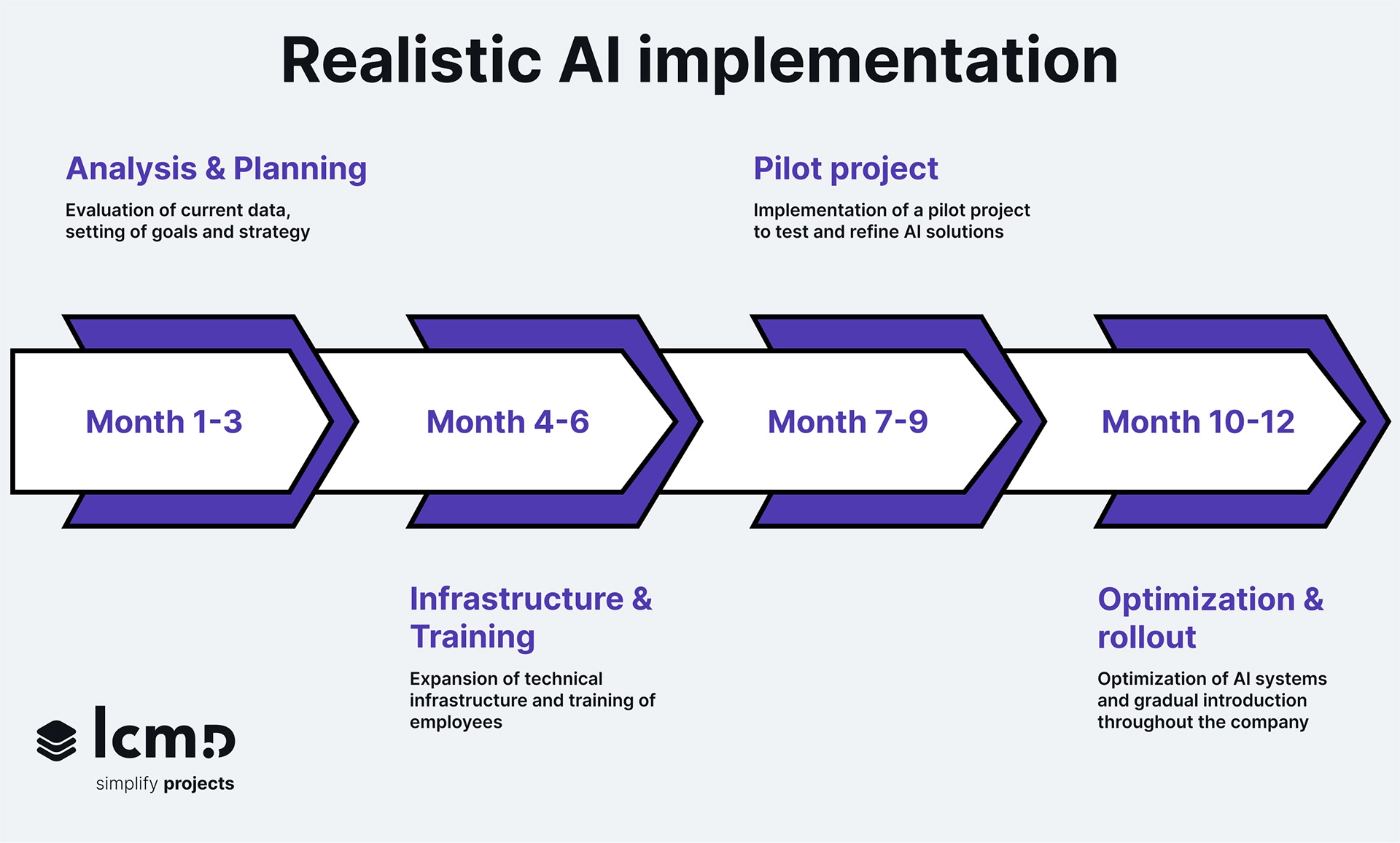
One last inconvenient truth: Successful AI implementation takes time. Expect 12-18 months from project start to productive operation — longer for larger organizations.
Why so long? They must build infrastructure, train employees, adapt processes, clean data and gain experience in pilot projects. Every abbreviation takes revenge later.
Don't sell a sprint internally. Sell a marathon. Set milestones, celebrate interim successes, but don't expect miracles overnight.
Construction sector aid package: Funding as a financing component
The question of financing is slowing down many digitization projects. This is where the construction industry aid package comes in — various funding programs can cover 30-50% of your costs.
What is being funded?
Digital Now from the Federal Ministry of Economics supports digitization projects with a grant of up to 50,000 EUR. Software, hardware, training and consulting are funded. The funding rate is 50% for small companies, 40% for medium-sized companies.
State funding programs vary greatly. Bavaria, Baden-Württemberg and NRW have their own digitization funding with 5,000-30,000 euros in subsidies. The conditions differ; state funding programs are often less bureaucratic than federal programs.
EU funding programmes for innovation and research reach higher sums but require more effort. If you want to develop innovative solutions — such as your own AI applications — the research is worthwhile.
Is it worth the effort?
Let's be honest: funding applications take time. They need concepts, cost plans, documentation. For 5,000 euros in funding, the effort is often disproportionate. Starting at 20,000 EUR, it is usually worthwhile.
An alternative: hire a funding advisor. Many work on a successful basis (15-25% of the funding amount). They know all the programs, know which ones fit, and take care of the paperwork. For larger projects (100,000+ EUR investment), this almost always pays off.
Sendinblue Status: Why transparency counts in the digital world
The Sendinblue status is a prime example of something the construction industry is still learning: transparent communication about system availability.
What is a status page?
Do you know that? The software doesn't work, you don't know why, support is overloaded. A status page solves this problem elegantly: It shows in real time whether the system is running, where there are problems and when they will be resolved.
Elements of a good status page:
- Current status of all services (green = OK, yellow = slow, red = down)
- History of the last 90 days
- Automatic notifications in case of problems
- Transparent communication about causes and solutions
Transfer to construction projects
Why is this relevant for AI in construction? Because your digital tools become critical infrastructure. If your project management software fails, work stalls on several construction sites.
Modern construction site software should offer:
- Real-time status of cloud services
- Proactive information during maintenance
- Transparency about data timeliness
- Mobile offline features as a fallback
The Lcmd software and similar solutions should integrate such transparency features — a sign of the quality of professional tools.
The future of the construction sector: Where is the journey heading?
The future of the construction industry will be more digital, connected and data-driven. Three trends are emerging.
%20Kopie.webp)
Trend 1: BIM and AI are merging
Building Information Modeling (BIM) provides the digital foundation for a building. When BIM is connected with planning, progress, quality, and operational data, it can evolve into a digital twin in construction. AI can then make this connected project data more useful by supporting forecasting, quality checks, and better decision-making.
The combination makes it possible to:
- Predictive maintenance
- Automatic quality controls during construction
- Energy optimization during the operating phase
- Simulation of conversion scenarios
BIM without AI is a static collection of data. AI without BIM is missing the database. Together, they develop their potential.
Trend 2: Robotics on construction sites
Robots wall, plaster, weld. What sounds like a dream of the future is becoming reality. Japanese and South Korean companies are already using construction robotics productively.
What does that mean for you? Not that masons become unemployed. But that dangerous, physically demanding work is increasingly being automated. The shortage of skilled workers is exacerbating this trend.
In 5-10 years, robots will be standard for structural work. Your area of responsibility is shifting: from execution to monitoring, from walls to programming and quality assurance.
Trend 3: Sustainability through optimization
AI construction contributes to more sustainable construction — not through technology magic, but through better planning.
Specific contributions:
- Material optimization reduces waste by 20-30%
- Intelligent logistics reduces transport costs
- Recycled AI precisely sorts demolition material
- Energy simulations optimize building envelope
The EU taxonomy and stricter sustainability requirements make these optimizations increasingly mandatory, not optional.
The figures: Market growth up to 2032
The global market for the use of artificial intelligence in construction is estimated at over 15 billion USD by 2032. This corresponds to an annual growth rate of around 25%.
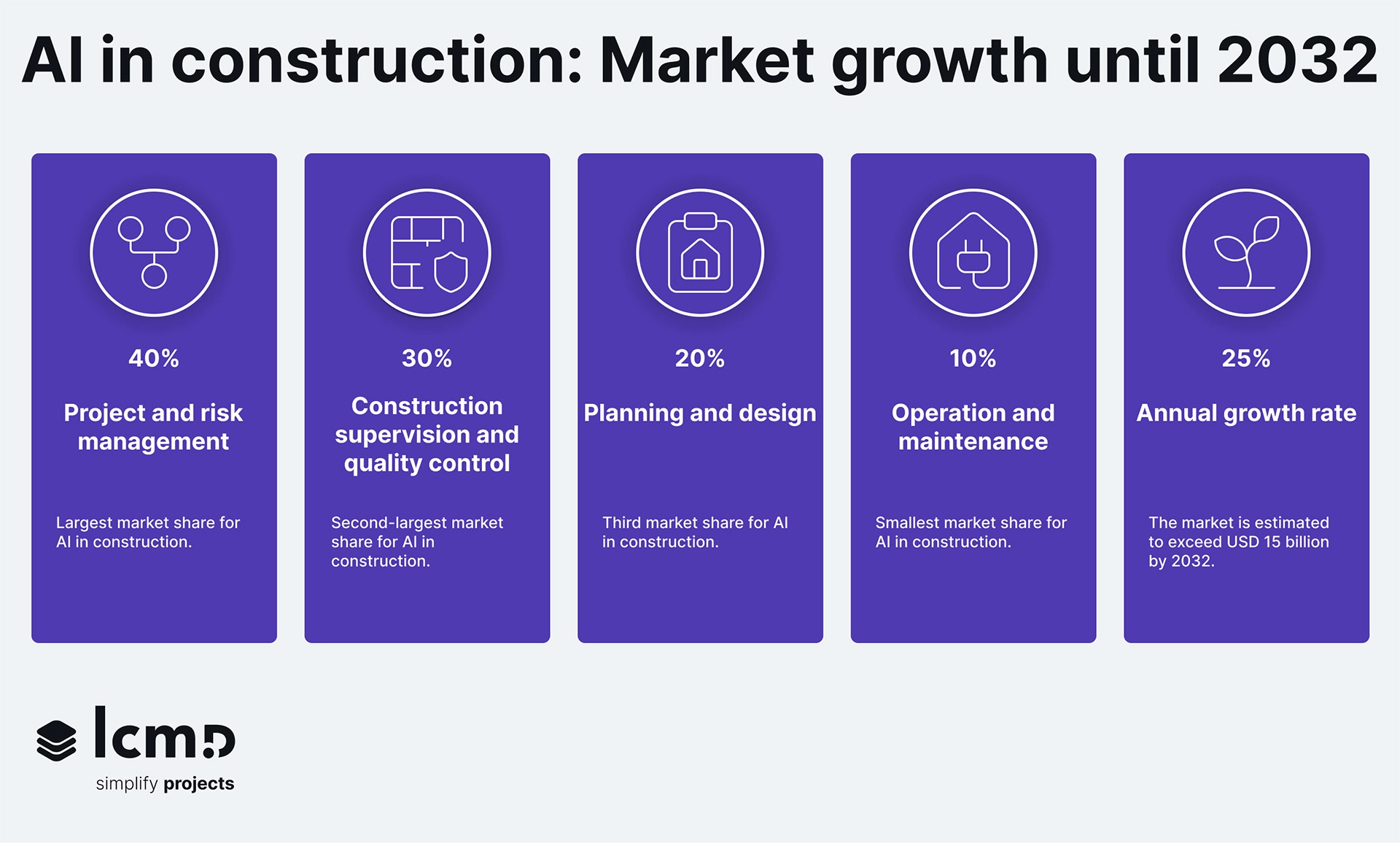
The greatest potential lies in:
- Project and risk management (40% of the market)
- Construction monitoring and quality control (30%)
- Planning and design (20%)
- Operation and maintenance (10%)
Asia-Pacific is leading the development, North America is following, Europe is catching up. Compared to other European countries, Germany is in the middle of the pack — there is potential to catch up.
Your roadmap to AI integration
Theory is good, practice is better. Here is your specific roadmap for the next 12 months.
Months 1-3: Analysis and planning
Week 1-2: Inventory Document your current processes. Where are you wasting time? Where do errors occur? Which tasks are repetitive?
Conduct interviews with construction site personnel, project managers, and planners. Ask specifically: “Which three tasks cost you the most time?” The answers show your use cases.
Week 3-4: Goal definition Define 2-3 specific goals. Not “become more efficient,” but “reduce documentation time by 40%” or “shorten the defect cycle from 6 to 3 days.”
Set measures. How do you measure success? Saving time in hours? Error rate in percent? Costs in euros?
Week 5-8: Market Review Research available solutions. Request demos Compare not only features, but also support, training offerings, and integration into your system landscape.
Week 9-12: Decision and budget Create a decision template for management. Calculate ROI realistically. Calculate not only software costs, but also training, integration and support.
Review funding opportunities (construction industry aid package). Apply for funding in parallel with budget approval.
Months 4-6: Infrastructure and Training
Month 4: Technical preparation Set up cloud access. Purchase mobile devices for construction sites (if necessary). Install software Configure interfaces.
Create authorization concepts. Who can see what? Who is allowed to change something? Document everything.
Month 5: Training Book a AI in Construction Training or an AI in Construction Seminar. First, train your pilot group intensively. These will later become multipliers.
Important: No one-day training without a practical part. Book at least two days of hands-on exercises.
Month 6: Process Customization Define new workflows. Who does what with which tool? Document in simple flow charts (BPMN 2.0 standard).
Create checklists and brief instructions. A construction manager on a construction site does not need 50-page instructions, but a step-by-step checklist.
Months 7-9: pilot project
Month 7-9: Test run Choose a medium-sized project for your pilot. Not too small (too little data), not too big (too much risk). Use all new tools consistently.
Collect feedback on a weekly basis. What's working? What not? Where is it stuck? Adjust processes without revising policy decisions.
Measure your key performance indicators. Are you achieving the goals you set? If so, document successes. If not, analyze causes.
Months 10-12: Optimization and roll-out
Month 10: Lessons Learned Evaluate the pilot project systematically. What would you do differently for your next project? Which processes still need to be adjusted?
Create best practices. Document what worked well. These success stories help roll out to other teams.
Month 11-12: Gradual roll-out Gradually expand to more projects. Not all at once, but project by project. Use your pilot group as an advisor for new teams.
Establish an internal support system Who answers questions? Who helps with problems? External support isn't enough — you need internal contacts.
Benefits for your specific role
The benefits of AI in the construction industry vary depending on the role. Let us be specific.
As a construction manager: time for the essentials
Your biggest challenge: There are too few hours in the day. Documentation, coordination, control — everything must happen at the same time.
AI in construction gives you back time. Construction site photos are automatically categorized and assigned to defects. The software creates daily reports from your key points. Material requests are suggested based on construction progress.
Realistic scenario: You save 5-7 hours per week on administrative work. You invest this time in coordination with subcontractors, quality controls and problem solutions — tasks that really need your expertise.
As an architect: More creativity, less routine
They went to work to design — not to size according to standards or to create material lists.
AI construction takes over the routines. Preliminary static tests are carried out automatically. Comparing variants immediately shows advantages and disadvantages. Visualizations are created at the push of a button.
They focus on what only you can: make space come alive, intelligently combine functions, and reconcile aesthetic and practical requirements.
As a project manager: control instead of surprises
Your success is measured by deadlines, budget and quality. Discrepancies are your biggest enemy.
Construction AI alerts you early on. The software sees patterns that you miss: This subcontractor has already arrived too late on three other projects. According to historical data, this material is unlikely to be delivered on time. This constellation has led to cost overruns in the past.
They react before problems arise. Your builders appreciate your reliability. Your team appreciates that you don't panic because you always have a plan B.
As general contractor: coordination across all trades
They coordinate 20+ subcontractors, manage complex supply chains and have overall responsibility.
The use of artificial intelligence makes this manageable. A central platform shows all participants the current status. Trade dependencies are automatically monitored. If trade A is delayed, you immediately see the effects on trade B, C and D.
Your advantage: You communicate proactively, not reactively. Subcontractors know what is expected of them. They see conflicts before they escalate.
As a lean manager: eliminate waste
Your focus is on process optimization. They chase waste: superfluous routes, waiting times, overproduction.
AI in construction is your digital eye. The software measures what you have only estimated so far: How much time elapses between reporting a defect and rectification? Where does duplication of work occur? Which process steps are bottlenecks?
The data enables fact-based improvements. They test changes, measure the impact, scale what works.
The honest cost-benefit calculation
Let's talk about numbers. How much does AI really cost in construction and what is the benefit of it?
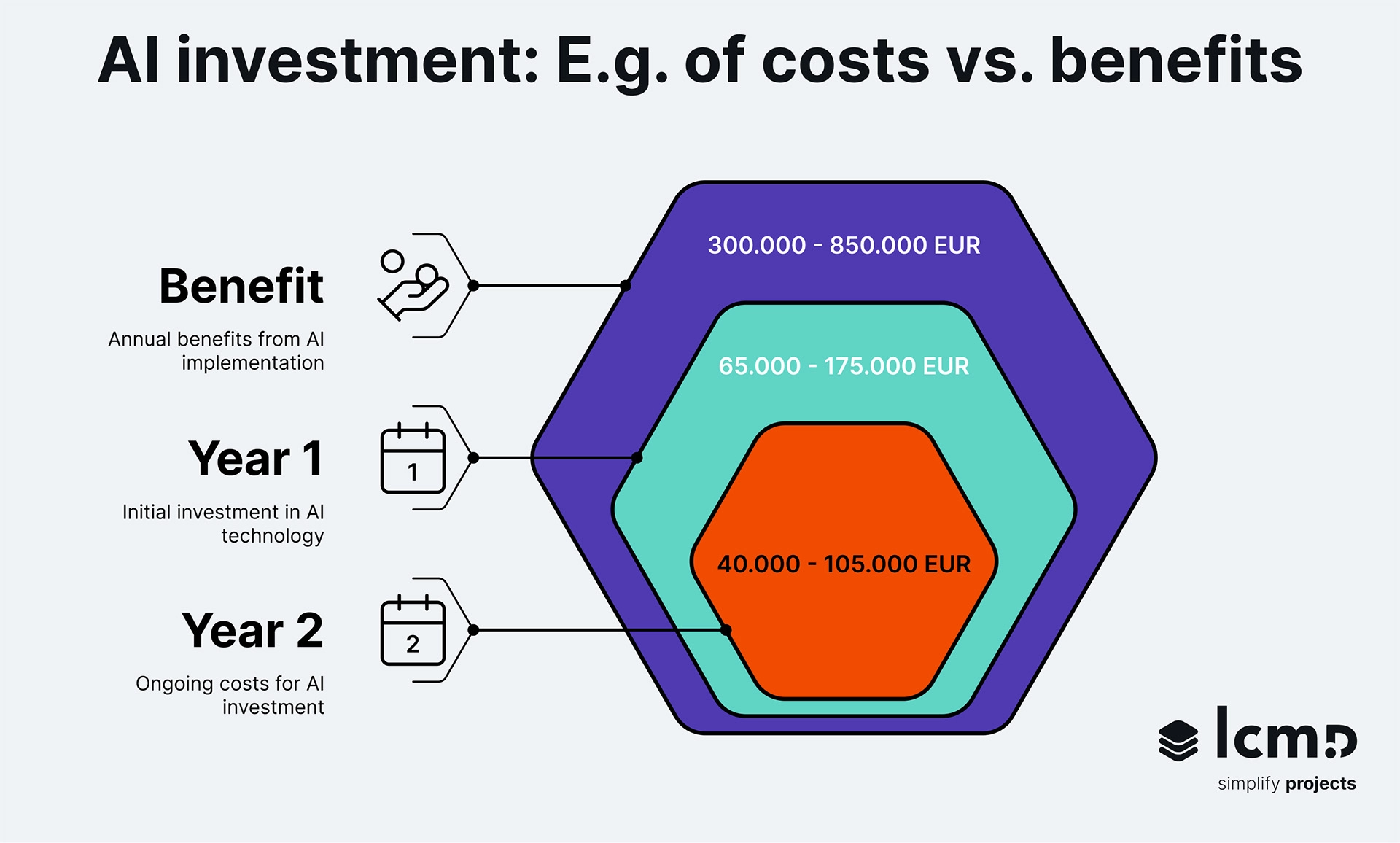
Investment costs (year 1)
Software licenses: 30,000-80,000 EUR Depending on number of employees and selected tools. Expect around 50-100 EUR per user and month for professional solutions.
Hardware: 5,000-15,000 EUR tablets for construction sites, more powerful computers for planning, possibly drones for construction site monitoring.
Training: 10,000-30,000 EUR initial training plus follow-ups. Calculate 1,000 EUR per employee for basic qualification.
Consulting and integration: 20,000-50,000 EUR External support for selection, integration and process adjustment. Saves time and avoids bad investments.
Total year 1:65,000-175,000 EUR for a medium-sized company (30-50 employees).
Current costs (from year 2)
Software: 30,000-80,000 EUR annually
Updates and maintenance: 5,000-10,000 EUR annually
Continuing education: 5,000-15,000 EUR annually
Total from year 2:40,000-105,000 EUR annually
Benefits (quantifiable)
Time savings: 150,000-400,000 EUR per year With 30 employees at an hourly rate of 75 EUR who save an average of 5 hours per week, that is 300,000 EUR per year.
Error reduction: 50,000-150,000 EUR per year Less rework, fewer defects, fewer legal disputes.
Faster projects: 100,000-300,000 EUR annually 18% shorter construction time means earlier acceptance, earlier payment, higher project throughput.
Total benefits: 300,000-850,000 EUR annually
The bill
Year 1:65,000-175,000 EUR costs, 300,000-850,000 EUR benefits = +135,000 to +675,000 EUR
ROI year 1:107% to 386%
Payback: 2-6 months
From year 2:40,000-105,000 EUR costs, 300,000-850,000 EUR benefits = +195,000 to +745,000 EUR
These figures are no guarantee. They are based on realistic assumptions from documented projects. Your outcome depends on how consistently you implement and how well you manage change.
Conclusion: The next step is up to you
AI in construction is no longer a hype and is not yet a matter of course. We are in the early majority phase — pioneers have shown success, laggards are still hesitating.
Where are you standing?
If you've read this far, you're probably one of the interested people, not the ignoramuses. They see potential, but they also have questions and concerns. That is a good thing. Blind enthusiasm for technology leads to bad investments.
Three thoughts in conclusion:
First, you don't have to do everything at once. Find a use case that particularly annoys you. Solve this one. Gain experience. Then expand.
Second, you're not alone. Take advantage of continuing education, attend seminars, and exchange ideas with colleagues. The community is helping.
Third: The best time to start was two years ago. The second-best time is now. Your competitors aren't sleeping. The construction industry of the future is being shaped by those who act today.
Your first step this week:
Select an action from this list and implement it:
- Research a AI in Construction Seminar and sign up
- Request a demo of Lcmd or another tool (https://www.lcmd.io/)
- Book a AI in construction training for your team
- Read a AI in Construction book to deepen
- Check Planradar costs or alternatives for a pilot project
- Find out more about the construction sector aid package and funding opportunities
AI in construction and construction isn't waiting for you. But you can actively shape the use of artificial intelligence instead of being overwhelmed by developments.
The technology is ready. Are you too?