Transparent processes from planning to installation
Project Stats
Project duration
permanent
Project volume
n/a
Industry
Area

About Künzli Davos
Künzli Davos AG has been developing and realizing sophisticated and sustainable buildings for over 145 years. More than 250 employees work at several locations in Switzerland and Germany. The range of services extends from intelligent planning to efficient installation and includes timber construction, window construction, facade construction, and modular timber construction.
The company's roots are in Davos. Today, Künzli is represented in locations including Davos, Landquart, Zurich, Bern, Wittenbach, and the Engadin, as well as through Künzli Deutschland GmbH in Munich and Rammingen. While the established locations cover a broad spectrum ranging from small customer orders to larger projects, the Zurich office focuses specifically on complex large-scale projects. Across the group, Künzli handles more than 300 projects per year.
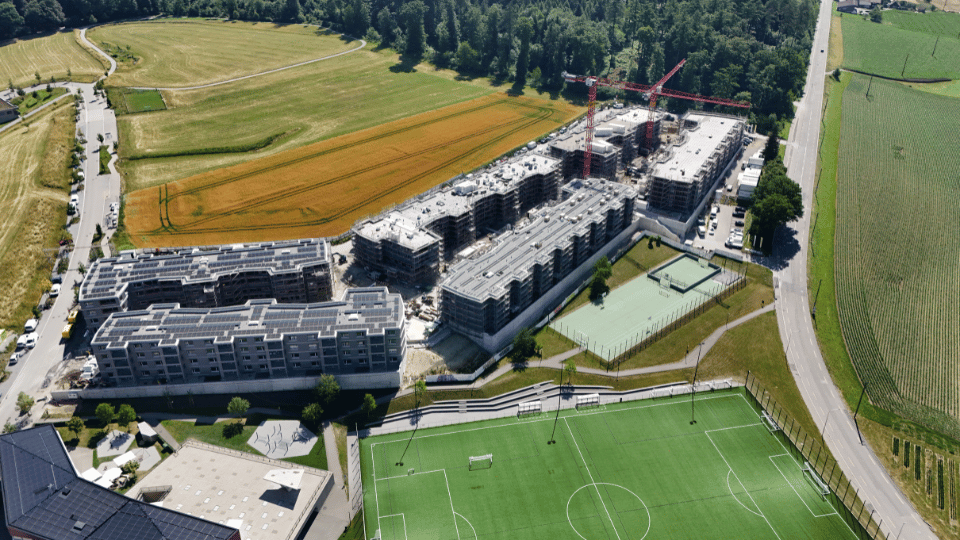
Since its strategic realignment in 2018, the company has purposefully expanded its expertise in handling large-scale timber construction projects. Künzli relies on cross-location collaboration, flexible production and project structures, as well as new technologies and the use of Lean Construction Management. Projects such as the Campus Biel/Bienne or the Ried F residential development with 250 apartments exemplify how the company coordinates complex planning, logistics, and installation processes. lcmd supports Künzli Davos in mapping these workflows centrally and transparently – from selected acquisition phases and site logistics to execution.
The specifics of complex timber construction projects
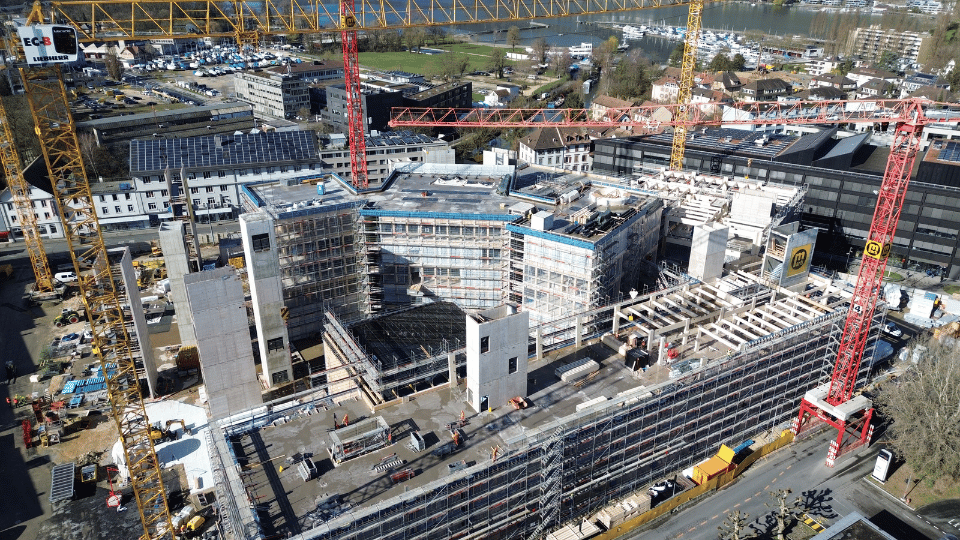
Large timber construction projects require close interaction between acquisition, planning, project management, site management, production, logistics, and installation. Many of these processes run in parallel. At the same time, in-house teams and multiple subcontractors work together on the construction site; deliveries must be synchronized, and changes must be incorporated into the planning on short notice.
The key challenges:
- High complexity and large project volumes with many parallel workflows
- Tight integration of planning, production, logistics, and installation
- Daily progress monitoring in facade management and timber construction installation
- Coordination of in-house teams and subcontractors on the construction site
- Flexible rescheduling when cycle sequences are not completed or are delayed
- Transparency regarding resources and hourly budgets as a basis for target-actual comparisons
No items found.
Individual working methods for different construction sites
How lcmd is used depends on the requirements of the respective project.
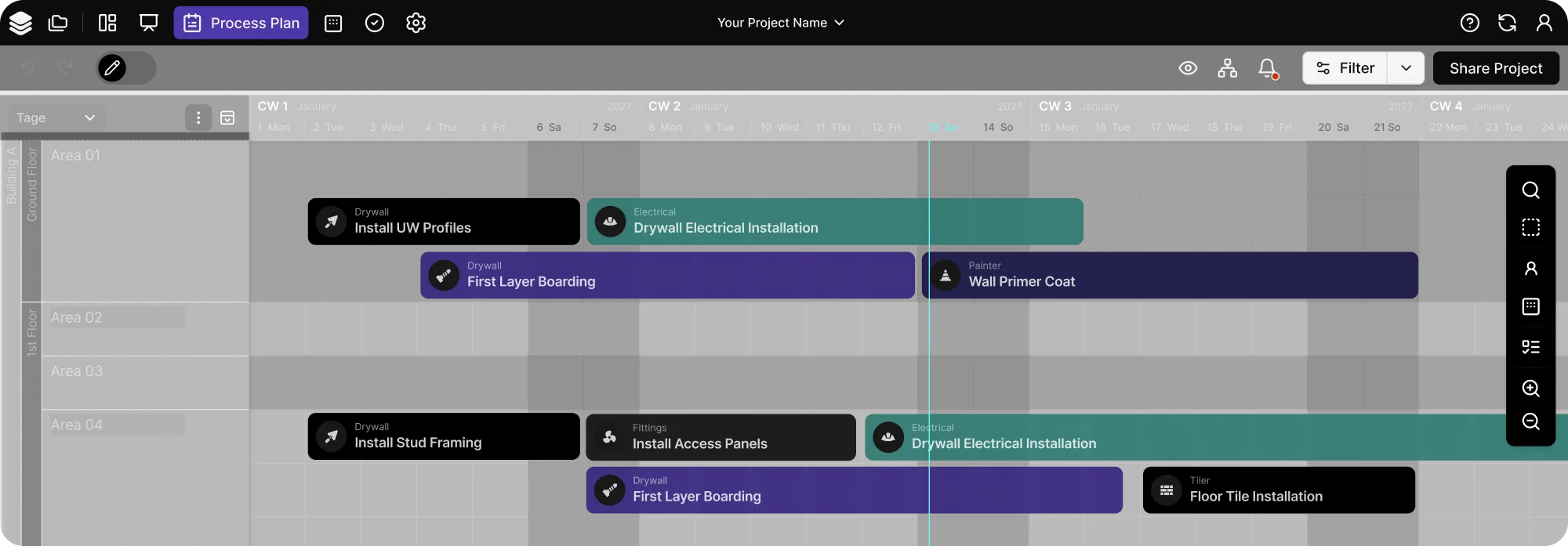
For the Campus Biel/Bienne project, site manager Beni Zürcher plans activities lasting longer than one day directly in the process plan, assigns them to teams, and uses them as a basis for hourly forecasting. Facade work is reconciled daily; every Thursday, the site team plans the upcoming week. At peak times, five installation companies were involved.
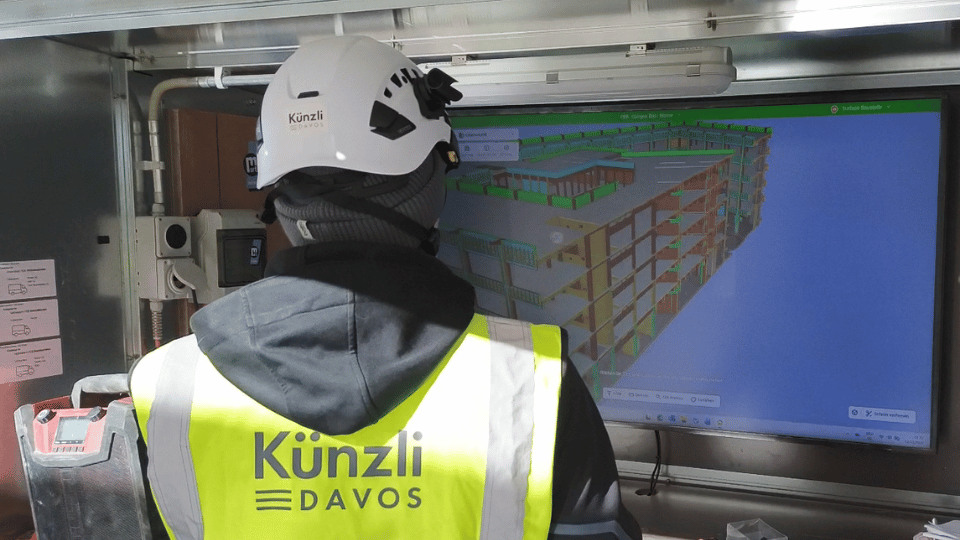
For project Ried F Künzli, by contrast, combines analog and digital planning. Project and site manager Josef Steinhilber coordinates the facade work with his own staff and subcontractors—a total of around 16 people. After the morning stand-up meeting at the planning board, the current status is documented via photo and transferred to lcmd. This keeps the workflow practical for the construction site team, while project and site management receive an up-to-date digital overview.
From Microsoft Project and Excel to centralized project management in lcmd
Before lcmd, Künzli primarily created schedules in MS Project. Excel was used for detailed analysis, and operational topics were sometimes managed in Monday. As a result, information was scattered across multiple systems.
With growing project volumes and increasing complexity, it became vital to consolidate relevant workflows centrally. Traditional scheduling reached its limits, especially in cycle planning: numerous work cycles are often in different stages of completion simultaneously. Completed tasks must be marked, pending cycles shifted, and new weekly plans adjusted quickly. In MS Project, this ongoing maintenance would be cumbersome and confusing—making it difficult to implement consistently in daily construction site operations. With lcmd, the team can move processes via drag-and-drop without having to redefine predecessor relationships or start times every time. Completed tasks are checked off directly.
This creates a visual and continuously updated overview of the actual status.
End-to-end planning from acquisition to execution
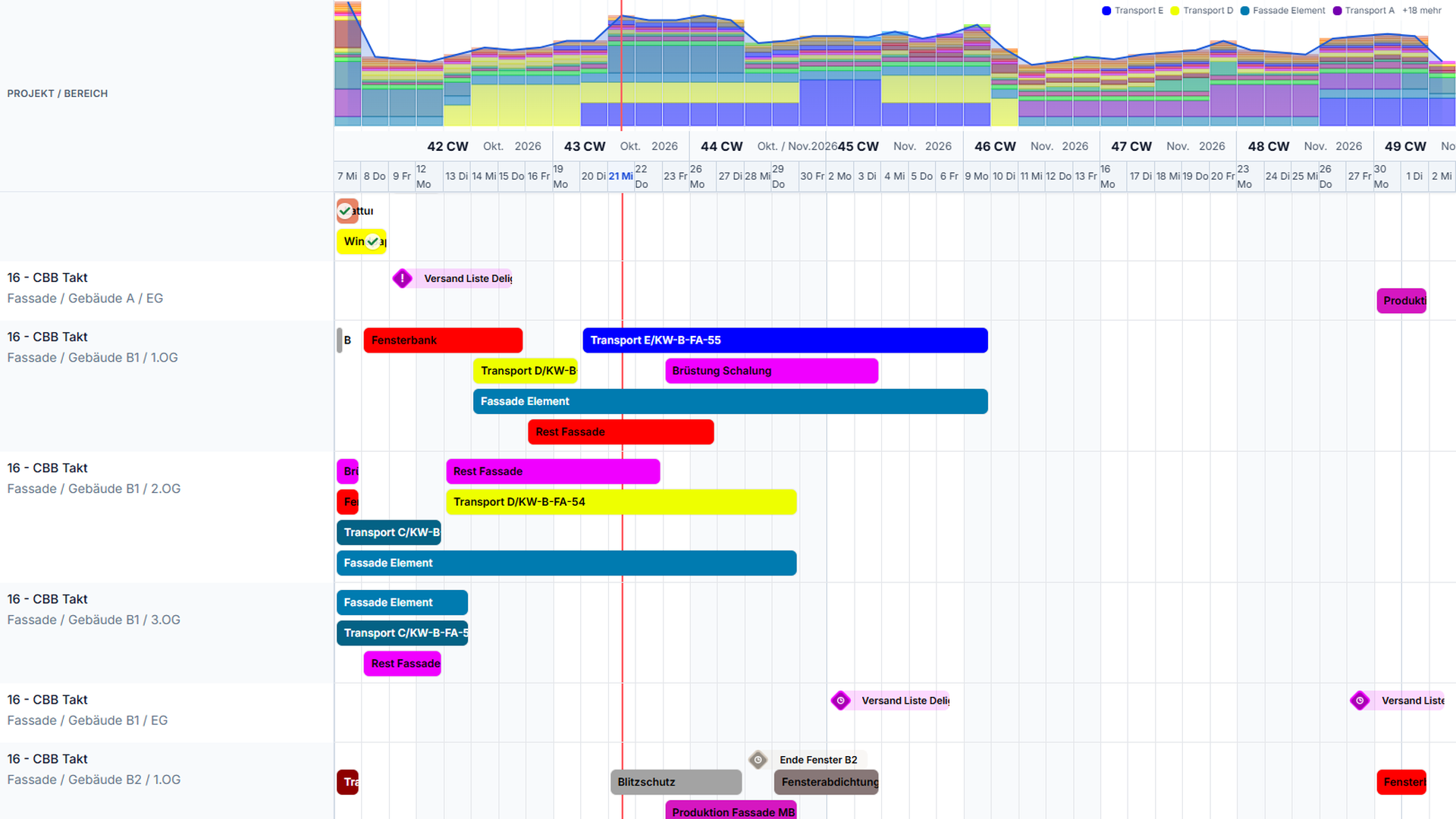
For longer and more complex acquisition phases, a small project team already uses lcmd to conceptually map schedules and dependencies. During execution, these plans are further refined: transport, delivery volumes, assembly sequences, and teams are integrated into the process plan.
Construction site logistics also become centrally visible and aligned with assembly planning. Subcontractors do not currently work directly in lcmd, but receive PDF excerpts as needed. Project and site management retain an overarching view and can quickly incorporate changes into further planning.
Lean Construction as the foundation for complex large-scale projects
The initiative for a more Lean-oriented project delivery began in 2023 through discussions between the project team and the timber construction management. Künzli is supported in this by an external Lean consultant. Initial experiences quickly demonstrated the potential that structured, visual planning offers for the execution of large timber construction projects.
The ease of use of lcmd facilitated the onboarding process: instead of extensive training, the focus was on learning by doing. Today, the process plan serves as the primary operational foundation. Filters ensure clarity even in very large plans; cycle trains, whiteboards, and task management are deliberately not used for these projects.
Transparency and simple control in daily project life
In daily construction site operations, what matters most to Künzli is that planning can be adjusted quickly, used consistently by all parties, and that actual progress can be tracked at any time. The intuitive operation and visual representation in lcmd simplify daily work: processes can be moved via drag-and-drop and completed tasks checked off immediately. This allows the team to see at a glance which tasks are finished and where adjustments are needed.
At the same time, Künzli links work cycles with teams, resources, and hourly budgets. The weekly analysis reviews what was planned versus what was actually completed. The subsequent comparison with the hours recorded in the ERP system creates a reliable basis for site and project management as well as higher-level reporting. The target-actual comparison is currently still performed via Excel exports; in the future, the lcmd Power BI integration and further developed resource functions are intended to automate this analysis more extensively.
Key benefits for Künzli Davos:
- Fast and intuitive adjustments via drag-and-drop
- Up-to-date overview of completed and pending work
- Binding weekly planning for internal teams and subcontractors
- Transparency regarding resources, hourly budgets, and capacity utilization
- Early detection of deviations and bottlenecks
- A shared data foundation for construction, project, and executive management
- Clear, concise reports for high-level project steering
Looking ahead, Künzli plans to further expand its project steering capabilities, including the use of evaluable custom fields, Power BI dashboards, cross-project views, and more detailed capacity planning. Furthermore, there are plans to implement lcmd for production planning and execution in the future.

As our project volumes grew and complexity increased, it became essential for us to centralize our processes. lcmd provides the transparency we need to manage our large-scale projects.

Sebastian Wissing
Head of Zurich Office & Overall Project Manager | Künzli Davos AG
The user-friendliness is the biggest advantage for me: I can drag and drop tasks exactly where I need them and see immediately what has been completed.

Benni Zürcher
Deputy Project Manager & Site Manager in Timber Construction | Künzli Davos AG
Discover how lcmd can make your company more efficient too.