

Share this article:
.svg)


.svg)
.svg)

Key Takeaways from this article
- HOAI Service Phase 3 succeeds when the project runs on one shared baseline - one version, one decision log, one set of assumptions.
- Interface ownership turns coordination into measurable progress—each clash gets resolved once, documented, and closed.
- Cost calculation earns decision power through traceability: one design version, clear scope boundaries, and a visible change trail.
- Loop closure is the Phase 3 accelerator; every open point needs an owner, a due point, and a recorded impact.
- A strong Phase 3 handover gives Phase 4 momentum by carrying forward documented intent, constraints, and decisions without rework.
Unclear integration is one of the fastest ways to derail a project.
Across the nine phases, HOAI Service Phase 3 is the first point where the design must behave like a system. Architecture, engineering services, constraints, and interfaces have to align into one workable design basis.
HOAI Service Phase 3 is where integration becomes concrete.
Decisions are recorded.
Open issues have clear owners and deadlines.
The handover to approval planning becomes predictable.
Phase 3 closes the loops that otherwise come back later.
Let’s define what it includes and how to run it well.
What is HOAI Service Phase 3
HOAI Service Phase 3 (Leistungsphase 3, Entwurfsplanung) is Design Planning, also called System and Integration Planning. According to HOAI, this phase develops the design into a coordinated, decision-ready state for construction projects.
Phase 3 aligns architecture and engineering services. The team clarifies key interfaces and maintains a clear decision log. This work prepares the project for Approval Planning (HOAI Phase 4).
The main outputs of HOAI Service Phase 3 are a coordinated design package and a cost calculation based on the current design.
These outputs help the client review scope, materials, and priorities before approvals and the next service phases. They also define what is fixed, what remains open, and what must be resolved next.
Where Service Phase 3 Sits Within the HOAI Service Phases
HOAI (Honorarordnung für Architekten und Ingenieure) is Germany’s fee regulation that defines the scope and structure of architectural and engineering services in building construction.
Overview of the Phases According to HOAI
HOAI structures architectural and engineering services into nine service phases. Each phase builds on the previous one and prepares the next step in the planning process for construction projects:
- Basic Evaluation Phase
- Preliminary Planning (Project and Planning Preparation)
- Design Planning (System and Integration Planning)
- Approval Planning
- Execution Planning
- Preparation of Contract Award
- Participation in Contract Award
- Project Supervision (Construction Supervision)
- Project Support and Documentation
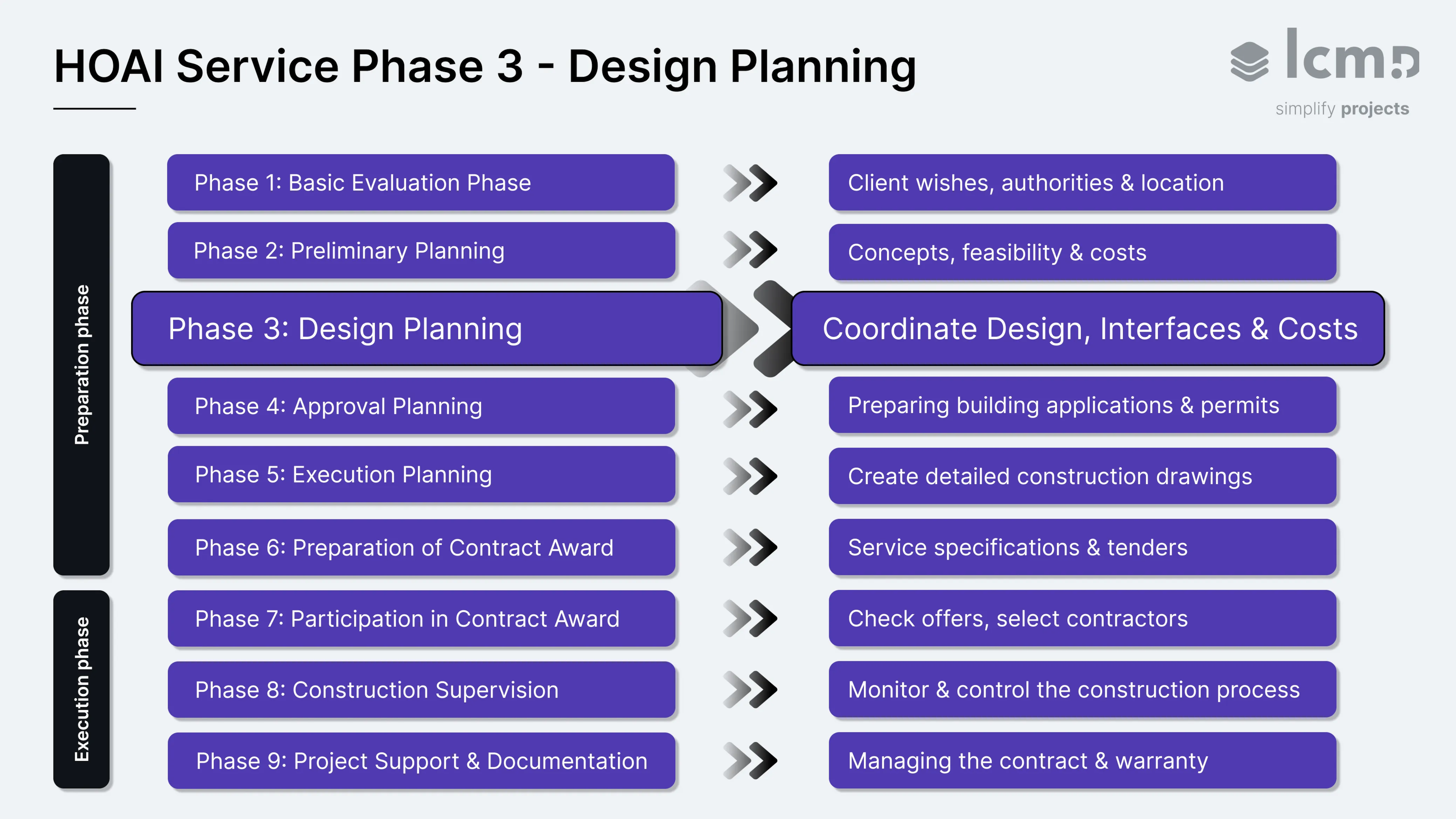
Service Phase 3 sits between Preliminary Planning and Approval Planning. It uses the outputs from Phase 2 to create one coordinated design basis for the next step. In short: Phase 3 is the bridge from “direction” to “approval-ready planning.”
And what does Phase 3 look like in day-to-day planning work?
Design Planning in HOAI Phase 3: How It Works in Practice
Design Planning in Phase 3 turns parallel drafts into one coordinated direction.
Decisions are captured in a shared planning basis. Open items, interfaces, and assumptions become visible and documented, so the planning process stays controllable.
Goal of Phase 3: A Decision-Ready Design
Phase 3 aligns the design with the client’s wishes, technical constraints, and budget reality. This also supports project management by making design choices traceable and comparable.
What Exactly Should Service Phase 3 Deliver
- A consolidated design direction built on the initial concept / conceptual design
- Key system choices (structure, MEP principles, main interfaces)
- Interfaces clarified and design inputs aligned across disciplines
- A clear record of decisions, assumptions, and open issues
- A design package plus a cost calculation
Why Phase 3 Matters for Construction Projects
Most teams see these 3 outcomes when Phase 3 is run well:
- The project reduces conflicts between disciplines and drawings.
- The project reduces late rework in the next phase and later service phases.
- The project improves cost control because the cost calculation is based on aligned inputs.
These outcomes are much easier to achieve when Phase 3 starts with clear prerequisites:
Inputs You Need Before Service Phase 3 Starts
HOAI Service Phase 3 runs faster when Preliminary Planning (Phase 2) already produced clear decisions. Phase 3 needs stable inputs so the team can develop the design instead of reopening basics.
4 Key Phase 2 Deliverables That Enable Design Planning
Before Service Phase 3 starts, the team should have these Phase 2 deliverables:
- Project goals and scope agreed with the client
- Functional requirements and key constraints (site, regulations, budget frame)
- A preferred concept direction from the conceptual design
- Early involvement of the key disciplines (first interface check)
Where Feasibility Studies and an Early Cost Estimate Fit
Once these outcomes are clear, Phase 3 needs two reality checks early: feasibility and cost.
- Feasibility studies test the concept against constraints before the design gets refined.
- An early cost estimate sets the cost frame at the same moment, so the team can adjust scope and priorities before details harden.
If you can test scope and sequencing scenarios early (for example with Lcmd), the team can spot budget pressure before details harden.
When feasibility and cost are checked early, the Phase 3 design work stays focused and the later cost calculation rests on a clearer basis.
Common Missing Inputs and Their Impact
If any of these inputs are weak or missing, Phase 3 slows down fast. Common gaps include:
- Unclear client decisions
- Late specialist input
- Incomplete requirements
- Scope gaps in the cost estimate
These gaps increase revisions and create friction in later service phases. Avoiding them comes down to two things: clear prerequisites and a structured set of core services.
Core Services in HOAI Service Phase 3
This section summarizes the main services provided in HOAI Service Phase 3. It can help you understand how Design Planning is typically structured and what teams usually cover before moving into Approval Planning.
What “System and Integration Planning” Means in Phase 3
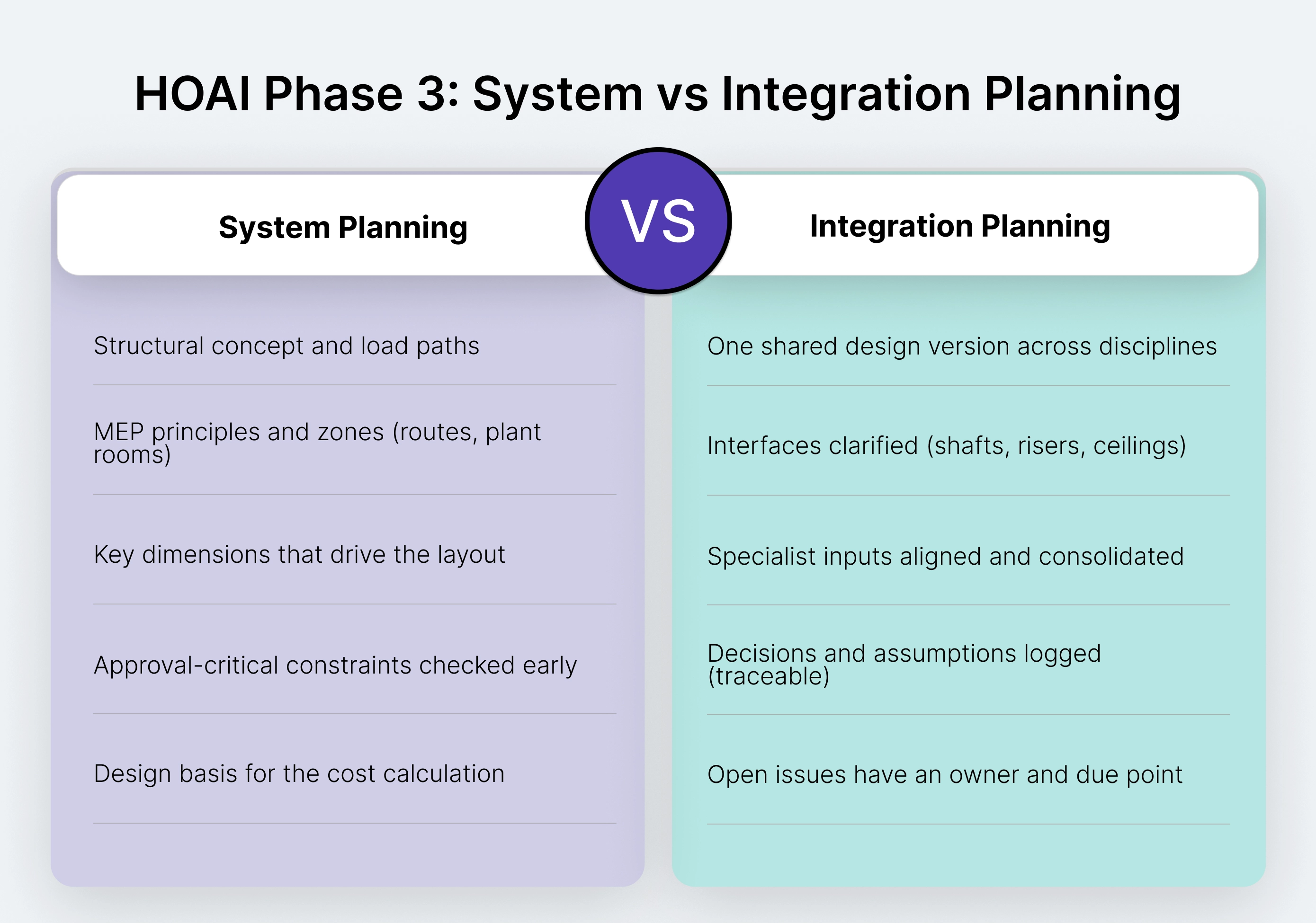
In Phase 3, “System And Integration Planning” describes two connected workstreams that run in parallel.
System Planning defines the main technical choices that shape the building solution. It typically covers:
- Structural direction
- MEP principles
- Key interfaces and dependencies
Integration Planning connects the parties involved so the design stays consistent across disciplines. In practice, this work often includes:
- Coordination across architects and engineers
- Alignment of engineering services and specialist input
- Interface management across disciplines
With that baseline in place, Phase 3 work usually follows a clear sequence:
1. Develop and Consolidate the Design
The team develops the conceptual design into a consolidated design direction. Key questions that affect scope, function, and cost are resolved at this stage. The work stays at Design Planning level and avoids implying detailed design or construction-ready drawings.
2. Coordinate and Integrate the Design Team
Phase 3 requires active coordination across the design team. Interfaces and responsibilities between architects, engineers, and specialist planners are clarified and coordination outputs stay consistent across disciplines.
3. Evaluate Options and Document Decisions
Variants and trade-offs are reviewed with the client and the project team. Options are checked against requirements and constraints, then documented in a clear decision record. This record supports project management and reduces later disputes about what was agreed.
A lightweight decision log in Lcmd makes those choices traceable without adding bureaucracy.
4. Prepare Approval Readiness (Without Doing Service Phase 4 Work Prematurely)
Phase 3 surfaces approval-critical constraints early - before documentation starts. Regulatory requirements are checked, risks are flagged, and missing inputs from relevant authorities are clarified. This preparation reduces delays when Phase 4 starts and approval documents are produced.
5. Document Assumptions, Constraints, and Outcomes
Service Phase 3 should end with a planning basis that others can use without re-interpreting intent. Assumptions, constraints, decisions, and open issues are documented in the necessary documents. This keeps the handover clean and reduces avoidable revisions in later service phases.
Now that the core work is clear, the next question is scope: what is included by default, and what needs a separate agreement?
“Basic Services” vs “Special Services” in Phase 3 According to HOAI
Phase 3 work is only half the story. Scope is the other half.
HOAI separates the services provided in each phase into basic services and specific services. This distinction protects the project from hidden effort and unclear expectations.
Basic services (“Grundleistungen”) form the standard Phase 3 scope. In HOAI Service Phase 3, this usually covers the coordinated design work and its core outputs, such as integration with other planners, an object description, and a cost calculation based on the current design.
Special services (“Besondere Leistungen”) go beyond the standard scope. They are agreed separately because they depend on the project. In Phase 3, this can include extra visualizations, physical or digital models, or deeper economic studies.
Scope can still vary by contract and object type (the relevant HOAI “Leistungsbild”). In practice, the agreed scope in the contract defines what Phase 3 covers.
After scope, the biggest risk is interface confusion. Let’s look at who is involved and where handoffs break down.
Who is Involved in Service Phase 3 (Roles and Interfaces)
Phase 3 runs best when the key disciplines are involved early and roles are clear. Design Planning needs tight coordination between architects and engineers, because key system choices and interfaces get fixed here.
Typical Roles in HOAI Phase 3
Typical roles in Phase 3 include:
- Client: confirms goals, priorities, and key decisions. Provides timely input and sign-offs.
- Architects: lead the design planning, coordinate the overall design basis, and manage interfaces across disciplines.
- Engineers and specialist planners: develop engineering services (for example structure and MEP principles) and clarify technical constraints and dependencies.
- Project managers (if involved): run the planning rhythm, track open issues, and keep decisions, responsibilities, and deadlines visible.
Where Coordination Breaks Down in Phase 3
Coordination breaks down most often in three places:
- Interfaces: responsibilities between disciplines stay vague, so drawings and assumptions drift apart.
- Decisions: choices get made in meetings, but no decision log is maintained, so questions return later.
- Documentation: inputs, constraints, and open items are not captured in a shared format, which slows approval planning and creates avoidable revisions.
Clear roles and interfaces reduce rework, because fewer questions bounce back later.
In Phase 3, real progress shows up as fewer unresolved loops. The milestones below are a simple way to check whether that’s happening.
4 Typical Coordination Checkpoints in Phase 3 (Coordination → Cost Check → Decision → Handover)
How do you know Phase 3 is progressing correctly?
These milestones describe the planning process in Phase 3 without implying fixed timelines. They make construction progress visible and support project efficiency.
- Coordination Baseline Set
A shared design direction is established. Interfaces have clear owners. Open coordination points are tracked in one place. - Cost Check Completed
A first cost check is run against the current design version. Budget fit is assessed. Major cost drivers are visible early. - Key Decisions Locked
Scope- and cost-relevant choices are confirmed by the client. Assumptions and decision boundaries are documented. The decision log reflects the current design status. - Handover Readiness Reached
The design, decisions, and cost logic are consistent enough to move forward. No fundamental questions remain unresolved. Approval Planning can start without reopening core assumptions.
Good progress looks like fewer unresolved interfaces, fewer repeated questions, and fewer “we’ll decide later” items.

These checkpoints show whether Phase 3 is stabilizing. Next, let’s look at what must exist at the end of the phase.
What Phase 3 Hands Over to Approval Planning
Unlike coordination checkpoints, Phase 3 deliverables define the actual handover state at the end of the phase. They describe what must exist so Approval Planning can start without reopening core assumptions, decisions, or cost logic.
In practice, Phase 3 hands over two non-negotiable outcomes:
- A coordinated design status
- A documented planning basis that explains and supports that design
Coordinated Design Status
By the end of Phase 3, the design must exist as one consistent state across disciplines. This is not about refinement or detailing, but about alignment.
At this point, the coordinated design status consists of:
- Design-planning drawings (plans, sections, key details at the Phase 3 level)
- Coordinated inputs from architects and engineers so interfaces match
- Updated design descriptions that explain the design intent and main system decisions
This design status is what Approval Planning builds on. If it is unclear or inconsistent, Phase 4 will inevitably reopen Phase 3 questions.
Documented Planning Basis
Equally important is the documentation that explains why the design looks the way it does. This is what prevents later reinterpretation.
The documented planning basis therefore includes:
- Decision log and open-issues list
- Assumptions and constraints (technical, functional, regulatory)
- Cost calculation basis linked to the coordinated design
- Version references so later changes stay traceable
Together, these documents define the reference frame that later phases rely on without reinterpretation.
Design Freeze at Phase 3 Level (What is Fixed, What is Not)
Phase 3 does not freeze every detail, but it does freeze direction.
By the end of the phase, the following elements must be fixed:
- The chosen design direction
- The main system decisions
- Scope decisions confirmed by the client
Not everything needs to be resolved at this point — but anything that stays open must be visible.
Open items are acceptable only when they are explicitly documented, with:
- A responsible owner
- A defined follow-up moment
- A stated impact (cost, scope, or approval risk)
Without this documentation, Approval Planning starts by re-interpreting intent instead of producing approval documents.
When HOAI Phase 3 is Complete
When prerequisites are clear and decisions are tracked consistently, Phase 3 tends to move quickly — because coordination replaces iteration.
Phase 3 is complete when one coordinated design status, one cost status, and one decision record exists and no further alignment is required to start approvals.
If the design is fixed, the cost story must be fixed too. Otherwise, the project starts drifting before approvals even begin.
Cost Calculation in Service Phase 3 (and Its Role in Construction Costs)
In HOAI Service Phase 3, cost calculation is the first cost figure that is built on a coordinated design basis. It connects design planning with real construction costs and gives the client a usable decision point before permitting documentation begins.
What “Cost Calculation” Means Here (vs. a Cost Estimate)
A cost estimate is an early cost frame. It is often based on the concept direction and rough quantities from preliminary planning.
A cost calculation in Phase 3 is more specific. It is derived from the coordinated design package and linked to defined scope and assumptions. That is why it becomes decision-grade in this phase: costs are no longer only “likely.” They are tied to concrete choices in structure, systems, and key interfaces.
What “Cost Calculation” is Used for
A Phase 3 cost calculation supports project management in a very practical way:
- Budget alignment: confirm whether the current design fits the target costs
- Option comparison: compare variants without guessing which change drives the difference
Tools like Lcmd help teams compare options against the same baseline, so “variant A vs B” doesn’t turn into a version debate. - Cost drivers: identify the few elements that move the total most (system choices, building size, complexity)
- Decision support: choose scope, materials, and priorities with cost impact visible
For construction projects, this is often the last “clean” moment to adjust direction without creating major rework later.
5 Common Mistakes That Make Cost Numbers Unreliable
Cost numbers turn unreliable when the planning basis is weak or unclear. Common causes include:
- Missing scope: design elements are not defined, but still assumed as included
- Late specialist input: engineering services arrive after the cost calculation is already built
- Unclear assumptions: quantities, standards, or performance levels are not stated
- Mixed versions: drawings and cost tables refer to different design states
- Hidden changes: small design shifts happen, but the cost model is not updated
These issues often show up later as “surprises” in the construction process or during construction work, even though the root cause was cost logic that was never made explicit.
5 Practical Tips for a Reliable Cost Calculation
A reliable Phase 3 cost calculation does not require perfect detail. It requires a clear structure.
- Write down assumptions: list what is included, excluded, and still open
- Version everything: link the cost calculation to a named design version and date
- Track changes: use simple change logic (what changed, why, and cost impact)
- Keep cost drivers visible: highlight the biggest contributors so decisions stay focused
- Update after key decisions: revise costs when scope or system choices change, not weeks later
This structured approach improves project efficiency because it reduces argument, rework, and “we thought it was included” moments.
{{cta}}
Common Problems in HOAI Phase 3 and How to Avoid Them
Even when the design work looks “advanced,” this phase can still drift in ways that later slow the construction process. In most construction projects, the problems are predictable and preventable with a few solid project management habits.
1. Design Looks Advanced, but the Disciplines Don’t Match
What it looks like: drawings seem polished, but structure and MEP assumptions don’t align at key interfaces. The first warning sign is usually mismatched technical drawings (shafts, ceiling zones, plant space, routing).
How to avoid it:
- Work from one named design version (date + revision).
- Do short interface checks on the biggest junctions (shafts, risers, plant rooms).
- Track unresolved interface questions in one list with an owner and next step.
2. Decisions Happen, but the Rationale Disappears
What it looks like: choices are agreed verbally, then re-discussed because the reason, boundary conditions, or impact were never captured.
How to avoid it:
- Keep a lightweight decision log (topic → choice → reason → impact → date → owner).
- Note what would trigger a revisit.
- Link key choices to the design version they belong to.
3. The Cost Picture Drifts Away from the Design
What it looks like: numbers change, but nobody can point to the specific design changes that caused it.
How to avoid it:
- Write down inclusions/exclusions (standards, performance levels, scope assumptions).
- Keep the major cost drivers visible, not buried in detail.
- Update the cost view immediately after major scope or system choices change.
4. Constraints Surface Late and Force Major Rework
What it looks like: a late constraint from relevant authorities or overlooked regulatory requirements forces redesign of core parts.
How to avoid it:
- List “must-check” constraints early and review them regularly.
- Validate the design direction against the most restrictive rules first.
- Maintain a short risk list with status and mitigation.
Handled early, these issues stay small. Left unchecked, they tend to show up later as delays during execution and even construction supervision.
Design Planning Checklist
Use this design planning checklist as a quick Phase 3 completion check. It helps confirm that Design Planning is coordinated, documented, and ready to move forward with minimal rework. The goal is a clear planning basis, necessary documents, and clean coordination across the parties involved.
{{asset}}
Conclusion
Service Phase 3 is where uncertainty gets reduced to a level the team can work with. A strong outcome is a design direction that holds up under questions: aligned interfaces, traceable decisions, explicit assumptions.
That stability carries the project forward. If Phase 3 produces one shared baseline the full team trusts, the next step stops depending on “who remembers what” and starts running on documented reality.


.jpg)