

Share this article:
.svg)


.svg)
.svg)

Key Takeaways from this article
- Building surveyor fees reflect the level of proof a project needs to make decisions without reopening the same question later.
- A building report earns its value when it turns findings into assignable next steps that survive handovers and stakeholder scrutiny.
- The real cost risk sits in coordination gaps after the inspection - unclear verification boundaries create delays, re-checks, and scope drift.
- Report quality shows in specificity: location-based evidence, clear severity, and recommendations written to be executed, not interpreted.
- Construction monitoring stays effective when evidence flows into ownership and follow-up at a consistent cadence, independent of the tool used.
In the construction industry, certainty is a project resource.
It protects quality, shapes sequencing, and removes friction from approvals.
That’s why people hire a building surveyor: independent inspections that replace uncertainty with documented facts, clear enough to address issues before they become scope decisions.
Fees sit in a broad range because scope sets the workload, the building sets the complexity, and the report sets the standard of proof.
If you want costs you can actually plan with, you’re in the right place. Let’s make the cost usable from inspection to handover.
What Building Surveyors Do: Inspections, Assessments, and Reports
Building surveyors are licensed professionals who inspect a building and produce an assessment that supports decisions on quality, scope, and next steps on a construction project. A surveyor’s value comes from turning inspections into documented facts that teams can use to verify compliance, track defects, and protect the project budget and schedule.
What Building Surveyors Exactly Document in a Building Survey
The core scope of building surveyors’ work typically includes:
- A building survey with internal inspections that review various aspects of the building’s condition
- Targeted structural and internal inspections when access, symptoms, or risk call for a closer look
- Clear documentation of findings, including what the surveyor is responsible for confirming and what needs follow-up
- Coordination with others involved in the project, including contractors, architects, or specialist construction experts when deeper testing is required
The goal is simple: documented facts the team can rely on across the team.
When you need proof that holds up across stakeholders, a building surveyor (or any licensed professional with comparable accreditation) is a signal that the work follows defined standards.
The Building Report: Evidence You Can Build On
A building report earns its keep when it settles questions instead of starting new ones. In construction, it’s a decision tool: it links on-site findings to clear next steps the project team can assign and track.
In practice, a building report documents the building’s condition with photos, defect descriptions, and practical recommendations. On existing buildings, that level of detail matters because uncertainty often hides behind finishes and limited access.
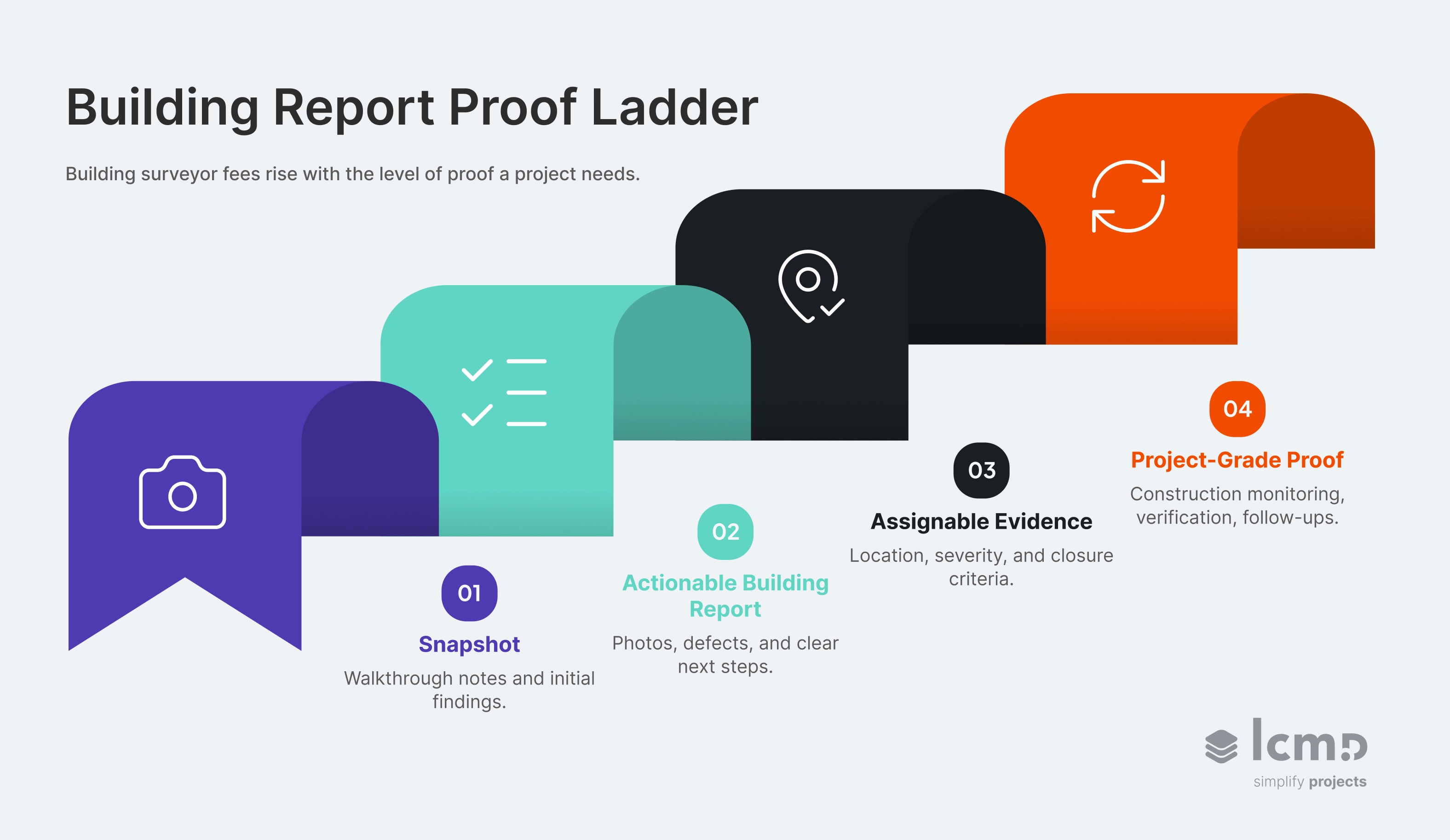
An effective building report should be specific enough that different stakeholders reach the same conclusion.
6 Quality Checks for a Building Report That Hold Up on a Project
What to expect in a clear, actionable building report:
- Photos that anchor findings to real physical features and locations
- A defect list that covers various aspects of the building’s condition
- Severity notes that point to structural integrity where relevant
- Clear references to the structure, including the existing structure when it matters
- Structural observations stated in plain language
- Recommended next steps that can be assigned and tracked
A rigorous report removes interpretation from the workflow. Next: the fee models behind it, and why the same scope can price out differently.
Typical Building Surveyor Fees (Hourly vs Fixed Price)
In construction industry, pricing follows scope. The more documented and defensible the outcome needs to be, the higher the fee, because the work shifts from a site visit to a deliverable you can rely on across the project.
Most clients pay either an hourly rate for a site visit or a fixed fee for a defined scope, then add a written report when they need documented, shareable evidence. Travel and VAT are common add-ons.
Here are the six factors that usually expand scope and documentation depth and push fees up.
6 Cost Drivers That Change Scope and Proof
- Scope: one visit is priced differently than repeat visits aligned to the plan and project cadence.
- Existing structure and access: older properties and tight access points add time, especially when structural integrity is part of the question.
- Type of job: existing buildings, renovation work, and handover inspections stress different parts of the property and require different proof.
- Report depth: a brief note is faster than a detailed written report that ties potential issues to evidence.
- Materials and extra tests: unusual materials or suspected moisture can trigger checks that go beyond standard visual review.
- Context: region and travel affect cost, and commercial properties often add coordination and documentation steps.
It’s worth paying more when a finding can change scope, sequencing, or liability. Report depth should match risk. When comparing providers, keep plan and scope fixed and select the one who is clearest about what will be documented.
Construction Monitoring and Site Supervision
A single inspection is a snapshot. Construction monitoring and site supervision create a feedback loop that keeps quality visible while the plan is still adjustable.
Construction monitoring is lightweight project management centered on evidence. Extra meetings rarely add value. The discipline is consistency: document what was found, its exact location, the affected trade, the acceptance standard, and the next action. That shared knowledge is what lets clients and companies make decisions early, while the fix is still small.
Lean Project Management for Construction Monitoring
This is also where the Lean angle becomes practical. Early detection reduces rework because issues are handled before follow-on work locks them in. Clear documentation creates accountability because someone is responsible and the next step is written down. Consistent follow-up keeps defects from “sticking around” across handovers between contractors, general contractors, architects, and builders.
A project manager often coordinates the rhythm, but monitoring only works when everyone sees the same reality: one plan, one source of truth, and clear ownership of next steps.
{{cta}}
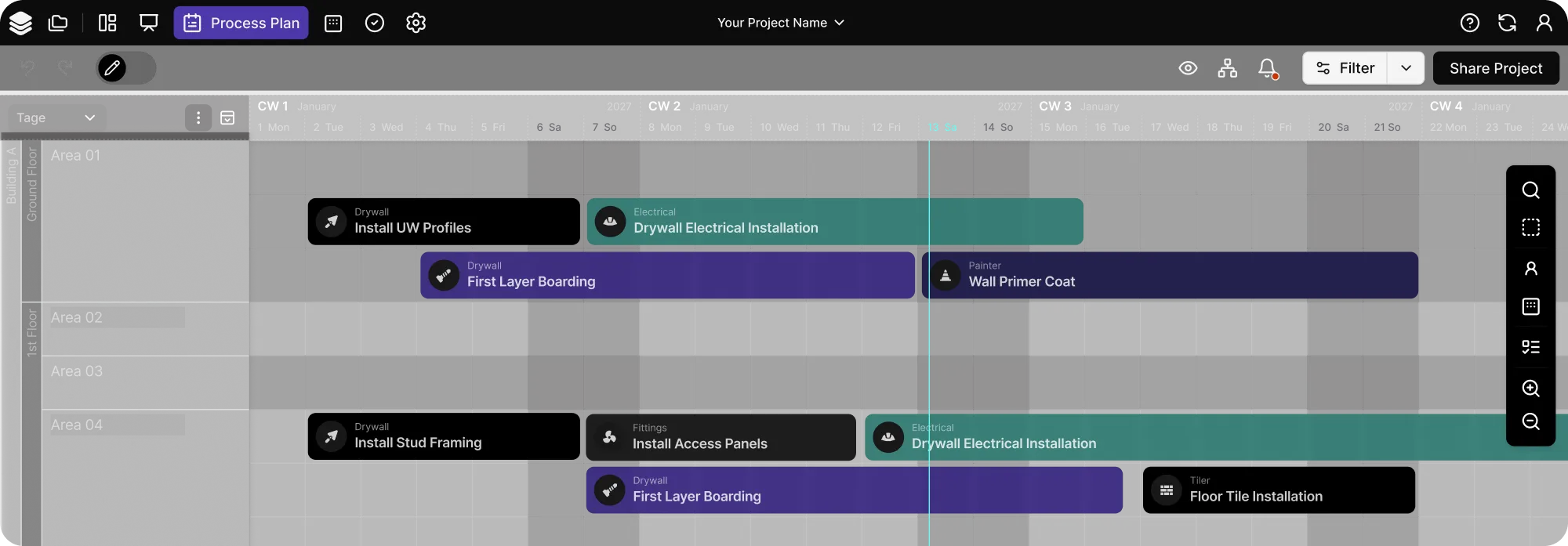
The medium can be simple, like spreadsheets. For sustained construction monitoring, a construction project management tool like Lcmd can link plans with lean workflows and support follow-up at pace.
Whether you use spreadsheets or dedicated tools, consistent documentation and clear ownership are what make monitoring pay off.
Conclusion
Building surveyor costs show up in a broad range because the fee often includes more than inspection time. It includes the cost of reducing coordination gaps after findings land on the project. Those gaps force everyone to do unnecessary coordination work across clients, contractors, and construction companies: clarification loops, re-checks, delayed approvals, and scope decisions made on partial information.
A licensed professional adds leverage through a report that makes responsibility workable. It sets boundaries around verification, preserves evidence, and defines what “closed” means for each issue. That creates a clean handover from inspection to action. Construction monitoring then carries through the follow-up throughout the project’s workflow.
7 Questions to Ask Before You Book a Building Surveyor
1.What’s Included in theBuilding Surveyor’s Fee?
A clear quote lists the inspection scope, time on site, what you receive (notes vs written report), and what counts as a “follow-up.” If the fee sits in a broad range, the difference is usually documentation depth and coordination time, not the walk-through itself.
2. Will the Inspection Include a Written Report, and How Detailed Will It Be?
Not every inspection includes a written report, so confirm the output format, expected length, photo coverage, and whether recommendations are specific enough to assign as next steps.
3. What Triggers Additional Costs Beyond the Quoted Building Surveyor Fee?
Common triggers include limited access, larger properties, urgent scheduling, specialist measurements, extra internal inspections, and requests for revisions or fast delivery.
4. How Are Defects Recorded in a Building Survey Report?
A useful building report ties each defect to a location, supporting photos, severity, and a recommended next step. “General advice” is rarely actionable on a project.
5. Who Is Responsible for Follow-Ups on Defects After the Inspection?
Responsibility depends on whether the building surveyor only identifies issues or also verifies fixes in a re-inspection. Clear responsibility prevents defects from drifting between parties.
6. What Does a Building Survey Inspect, and What Is Explicitly Excluded?
Confirm what “internal inspections” include (visible finishes only vs accessible cavities, roof space, plant rooms) and what is explicitly excluded (e.g., destructive testing, concealed services).
7. Do Building Surveyor Fees Differ for Commercial Properties Compared to Residential Ones?
Often yes. Commercial properties tend to increase coordination, documentation standards, and access management, which can move both the fee and the reporting effort.