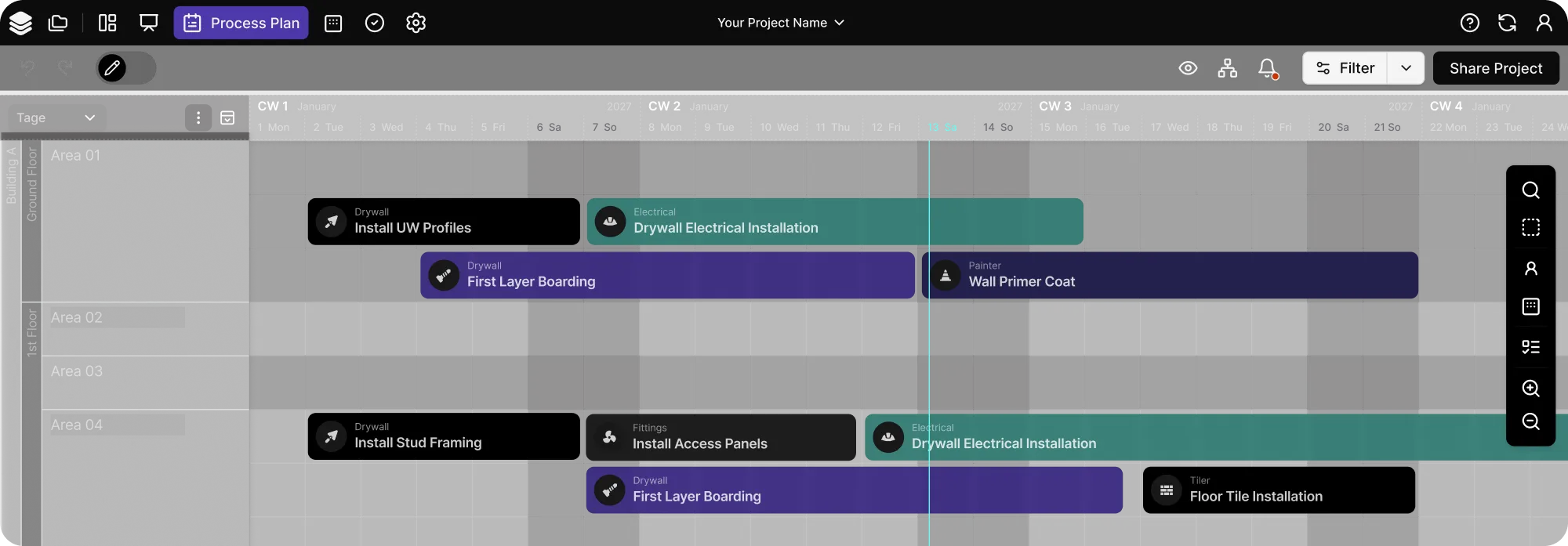


Share this article:
.svg)


.svg)
.svg)

Key Takeaways from this article
- Predictability is a financial control mechanism: when reliability becomes repeatable, schedule and cost exposure stop being managed through firefighting.
- Weekly plans fail when readiness is assumed; Percent Plan Complete exposes whether commitments are buildable and whether your schedule is a plan or a weekly negotiation.
- Structured planning pays off when decision timing, handoffs, and prerequisites are managed as production inputs, not informal coordination.
- The Last Planner System® improves financial control by turning planning into production control: make-ready and constraint removal protect productivity before losses hit the field.
- The real ROI compounds across portfolios: one shared planning standard converts small reliability gains into repeatable, auditable savings year after year.
Predictability is one of the strongest financial levers in construction delivery.
When work flows reliably, costs stabilize and decisions improve.
Many projects never reach that state consistently. The planning effort is usually real, but results still vary from week to week. That volatility is where delays, rework, and cost growth take hold.
Structured planning turns coordination into a routine instead of a scramble. By formalizing how work is coordinated, reliability becomes repeatable - and its financial impact becomes visible.
What follows explains how this shift in coordination drives financial performance and why its effects compound at portfolio scale.
Why Construction Projects Become Unpredictable in the Planning Process
Financial outcomes are set early - mostly in the planning-to-execution window where constraints are removed (or ignored).
Why Weekly Plans Stop Holding Up: Reliable Commitments and Percent Plan Complete
Teams plan the week, then spend the week adjusting. Tasks enter the weekly plan without true readiness. Constraints emerge late. Handoffs become unstable. Project managers track milestones, but execution keeps getting resequenced because the next task isn’t actually buildable yet.
In day-to-day work planning, this typically shows up as lower percent plan complete (PPC), weaker reliable commitments, and weekly plans that no longer reflect actual work conditions. Even highly experienced construction teams are affected when planning lacks a clear, shared, and visible coordination structure that connects decisions, commitments, and constraints into a predictable workflow.
Structured Planning System: Building a Predictable Workflow
A structured planning system is a repeatable planning process that connects long-range intent to near-term execution through clear routines, roles, and handoffs.
It creates one shared way to translate master planning and a master schedule into executable work.
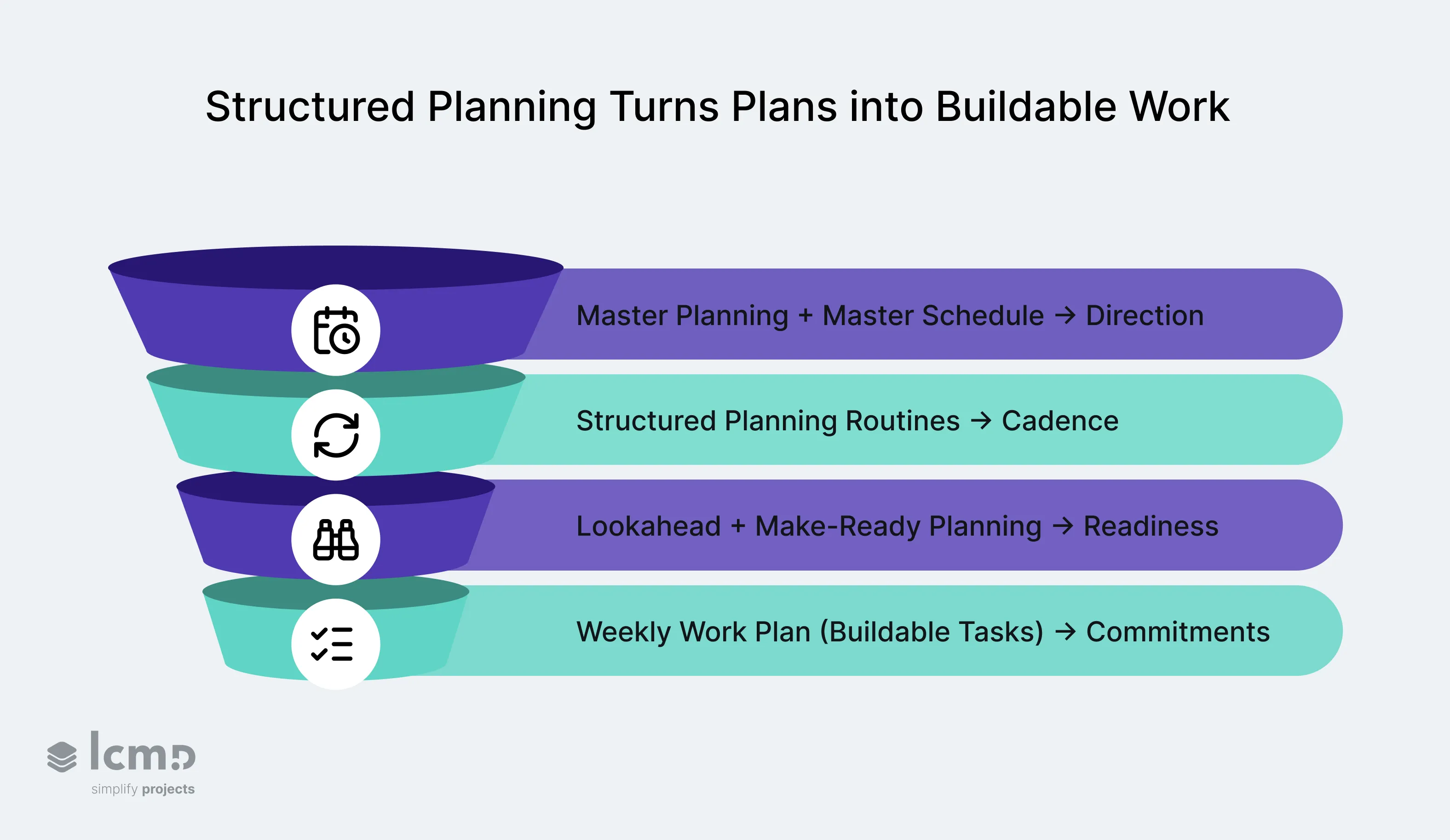
In practice, it strengthens 3 execution conditions that determine whether plans hold up in the field:
Decision Flow Becomes Explicit
On many construction projects, decisions exist, but the path to get them made in time for upcoming work remains unclear. Structured planning makes decision needs visible earlier by linking near-term work to the decisions it depends on and by treating decision timing as part of production control, not an afterthought.
Team Alignment Becomes Operational
Alignment becomes operational when project teams coordinate handoffs, interfaces, and sequencing with the people who execute the work—not only at the level of a central plan.
In practice, alignment shifts into shared commitments across trades and disciplines. That shared commitment structure is what supports an efficient workflow.
Daily Work Readiness Becomes the Standard
Make-ready planning brings upcoming work into a condition where it can be done, supported by lookahead planning and constraint removal.
When teams run readiness checks consistently, the weekly plan is built from tasks that have been screened for prerequisites. That is also why percent plan complete exists in the system: it measures how reliably planned promises were completed and feeds learning.
When these three conditions hold and coordination stays under control, the performance signal becomes hard to ignore.
Measurable Project Outcomes: What Organizations Report in the Construction Industry
Across construction projects, organizations running a structured planning and coordination system typically report:
- 10–20% reduction in total project duration¹
- 40–60% fewer issues that trigger rework or delay²
- 25–35% improvement in plan reliability³ (often tracked through percent plan complete)
- Higher labor productivity and lower general conditions costs
How Predictability Drives Financial Performance in Construction Projects
In construction management, every week removed from the master schedule reduces general conditions: site overhead, temporary works, supervision, logistics, rentals, and the coordination effort that accrues regardless of production.
Fewer disruptions protect productivity. When constraints are removed earlier, team members spend fewer paid hours on resequencing, expediting, and double-handling. The cost isn’t just rework—it’s the production rate you lose around it.
Higher reliability improves commercial control. Stronger plan reliability (often reflected in percent plan complete) gives construction project management teams a baseline they can staff, procure, and commit against with fewer buffers. It also turns work planning into production control instead of constant recovery.
At portfolio scale, small gains compound. Repeated across many construction projects, they add up to a meaningful, trackable shift in financial performance.
Why the Last Planner System® Improves Reliability in Construction Projects
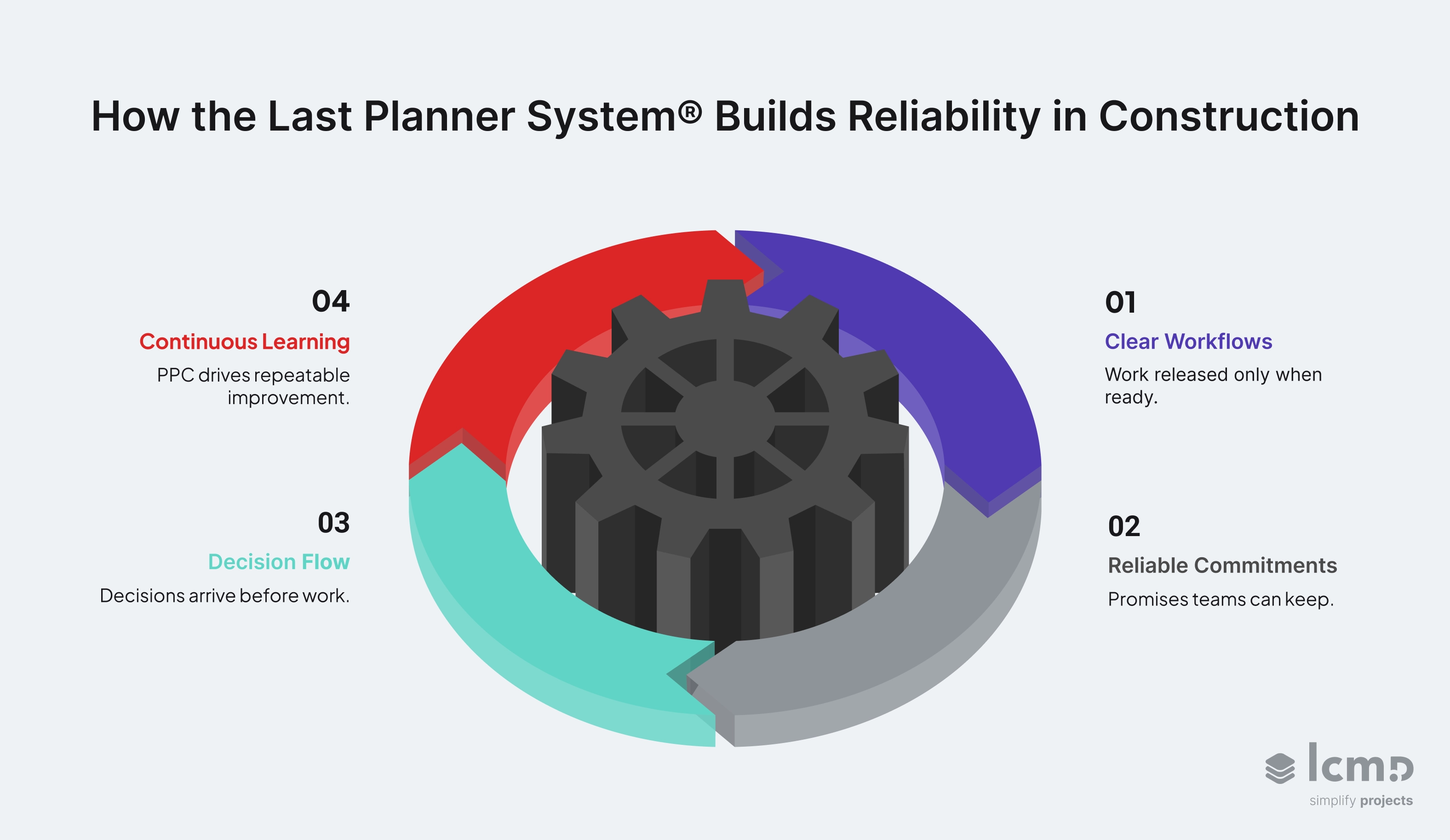
The Last Planner System® improves reliability because it treats planning as production control - a living system that steers work as conditions change.
It connects what should happen (master schedule and phase scheduling) to what can happen next, based on readiness, coordination, and clear commitments across project teams - one of the core mechanisms behind lean construction.
1) Clear Workflows Reduce Waste
In many construction projects, waste is created when work is released without prerequisites in place.
Last Planner System® reduces this by making constraints visible early through lookahead planning and make-ready planning. Instead of discovering blockers on the day of installation, teams surface them while there is still time to remove them.
The result is typically:
- less downtime,
- fewer resequencing loops,
- fewer return visits,
- less expediting,
- fewer last-minute cost spikes.
Construction management becomes steadier because workflow interruptions are prevented before they hit the field.
2) Reliable Commitments Improve Predictability
Predictability comes from commitments that match actual conditions. In the planner system, commitments are not abstract targets; they are promises made by the people closest to the work, based on what is ready and coordinated.
That is what makes weekly work planning useful: it turns coordination into reliable commitments that project teams can plan around.
As reliability improves, teams can reduce some contingency buffers. Trade-to-trade handoffs become more stable, planning conversations get more concrete, and construction project management gains a baseline that holds from week to week, because commitments reflect reality. That steadier baseline reduces general conditions pressure and coordination overhead.
3) Better Decision Flow Reduces Variability
Variability increases when decisions and inputs arrive late: design answers lag, scope boundaries shift, and field teams are asked to start while key constraints are still unresolved.
Last Planner System® improves decision flow by linking upcoming tasks to the constraints and inputs they depend on and making those needs visible early enough to protect execution.
When decision paths are clearer, teams work from a shared baseline, late redesign cycles drop, and the schedule stops absorbing surprise changes as ‘normal.’ That stabilizes both duration and cost exposure.
4) Continuous Learning Improves Portfolio Performance
Reliability improves faster when it is measured and used. Last Planner System® creates a feedback loop through percent plan complete and related reliability key metrics, so teams involved can see where plans failed and why.
The point is learning: which constraints repeatedly block work, which handoffs break down, and which parts of the planning process create avoidable variation.
Over time, this supports continuous improvement across construction projects. For organizations managing multiple projects, the same learning cycle enables lean process improvement at portfolio scale: clearer standards, faster onboarding, and less reinvention of the planning system from one team to the next.
Return on Investment of Structured Planning in Lean Construction
At ROI level, the conversation moves from intent to financial signals owners can audit across construction projects.
The ranges below summarize what organizations typically see when the weekly plan is built from coordinated upcoming tasks:
- General conditions savings of 5–12%⁴ - From shorter duration and less firefighting around logistics, supervision, temporary works, and site overhead.
- Trade labor savings of 3–10%⁵ - From steadier workflow, fewer stops/starts, and less resequencing and expediting.
- Fewer change orders and claims - often a 25–50% reduction⁶ - From clearer commitments, earlier constraint removal, and fewer late surprises that trigger commercial escalation.
- Earlier revenue capture and occupancy⁷ -A major driver in healthcare, education, and commercial portfolios where completion dates tie directly to operating revenue.
Portfolio-Level Project Outcomes from Structured Planning
Portfolio compounding is where the ROI becomes unmistakable. That’s why owners, CFOs, and project stakeholders tend to care less about the labels and more about repeatability across construction projects.
On a single $50M project, even a modest improvement in schedule reliability can return 10–20× the cost of implementing lean construction planning and coordination practices. But the bigger effect shows up across an enterprise portfolio: for owners running 10–50 construction projects per year, the same structured planning system gets reused, refined, and scaled instead of reinvented.
That means even small percentage improvements don’t stay small - they compound across dozens of projects into millions of dollars in annual savings.
Scaling Lean Construction Principles Needs Standardization
Many organizations understand the value of Lean Construction and the Last Planner System®, but struggle to apply these practices consistently.
This happens when teams don’t share a standard way of running the Last Planner System®:
- Practices vary from project to project
- Tools differ by team or region
- Key metrics are inconsistent
- Lessons learned don’t transfer across the portfolio
This is usually a standardization problem: without a shared system, every team rebuilds the planning process in its own way.
How Lcmd Enables Lean Project Delivery at Scale
To close that gap, Lcmd provides an easy-to-use standardized digital platform for collaborative planning and reliable execution:
- One interface for pull planning, lookahead planning, constraints, weekly commitments, and daily huddles
- Real-time transparency for all disciplines
- Automated collection of reliability metrics
- Standard workflows that improve adoption and enhance efficiency across teams
- Portfolio-wide data for organizational learning
With Lcmd, teams no longer reinvent the planning process on every project. The platform creates a consistent, easy-to-use standard for weekly planning, commitment tracking, constraint management, and portfolio-level learning.
This makes adoption simpler, performance more reliable, and results repeatable across an entire organization.
{{cta}}
Conclusion
Predictability comes from treating planning like an operating system that survives across project phases.
Tight phase planning reduces structural uncertainty; disciplined work planning prevents small misses from cascading into schedule-driven cost exposure.
When teams can sustain that cadence consistently, financial control stops being reactive. Construction management software like Lcmd helps by making that cadence repeatable across projects, so reliability becomes an asset, not a one-off result.
For most organizations, that’s the real lean journey: consistent execution first, then integration with other lean methodologies.
Sources
¹ Improved Duration (10–20%+)
Ballard & Howell (2003). Lean Project Delivery.
– Studies summarized in this foundational work show 10–30% duration improvement from stable workflow.
Hamzeh, Zankoul & Rouhana (2015). How Can Last Planner Improve Project Delivery?
– Reports average 20% schedule improvement on LPS projects.
LCI Research Committee (Industry Case Study Compilations).
– Cited results show 10–20% faster delivery on LPS-supported projects.
² Reduction in Issues/Rework(40–60%)
El Reifi & EmmiC (2013). Effectiveness of the Last Planner System in Reducing Rework.
– Demonstrates 30–60% reduction in rework-causing issues.
Lean Construction Institute (LCI) / Dodge Data & Analytics SmartMarket Report (2017).
– Collaborative planning practices reduce field coordination issues by 40% or more.
³ Improvement in Plan Reliability (25–35%)
Hamzeh et al. (2019). Improving Weekly Work Plan Reliability.
– Shows consistent 20–40% increases in PPC when LPS rouHnes are implemented correctly.
Kim & Ballard (2010). Management of Process Variability Using Last Planner.
– Demonstrates measurable PPC improvements of 25–35% across case studies.
⁴ General Conditions Savings (5–15%)
LCI. (n.d.). Transforming Design & Construction (TDC), 2nd ed.
– Case studies show 5–15% savings in general conditions from reduced duration.
⁵ Trade Labor / Productivity Improvements (3–10%)
Dodge SmartMarket Report (2017).
– Highlights lower labor hours when workflow stability increases; reports ~3–10% productivity improvements from reliable workflow.
⁶ Reduction in Change Orders / Claims (25–50%)
Dodge SmartMarket Report (2017): Lean Construction Findings.
– Teams using structured planning and constraint removal report significant reductions in change orders, typically ~20–50%.
LCI Case Study Library.
– Multiple projects report dramatically fewer late changes, especially in healthcare and institutional projects.
⁷ Earlier Revenue Capture / Occupancy
Healthcare case studies in TDC.
– A ~5–10% earlier occupancy window has major financial implications (consistent with your argument).
Koskela, L., & Howell, G. (2002). The Underlying Theory of Lean Construction.
– Argues stable workflow reduces cycle time, enabling earlier value delivery.