

Share this article:
.svg)


.svg)
.svg)

Key Takeaways from this article
- Lean construction results are shaped most by the underlying system of processes, approvals and habits that evolved over time.
- The same approval chains, handover habits and meeting routines that caused problems before will keep undermining Lean until they are redesigned on purpose.
- Lean starts to work when it is treated as a management system with stable routines for planning, removing constraints and learning each week.
- Small design choices—who joins planning, which constraints are tracked, where data lives—decide whether Lean builds trust or just adds more ceremony.
- Linking Lean practices with one shared digital planning environment gives project teams a single source of truth that supports continuous improvement across projects.
Most construction companies never decided to run projects the way they do.
The system just… evolved.
Over time, it became the default way construction projects are delivered – a dense web of existing processes nobody would design from scratch. When deadlines slip, the project team blames individual behaviour instead of the patterns underneath.
When an Old Production System Swallows Lean Processes
Lean construction management is often expected to improve outcomes without touching the hidden design choices that drive how work, information, and responsibility move on construction sites.
When Lean construction goals like waste reduction and continuous improvement are pursued inside the same approval chains and decision habits, the result is predictable: the plan breaks, and everyone points at the last person who touched it.
These aren’t isolated incidents.
They’re patterns in how your current system works.
Until those patterns are surfaced and challenged, many Lean construction practices will reinforce the same bottlenecks and conflicts they were meant to solve.
This article exposes 5 Lean construction failure patterns in existing processes – and how to fix them, so your next project report doesn’t look like the last.
If you're here for real solutions, you're in the right place.
What Lean Construction Resources Reveal About Barriers to Implementing Lean Building in Construction Operations
A literature study on implementing Lean construction analysed 227 research articles and found that the most frequent barriers were lack of awareness, resistance to change, and weak top-management support – issues rooted in organisation and culture, not in the Lean construction philosophy itself.
A 2024 systematic review of 60 articles on Lean construction barriers reached the same conclusion: internal organisational characteristics often block or even derail lean implementation.
A separate review of 67 academic articles on Last Planner System implementation showed that organisational and management barriers are cited far more often than tool or training issues.
In other words, Lean construction principles rarely fail because the methods are wrong. They fail when the organisations keep working the old way.
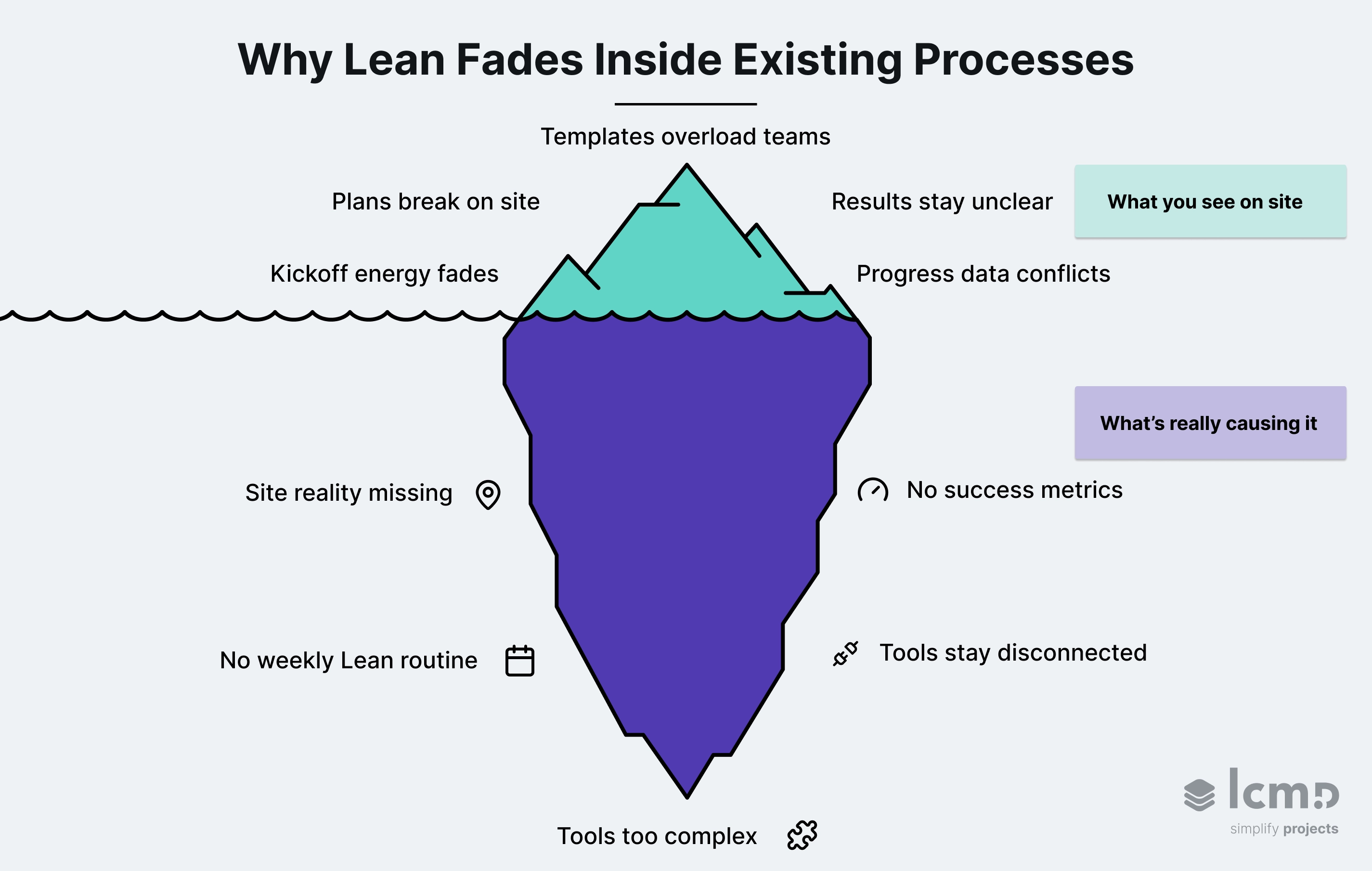
These five patterns connect what research says about Lean construction barriers to how existing processes behave day to day on real construction projects.
5 Lean Journey Failure Patterns in Construction Projects – and What to Do About Them
What follows are five recurring breakdown points where Lean construction methods collide with the reality of construction projects.
For each pattern, you’ll see how it shows up on real construction projects, why it keeps appearing in lean processes, and which practical changes can help you support your continuous improvement goals and improve efficiency instead of fighting the same problems on future projects.
5 Lean Journey Failure Patterns:
- Treating Lean as a One-Off Workshop, Not an Ongoing Management System
- Planning Lean Without the Site Team’s Reality in the Room
- Drowning Lean Construction in Overcomplicated Tools and Templates
- Running Lean Construction Without Clear Success Criteria
- Keeping Lean Practices Separate From Your Project Management Software

1. Treating Lean as a One-off Workshop
On a documented U.S. parking-garage project, the Last Planner System and other Lean construction tools were introduced, but treated as extra paperwork. Daily huddles faded. Constraints weren’t recorded. The schedule was created once and then ignored.
Lean processes existed on paper, but were absent from day-to-day decisions.
No significant shift. No control.
Reviews of Lean principles and Lean practices describe this as typical: partial adoption, old habits. The project team “does Lean” once and then slides back into the previous production system.
The St. Olav hospital project shows the alternative. When Lean practices are genuinely built into construction operations:
- building time stayed stable despite higher complexity,
- cost per m² dropped ~3.4%,
- warranty costs per m² dropped ~55%,
- H-value dropped ~56%.
Lean worked because the planning system changed, not because the workshop was better.
Making Lean a Continuous Improvement Routine, Not an Event
- Frame the initial pull session as the start of lean processes, not the whole journey.
- Give the project team one simple visual system for weekly planning, constraints and commitments.
- Make one role accountable for protecting the routine and linking it to continuous improvement goals.
If you want a concrete roadmap for building these routines into your whole construction process, you can follow the 8-step guide in our article on Lean process improvement in construction.
2. Planning Lean Without the Site Team’s Reality in the Room
Many Lean construction case studies on construction projects describe the same picture: weekly plans are drawn up in the office while construction teams and foremen deal with access, safety and logistics issues on site.
This split between planning and execution wastes human potential and prevents a real lean mindset from forming.
In Lean construction methodology, foremen and superintendents are treated as last planners. Guidance and Lean practices built on Lean principles show what happens when site leaders shape the plan: higher Percent Plan Complete, smoother handovers, fewer surprises.
Planning becomes the result of everyone’s effort, not a document issued to the site.
Bringing Site Reality Into Lean Construction Methods
- Foremen and key trades participate in pull sessions and weekly planning so site knowledge shapes Lean processes.
- A short site-reality round in each planning meeting – access, safety, logistics – surfaces constraints early.
- These inputs are captured in the planning board or Lean construction tools, linking site conditions, commitments and continuous improvement goals.
3. Drowning Lean Construction in Overcomplicated Tools and Templates
On one documented project, the Last Planner System was moved into a huge Excel workbook. Each trade adapted its own tab. Updates lagged. Data was inconsistent. Weekly planning turned into a reporting exercise instead of a flow conversation. Teams saw the Lean construction tools as extra admin, not as support for coordination and waste reduction.
Reviews of Lean construction barriers on large projects show similar patterns: limited software support, complex templates and fragmented data make Lean methods hard to sustain in daily construction management.
Keeping Lean Tools Simple Enough for Daily Use
- Use one shared, visual planning board as the central Lean construction method.
- Limit required fields to what construction teams actually need for flow, handovers and waste reduction.
- Treat extra reports as optional, so Lean techniques support efficient processes instead of documenting chaos.
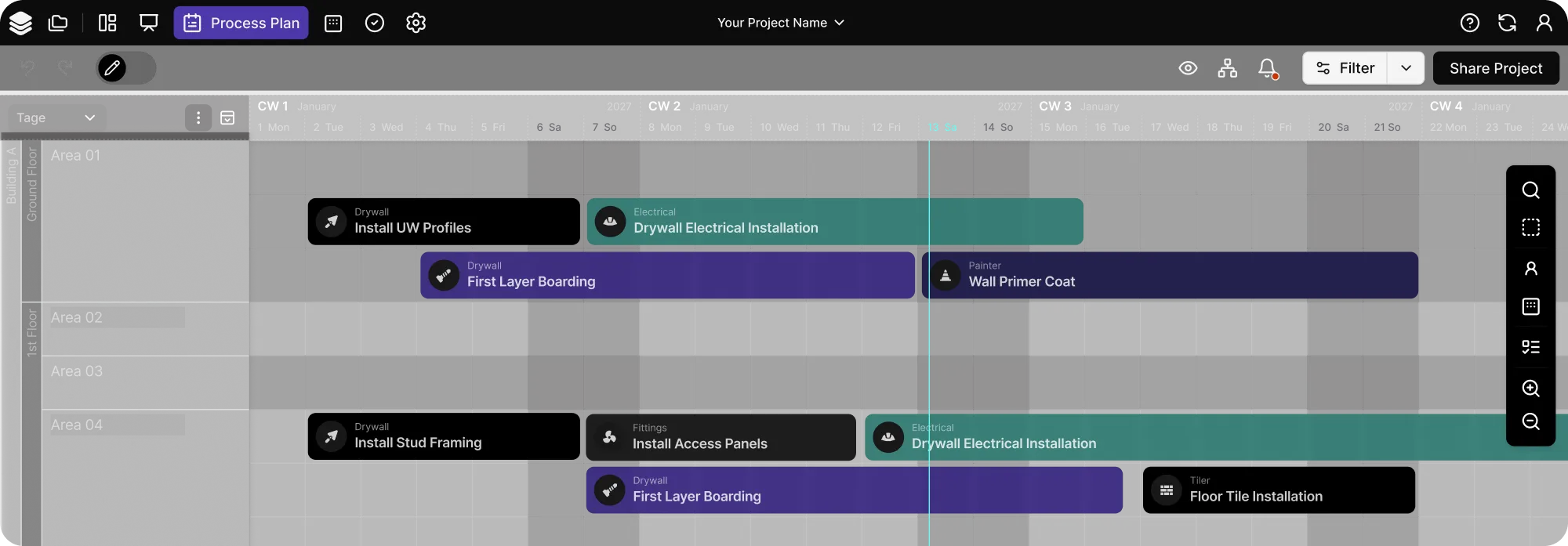
Lean construction software platforms like Lcmd can help you to pull data from the same plan so Lean processes stay simple on site while decision-makers still see the detail.
{{cta}}
4. Running Lean Construction Without Clear Success Criteria
On many construction projects, Lean meetings run every week, but sometimes nobody can say whether reliability is improving. Tasks roll over. Promises are broken. The project team talks about Lean construction aims, but has no hard evidence that anything changed.
Studies of the Last Planner System highlight simple metrics such as Percent Plan Complete (PPC), reasons for non-completion and constraint removal as core indicators of process stability and continuous improvement.
Projects that track and review these numbers report better schedule reliability and fewer surprises during execution.
Turning Lean Principles into Measurable Outcomes
- Define 3–5 clear project objectives for Lean (e.g. PPC, rework rate, waiting time on site).
- Capture PPC and reasons for non-completion in every coordination meeting, not just at milestones.
- Review trends regularly with key project stakeholders and adjust construction processes based on what the data shows.
5. Keeping Lean Practices Separate From Your Project Management Software
On many construction sites, the Lean board lives in a site cabin, the master schedule lives in Primavera or MS Project, and progress is tracked in yet another tool. Dates drift. Constraints are solved in meetings but never reach the schedule. Over time, project managers and construction teams stop trusting both systems.
Research on integrating Lean construction with BIM and digital project delivery shows that when constraints, commitments and progress are managed in one environment, clashes are detected earlier, rework is reduced and continuous improvement becomes part of day-to-day production management.
Connecting Lean Practices with Digital Project Delivery
- Choose one “source of truth” for short-interval planning and progress tracking, and align Lean boards with it.
- Link key Lean data – constraints, handovers, PPC – into your project management software or BIM environment.
- Use that shared system in coordination meetings so every project participant decides from the same information.
If you’re rethinking your digital stack, it helps to start from tools that support Lean planning views and field input – this field-tested guide to modern project management software for construction teams walks through concrete options and trade-offs.
Conclusion: What These 5 Patterns Reveal About Your Lean Processes
The five patterns are signals of how your existing processes really work under pressure.
If workshops, boards and Lean language sit on top of the old habits, Lean construction will stay a label, not a way of running construction projects.
Fixing even one pattern – clearer criteria, simpler tools, real site input, one source of truth – is already improvement. Fixing several turns Lean from an experiment into your default mode of construction project management on future projects.