
Share this article:
.svg)


.svg)
.svg)

Key Takeaways from this article
- Construction risk management works when uncertainty is converted into owned commitments with a deadline and closure evidence.
- Risk categories help teams see patterns fast, so attention stays on what can move schedule, cost, safety, quality, and compliance.
- Projects stay predictable when risk review runs as a weekly operating rhythm, not an occasional workshop or a static document.
- A one-page plan is enough when it sets consistent rules for cadence, escalation, and proof, so risk management holds up under pressure.
Construction risk management is the discipline of keeping promises small.
At the start of a construction project, everything looks possible. Then lead times, inspections, and trade handoffs start setting the terms. McKinsey estimates that 98% of megaprojects run more than 30% over budget and 77% are at least 40% late.
Control comes from making risk concrete. Every risk needs an owner, a deadline, and proof that it’s closed. If any part is missing, the risk stays vague and the schedule starts paying for it.
Example: “Permit approval late → owner: design lead → due: Friday → evidence: approved permit PDF.”
That simple rule turns risk management in construction into a weekly rhythm the project team can run without drama. Potential risks stay visible, risk mitigation stays prioritized, and project costs stay protected as the construction process moves.
Let’s turn that rule into a practical construction risk management plan.
What Is Risk Management in Construction
Construction risk management is the process of identifying potential risks, completing a quick risk assessment, and applying risk mitigation to protect a construction project’s schedule, project costs, and safety. It helps project managers control risk before it undermines predictable project delivery.
CMAA puts it plainly: proactively identifying risks supports mitigation so the project is completed “on time and within budget.”
Risk Identification in Construction: Risk vs Issue vs Constraint vs Change
Risk is not the same as an issue.
A risk is a possible future event.
An issue is a problem already affecting the project.
A constraint blocks planned work.
A change modifies scope, design, cost, or sequence.
Clear definitions help construction teams respond correctly instead of treating every situation the same way.
Importance of Risk Management in Construction
Strong risk management keeps a construction project predictable. When it is run as a routine and tied to ownership and evidence, these outcomes follow:
- Reduce cost overruns by surfacing financial risks before cash flow tightens.
- Prevent project delays by removing constraints before they hit the construction schedule.
- Improve occupational safety by closing hazards with documented controls.
- Limit legal risk by capturing decisions and changes in project documents.
These outcomes start with mapping common risk categories in construction projects and setting clear priorities.
Common Risk Categories in Construction Projects and How to Spot Them Early
Construction project risks can escalate fast because site conditions, handoffs between parties involved, and supply chain lead times compound across the project lifecycle. A practical starting point is to group common construction risks into categories, so risk assessment and risk mitigation can stay focused.
In practice, construction teams often group risks into six working categories:
- Financial risks in construction include inaccurate cost estimates, fluctuating material prices, and client payment delays.
- Operational and coordination risks include design gaps, RFIs/submittals, trade clashes, poor workmanship, and equipment breakdowns.
- Safety risks like falls, struck-by incidents, caught-in/between hazards, electrocution, and exposure to hazardous materials.
- Environmental risks involve pollution, waste management failures, and damage to land or water ecosystems.
- Legal and regulatory risks arise from contract breaches, zoning violations, and non-compliance with regulations.
- Supply chain risks include long lead times, logistics constraints, and supplier capacity limits.
The table below keeps the categories concrete by pairing each category with a typical example and an early warning signal:
Construction Risk Management Process in 5 Steps
Effective construction risk management starts in pre-construction, not once the site is already moving. A quick site investigation and a disciplined design document review surface the most significant risks while there’s still room to choose a cleaner path.
Identify: Capture risks that could impact schedule, cost, safety, quality, or compliance.
Assess (probability × impact): Rank what matters and note the earliest warning signal.
Assign owner: Every risk needs one responsible party. No owner means no action.
Respond: Choose one path - avoid, transfer, mitigate, or accept with a contingency plan.
Monitor + verify (closure): Review in regular risk meetings and close items only when closure evidence exists.
The process is simple: identify what could go wrong, rank it, assign ownership, act early, and close the item only with evidence.
How to Create a Construction Risk Management Plan
The best risk plan is the one teams still follow under pressure. That is why a minimum viable plan fits on one page. It keeps the process consistent as the project accelerates.
A one-page format makes risk review easier to run in real project conditions. It helps teams keep decisions visible, move faster in meetings, and maintain traceability as new risks emerge.
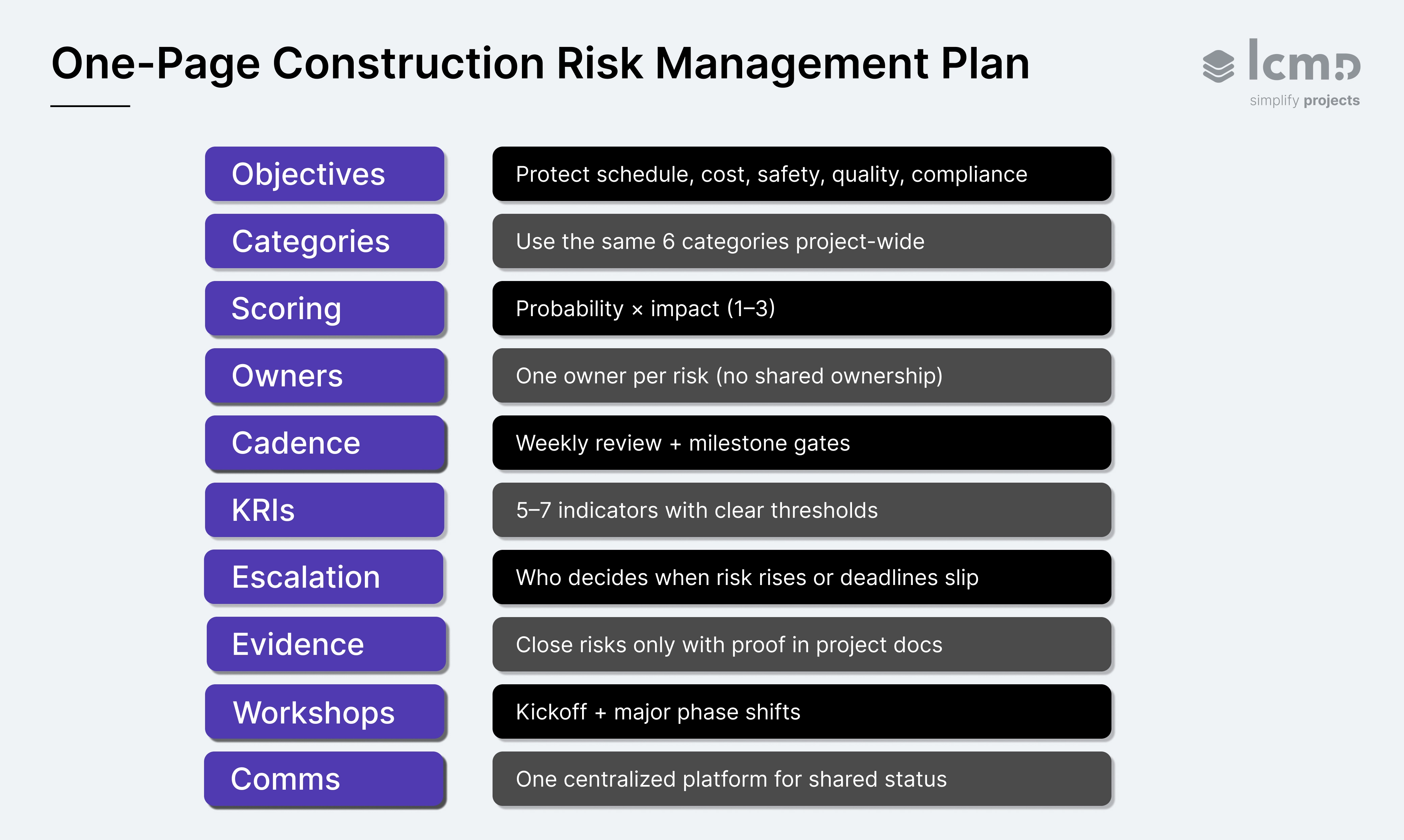
If any risk is missing owner, due date, or closure evidence, it’s not managed yet.
Set Up the Plan in 60 Minutes
- List the top 10 risks for this project (not generic risks).
- Assign one owner + one due date per risk.
- Pick 5–7 Key Risk Indicators and agree on thresholds.
- Schedule a weekly 20–30 minute review with a hard timebox.
Here’s what “small promises” look like when they’re written down.
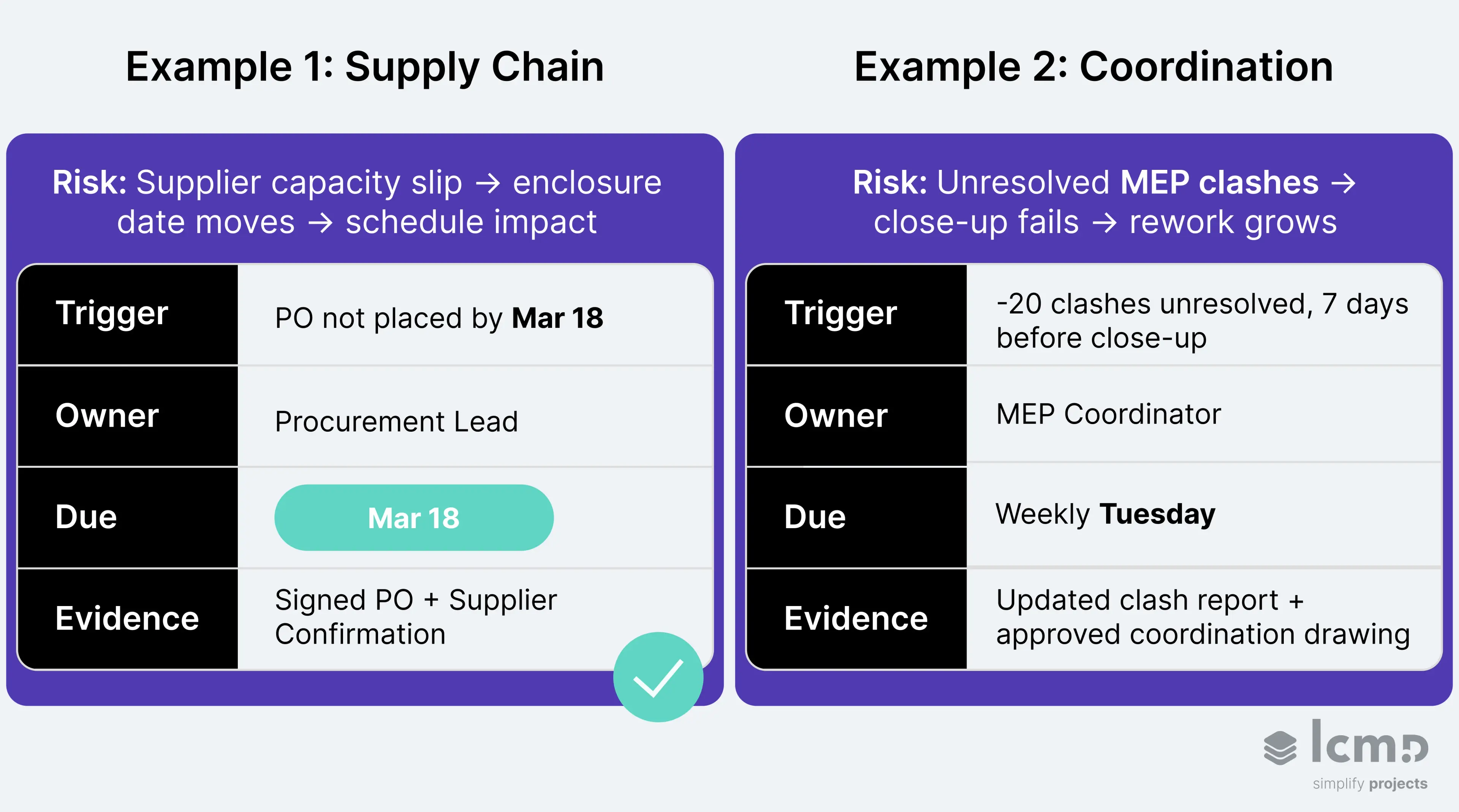
Risk Register Entries That Hold Up in the Field
The first construction risk register functions as a living document. It is updated when new risks appear, and items are closed only when the proof exists.
Rule: A risk is closed only when the mitigation is done and the closure evidence exists in project documents.
Good risk statement formula:
Cause → Event → Impact (plus a trigger)
Key Risk Indicators for Construction Risk Management That Warn You Early
Risk categories describe what can go wrong. KRIs show when it’s starting. Example: if a supplier date slips by a week, the team needs a decision today.
Good KRIs are measurable, time-bound, and tied to a decision. They do not describe the risk in general terms. They show when a threshold has been crossed and who needs to act.
In construction, useful KRIs often relate to aging RFIs, unresolved clashes, open constraints, late supplier confirmations, cost-to-complete drift, and safety observations that stay open too long.
How Lcmd Supports Effective Construction Risk Management on Site
Lcmd helps construction teams identify risks early and manage them effectively by bringing planning, progress, and project data together in one central place. This keeps risk signals, status, and follow-ups visible at all times.
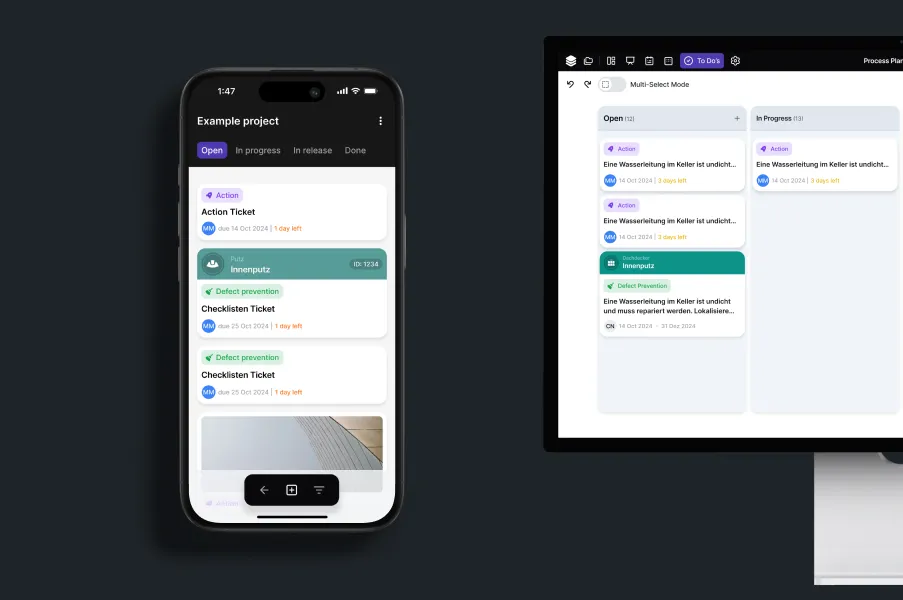
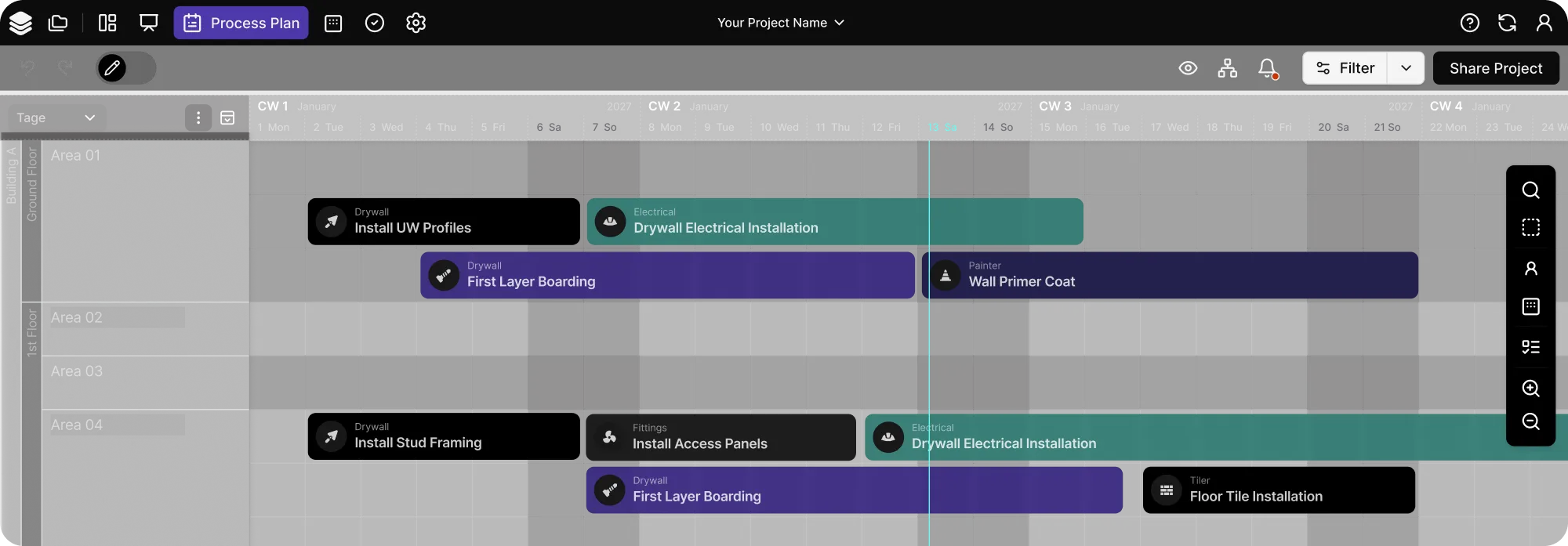
Instead of relying on a risk register that becomes outdated over time, the project team can link risk follow-ups directly to tasks in the live process plan. Changes and progress become visible immediately, so risks remain connected to sequencing and handoffs.
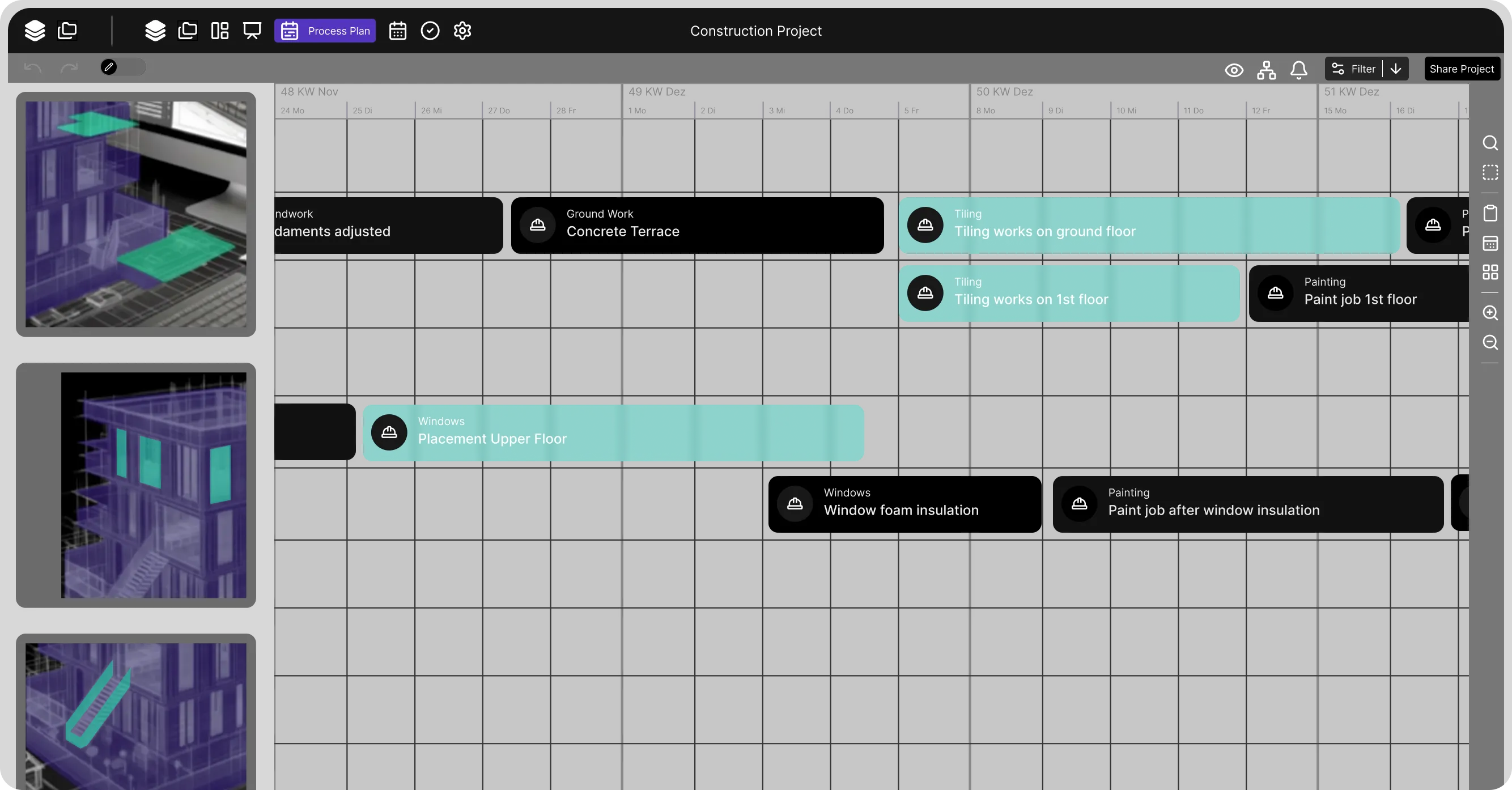
Dashboards and visual planning help teams identify schedule drift, dependencies, and conflicts early, before they become real problems. This allows mitigation to happen before delays spread through the project.
{{cta}}
Conclusion
A strong risk routine protects flow. It keeps the next critical decision visible and time-bound, with evidence attached when it’s closed. That consistency reduces rework and stabilizes the schedule.
FAQs
What Is Risk Assessment in Construction Projects?
Risk assessment evaluates identified risks based on likelihood and impact, often using a risk matrix. It helps project managers prioritize critical risks and focus mitigation where it matters most.
How Many Risks Should Be Tracked at Once?
Keep the active list short. Most projects run best with a top 10 for weekly review and a longer backlog only when needed. If everything is “high priority,” nothing is.
How Often Should a Risk Review Happen?
For most projects, a weekly review cadence works well. Increase frequency during high-risk phases such as mobilization, major handoffs, close-ups, commissioning, or after major scope changes.
How Does Risk Management Improve Safety on a Construction Site?
Risk management supports occupational safety by identifying hazards, enforcing safety protocols, and ensuring proper training for construction workers. It also tracks closure evidence so safety risks don’t stay open.
When Should Construction Risk Management Start?
Construction risk management should start in pre-construction during site investigations and design document reviews. It continues throughout the project lifecycle with ongoing monitoring as the project progresses.
What Software Helps with Construction Risk Management?
Risk management tools include cloud platforms, mobile apps, BIM, and automation that speed up risk identification and collaboration. The best tools connect risks to tasks, owners, due dates, and evidence so teams manage risks effectively.