

Share this article:
.svg)


.svg)
.svg)

Key Takeaways from this article
- Construction change management succeeds when project teams see the change as part of how work gets controlled, coordinated, and improved.
- Change initiatives fail repeatedly across construction projects because the industry’s operating model disrupts habit formation before adoption can mature.
- People commit faster to processes they helped shape, especially when those processes reflect the pressure and friction of real site work.
- Lean construction makes organizational change durable by turning adaptation into a weekly project habit.
- The strongest construction companies involve the people closest to the work early enough to make adoption practical, credible, and measurable.
Most construction teams know how to process a change order. Adjusting scope, repricing a contract, updating the project schedule: that is familiar territory.
What construction organizations struggle with is the more demanding side of change management in construction: how to get teams to actually work differently.
Why? Because it involves people.
What is Change Management in Construction?
Change management in construction is the structured process of helping project teams adopt changes in workflows, tools, responsibilities, and communication routines without losing control of scope, schedule, or coordination.
Adopt a new planning method. Roll out a digital tool. Change how the site communicates.
According to the Lean Construction Institute, under traditional project planning only 54% of weekly assignments made by foremen were actually completed. That is an organizational problem. The pattern runs deep: companies with failed transformation programs identify employee resistance or management behavior as the main barrier in 72% of cases.
That gap between a better idea and real adoption on a construction project is what this article is about.
Organizational Change Management
In construction, change management is often used in two ways:
Change order management is the formal process of documenting, pricing, and approving changes to project scope, schedule, or contract.
Organizational change management is the process of helping people, teams, and organizations shift their behavior, habits, and working methods.
Change Order Management and Organizational Change Management: Key Differences
In the construction industry, this typically comes up when a company decides to adopt Lean construction principles, implement a new digital platform, or restructure how planning and coordination happen across a project.
Why Construction Is One of the Hardest Industries to Change
McKinsey research found that digital transformation success rates in traditional industries range between 4% and 11%. For construction companies, that number is a warning: changing tools is easier than changing daily work.
3 Conditions That Block Construction Change Management
Three structural conditions make construction uniquely resistant to change:
- Projects end before new habits form
Each project reassembles a different mix of trades, companies, and subcontractors. Learning that starts on one project rarely carries to the next. Goldman Sachs Research shows that from 1970 to 2024, productivity in the US construction industry fell by 30%, while economy-wide productivity more than doubled. - Site culture is built around experience
Professionals who have developed their methods over years do not abandon them because of a management mandate. RICS survey data from nearly 3,000 construction professionals shows why: productivity improvement in construction still depends most on workforce skills, not technology alone. - Most change initiatives lack a system to last
In 2024, 70% of contractors had no formal technology roadmap. New methods are introduced without a clear process, ownership model, or adoption plan.
Where Construction Teams Lose the Change Management Process
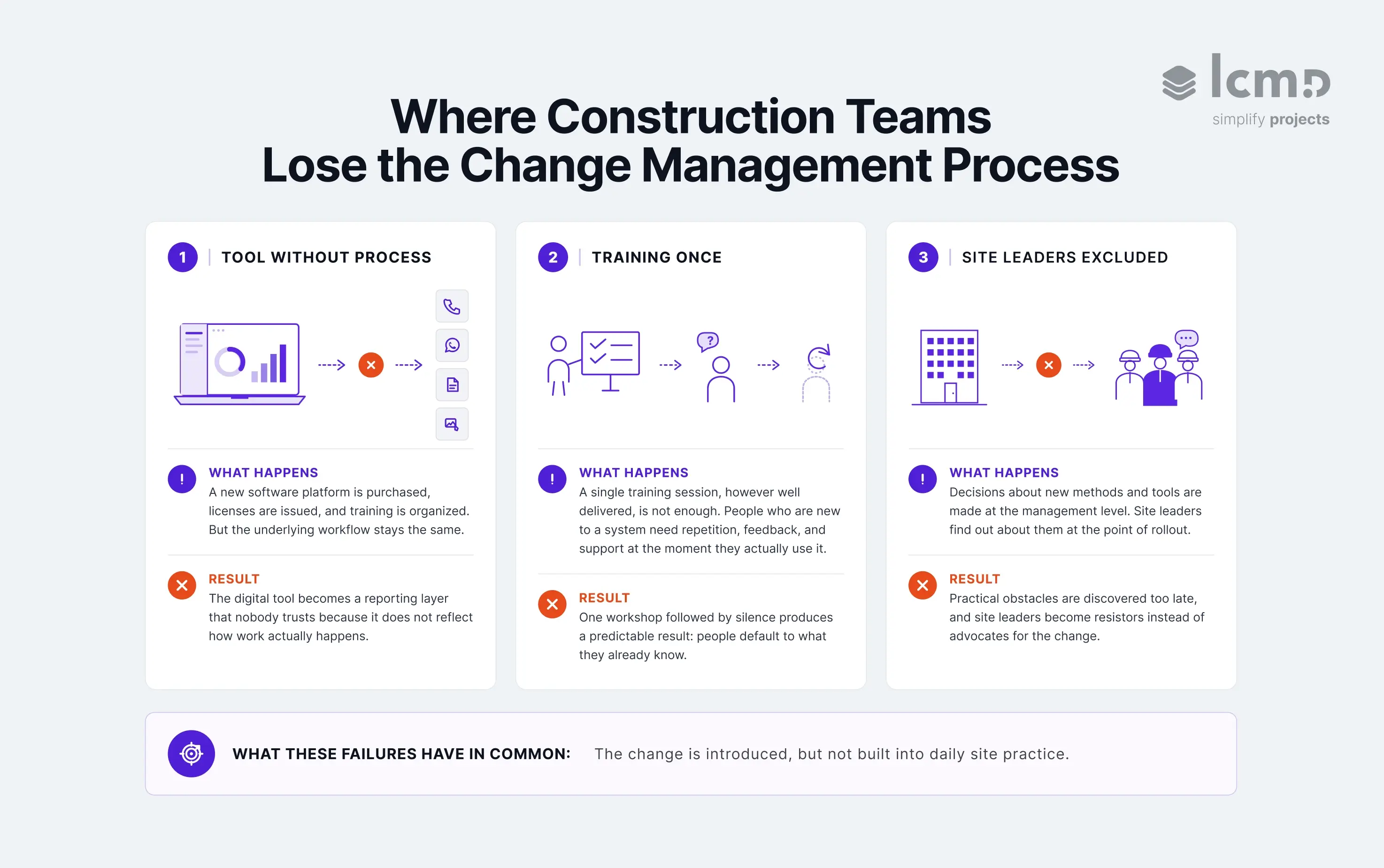
On most construction projects, a new process gets used inconsistently for a few weeks, then quietly abandoned. Three patterns account for most of these failures:
- Implementing changes without redesigning the workflow around the new tool
- Training construction teams once and assuming adoption follows
- Managing change without involving the people who actually run the site
Best Practices for Change Management in Construction
The construction teams that sustain change treat adoption as the actual work.
Start the Change Management Process With a Willing Project Team
Resistance is never uniform across a construction company. Some project teams are ready. Start there.
Everett Rogers' Diffusion of Innovations shows that change spreads fastest when it starts with willing early adopters who then influence the broader group.
Implementing changes company-wide before proving value on a single willing project ignores how behavioral change actually spreads. A successful pilot creates evidence and internal advocates that no training program can replicate.
Connect the Change Management Process to Project Outcomes Teams Already Want
Construction professionals respond to concrete results.
Kahneman and Tversky's prospect theory helps explain why people resist change: the perceived risk of losing familiar methods can outweigh the perceived benefit of something new.
Effective change management practices counter that directly: make the benefit visible and specific before asking for commitment. Fewer project delays. Less rework. More time supervising and less time chasing information. When the outcome is tangible and relevant to the person being asked to change, resistance drops.
Involve Key Stakeholders Before the Change Management Decision Is Made
On most construction projects, site managers and foremen find out about new methods at the point of rollout. Deci and Ryan's self-determination theory shows why that sequence consistently fails: people have a fundamental psychological need for autonomy.
Sustained commitment rarely follows a decision that site leaders had no part in making.
Involve site leaders in the process design before the tool is selected. Encourage open communication about what creates friction in the current workflow. When key stakeholders help shape the process, they have a genuine reason to make it work.
How Lean Construction Sustains Organizational Change on Real Projects
Those practices are easier to sustain when the project itself is structured to support them. Lean construction creates the feedback loops, planning rhythms, and shared visibility that help new behaviors become part of daily project work.
Three LCI-funded studies examining 162+ projects across the US found that high Lean intensity projects are significantly more likely to finish ahead of schedule, under budget, and to the owner’s satisfaction.
Each change creates the opportunity for more and often larger improvements.
Glenn Ballard and Greg Howell, co-founders of the Lean Construction Institute
Effective change management in construction projects depends on that repetition: improvement has to become part of the project rhythm.
The Last Planner System® and takt planning both support that routine. Teams plan in shorter cycles, make constraints visible, coordinate construction teams around shared sequences, and review what actually happened on site.
Unified Platform for Lean Change Management at Scale
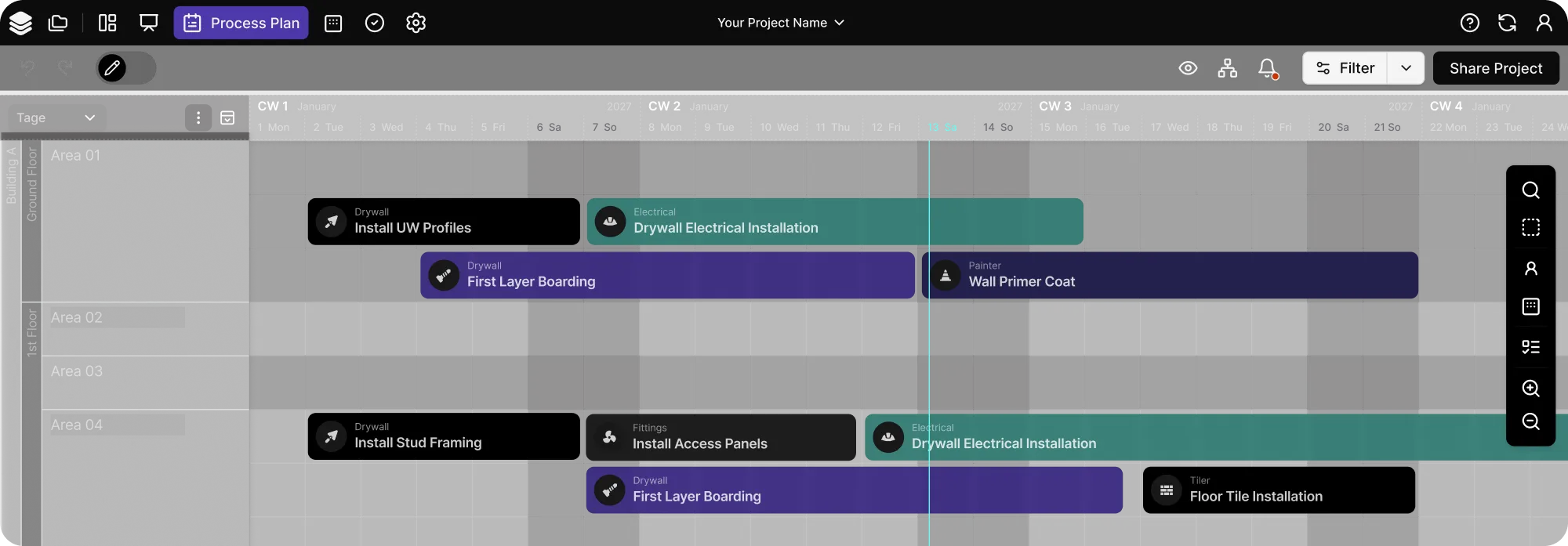
On large-scale construction projects, Lean feedback loops depend on shared visibility. Construction change management software gives project teams a common view of commitments, takt sequences, constraints, and site-level deviations, so the impact of change remains visible in daily coordination. In a connected platform like Lcmd, that feedback loop stays intact across the entire project team.
Lean's short planning cycles, visual management, and structured retrospectives create the organizational infrastructure that makes change management durable on real construction projects.
Measuring Progress: How Construction Change Management Reduces Resistance
Effective change management in construction comes down to three conditions: starting where adoption is most likely, involving the right people early, and making progress visible across the project team. Connected construction change management software delivers that visibility. Progress becomes measurable. Resistance becomes easier to address.
Tracking construction progress makes the following visible on every project:
- Plan reliability. Are weekly commitments being met? Tracking that consistently gives teams concrete evidence that the change is holding.
- Deviation patterns. Where do disruptions repeatedly occur? Visible deviation data helps construction companies identify root causes before they compound into project delays.
- Project performance against baseline. Are the new workflows actually improving outcomes? Measurable results give project managers and site leaders the evidence needed to sustain commitment across future projects.
For construction teams ready to make that visibility a reality, Lcmd connects planning and execution so that progress, deviations, and outcomes stay clear to everyone on the project. The result is measurable project delivery.
Conclusion
Construction is changing whether teams are ready or not. The companies that will lead are the ones that learn how to bring their people with them. That gap between a new method and lasting adoption is where real competitive advantage is built.
{{cta}}
FAQs
How Does Change Management Help Prevent Cost Overruns and Project Delays?
Change management helps prevent cost overruns and project delays by making the impact of each workflow or process change visible before it affects coordination, scheduling, or site execution. A structured change management process gives project managers the information they need to spot cost impacts and timeline risks early, before they compound into delays, rework, or cost overruns.
What Role Do Project Stakeholders Play in Effective Change Management?
Project stakeholders play a central role in effective change management because they shape whether a proposed change can work in daily project conditions. Owners, project managers, site leaders, subcontractors, and key trades help identify practical risks, align project goals, and make the implementation process more credible across the project team.
How Do Change Management Systems Support Large-Scale Construction Projects?
Change management systems support large-scale construction projects by giving teams a shared system to track adoption, constraints, deviations, project progress, and decisions. A centralized database helps construction companies manage change consistently across multiple stakeholders, teams, and work areas.
Who Is Responsible for Leading Change Management on a Construction Project?
Project managers typically lead change management on a construction project, but effective change management also depends on site leaders, key stakeholders, and senior decision-makers. The project manager coordinates the structured process, while foremen, construction teams, and subcontractors help make the change workable in daily execution.
What Should Construction Change Management Software Include?
Construction change management software should include change request tracking, approval workflows, cost impact visibility, schedule impact tracking, task ownership, project progress reporting, and a centralized database for decisions and documentation. Effective systems connect planning and execution so project teams can manage change without losing control of scope, schedule, or coordination.