

Share this article:
.svg)


.svg)
.svg)

Key Takeaways from this article
- Digital transformation in construction changes when project information arrives, where it lives, and who can act on it while the outcome can still change.
- The process you digitize determines the outcome you get, which makes process design the foundation for every successful digital platform.
- Successful digital transformation starts with one specific operational problem that has a measurable cost and enough visibility to prove progress.
- Takt planning and the Last Planner System create the process architecture that gives digital platforms something structured enough to amplify.
- Construction companies that build digital capability around current project information create organizations where plans, data, and teams become more reliable with every project.
Digital transformation is not a trend you can wait out. It is reshaping every industry, and construction is no exception. Global investment in digital transformation is projected to reach nearly $4 trillion by 2027.
In construction, the feelings around this are mixed. Adoption pressure is real. So is platform fatigue. Many construction professionals are dealing with too many platforms, unclear returns, and legitimate questions about where to start.
There are so many point solutions, so many workflows, and you have to do so many different logins. I've never seen that in any other industry.
Tanja Kufner, Head of Ventures and Startups at Nemetschek Group
Construction businesses now use 6.2 technologies on average, yet bad data across disconnected systems costs the industry an estimated $1.85 trillion a year. AI adds another layer: 45% of construction organizations report no implementation, while only 1.5% use it across multiple processes.
The strongest case for digital transformation in construction is what happens when it is led well.
When it does, the difference is immediate. The work becomes easier to control. Plans stay closer to reality. Problems appear earlier. Site teams spend less time chasing information and more time moving the project forward.
That is the transformation construction companies should be leading.
What Is Digital Transformation in Construction?
Digital transformation in the construction industry is the process of connecting planning, site execution, subcontractor coordination, and project reporting into one continuously updated flow of project information. It gives construction teams a shared view of current project reality, so decisions are based on live data, deviations become visible before they cause delays, and every stakeholder works from the same information at the same time.
Why Digital Transformation in Construction Can No Longer Wait
The numbers below describe what is already happening across construction projects and construction companies today.
The Construction Sector Is Falling Behind on Productivity
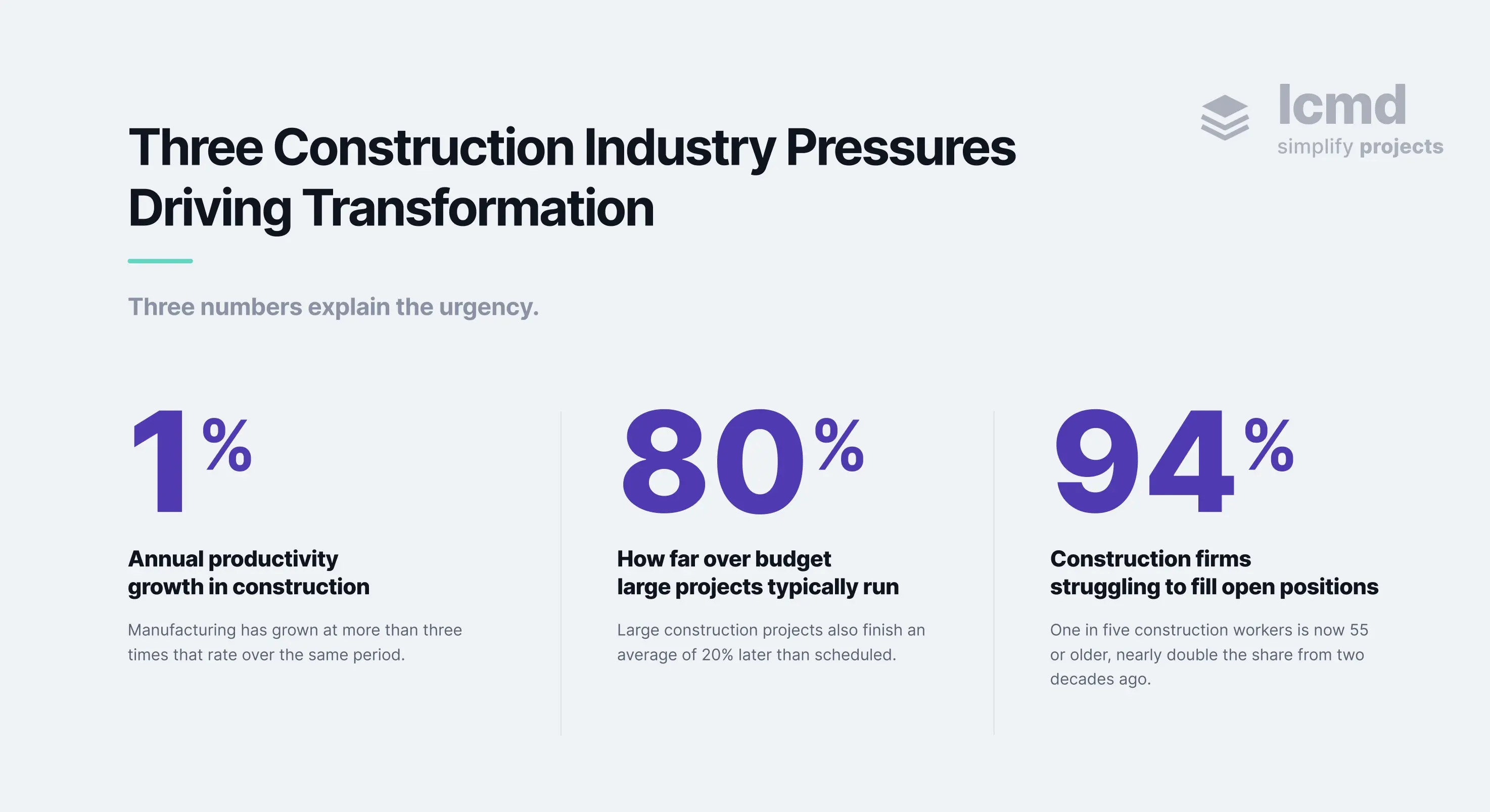
Construction labor productivity has grown at just 1% annually over the past two decades. Manufacturing has grown at more than three times that rate. That gap compounds. Every year of lower productivity means tighter margins, less capacity to invest, and a wider distance to close.
Cost Overruns Show the Pressure on Construction Projects
Large construction projects typically finish 20% later than scheduled and run up to 80% over budget. Construction professionals spend 35% of their working time on non-productive activities. Poor communication alone is the primary reason one-third of projects fail to meet cost or schedule targets. The pattern is consistent: fragmented information and disconnected workflows compounding into losses that better-connected systems can prevent.
The Aging Workforce Raises the Stakes for Construction Firms
94% of construction firms are currently struggling to fill open positions. One in five workers is now 55 or older, nearly double the share from two decades ago. In the UK, the sector is projected to lose a quarter of its workforce to retirement within 15 years. Building the digital capability to make existing teams more effective is the lever that remains.
5 Operational Domains of Digital Transformation in Construction
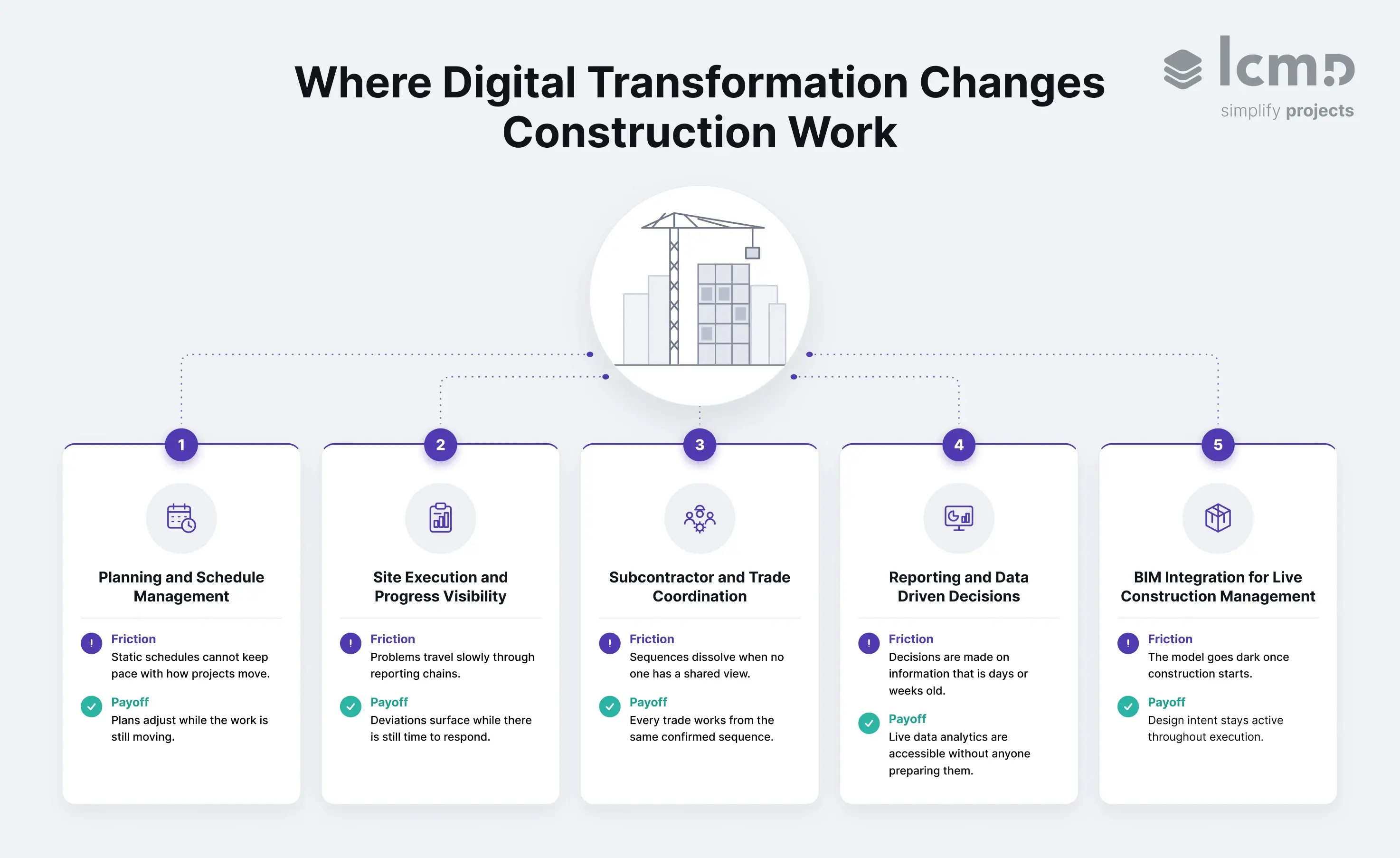
Digital transformation in construction means different things at different levels of a project organization. At the operational level, where plans meet execution and where most projects are won or lost, it comes down to five specific domains.
So, where does digital transformation actually touch the daily work?
1. Digital Planning and Schedule Control
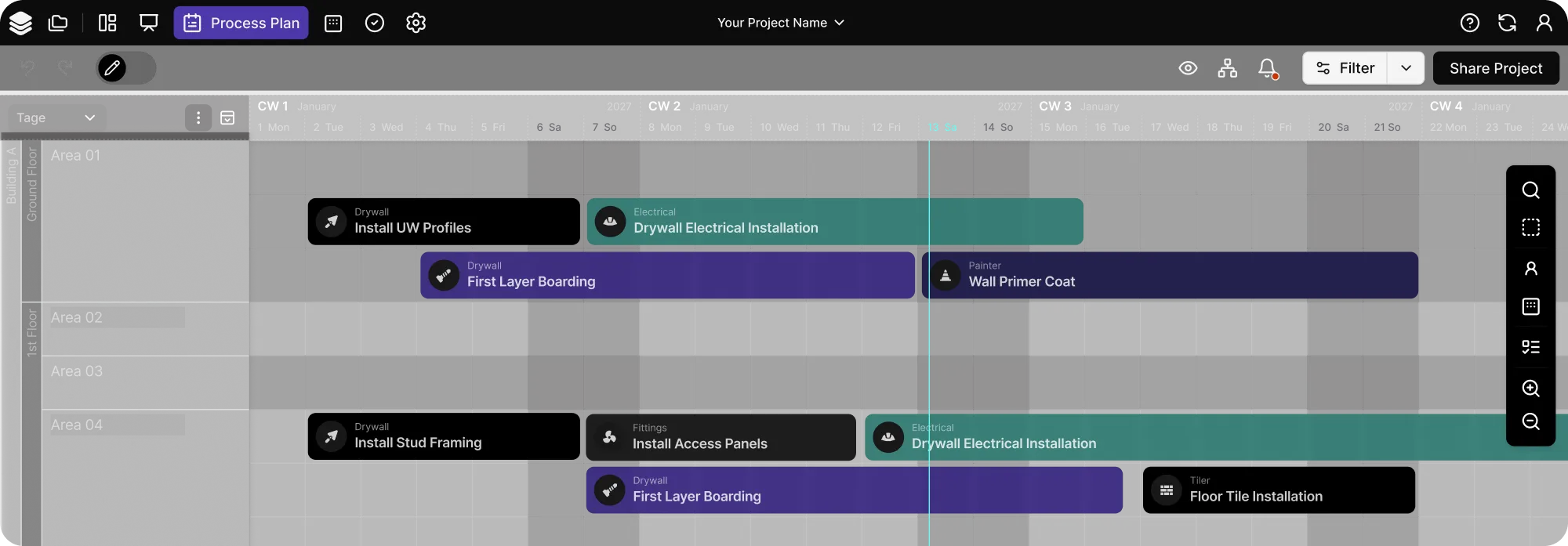
Existing processes built around static schedules and weekly updates cannot keep pace with how construction projects actually move. Digital tools replace them with connected process plans where dependencies, constraints, and lookaheads can be updated while the work is still moving.
Pull planning structures the sequence from the end goal backward. Teams adjust the path before one missed prerequisite disrupts the next activity. When a constraint is flagged on site, it appears in the coordination meeting that day. When a trade finishes early, the next trade knows immediately.
Optimizing workflows at this level changes the quality of every downstream decision in construction project management.
2. Site Execution and Progress Visibility
On most construction sites, problems travel slowly. A deviation happens on site, gets noted in a report, discussed in a meeting, and reaches the right person days later. By then, the delay has already compounded.
Digital transformation changes when project progress becomes visible. Deviations surface in real time. Construction sites stop operating on the information from last week. Project managers get actionable insights on current performance. The information is there when it can still change the outcome.
Data-driven decisions replace reactive ones. Key metrics on project performance stay current without anyone having to compile them manually.
3. Subcontractor and Trade Coordination
Subcontractor coordination is one of the highest-friction points on most construction projects. A trade arrives to find the preceding work incomplete. A constraint nobody flagged blocks three crews simultaneously. Sequences agreed in planning dissolve on site because no one has a shared view of the current status.
Digital transformation gives construction teams a shared sequence to work from. Every trade can see what has to be ready, who owns the next step, and which conditions have been confirmed before work starts.
The Last Planner System brings the commitment structure that makes coordination reliable across the full trade sequence.
4. Reporting and Data-Driven Decisions
Executive management and project owners currently make decisions about active construction projects based on information that is days or weeks old. A site manager compiles a report. Someone formats it. Someone presents it. By the time it reaches the people with authority to act, the project has already moved.
Digital transformation changes who has access to current project performance data and when. Data analytics on project progress stay live across the portfolio without anyone having to prepare them.
The quality of decision-making in construction has always been limited by the freshness of available information. Data integrity and real-time data insights remove that constraint at every level of the organization.
5. BIM Integration for Live Construction Management
On most construction projects, the BIM model does its most valuable work before the first spade hits the ground. Once construction starts, information modeling shifts to the background. The model exists, but the site runs on its own logic.
Digital transformation connects the model to live construction management. Digital platforms give site teams access to spatial sequences, clash detection, and design intent throughout execution rather than only at handover. The gap between what was designed and what is being built stays manageable when both exist in the same connected environment.
BIM integration turns a planning deliverable into an active project coordination tool across the full construction lifecycle.
Implementing across these five domains is the what. The construction companies delivering the strongest results have also solved the how: the operating structure that gives digital tools something reliable to work with.
Why Lean Construction Makes Digital Transformation Work
McKinsey documented a large contractor that spent five years and considerable investment trialing digital solutions across dozens of projects, including 5D BIM. Every attempt failed to move the needle on project delivery. Productivity barely budged. Delays and cost overruns continued at the same rate as before.
The investigation pointed to the same root cause each time: the process those tools were applied to.
The Process You Digitize Determines the Outcome You Get
Digital tools accelerate whatever they are connected to. When the process underneath is fragmented, the platform gives teams faster access to the same coordination gaps, unclear handoffs, and changing commitments.
Construction companies driving successful digital transformation pair process discipline with platform investment. Connected workflows, clear handoffs, and short-cycle planning rhythms give digital platforms something stable to work with. With that foundation, project data becomes more than a record of what happened. It becomes material for continuous improvement.
What Lean Construction Gives Digital Tools to Work With
Takt planning structures work into stable, repeatable sequences. When a deviation occurs inside that rhythm, a digital platform can flag it, quantify it, and route it to the right person. The stable sequence turns the deviation into a signal instead of noise.
The Last Planner System produces structured weekly commitments and documented variance. That data gives digital reporting tools something precise to surface rather than a general sense that things are running late. Pull planning builds the sequence backward from a confirmed milestone around subcontractor commitments, giving digital coordination tools the right constraint at the right time.
Measurable Results Instead of Digital Pilots
The proof shows up on real projects:
- Published case studies document project duration reductions of 24% to 50% in connection with takt planning.
- McKinsey puts the full digital transformation payoff for companies that execute well at 14% to 15% productivity gains.
- McKinsey also identifies cost reductions of 4% to 6%.
Process discipline is what closes the gap between pilot and portfolio.
Lean and BIM integration extends the same logic into model-based coordination. On a platform built for Lean construction management, the model stays connected to live commitments, spatial sequences, and execution planning throughout the project.
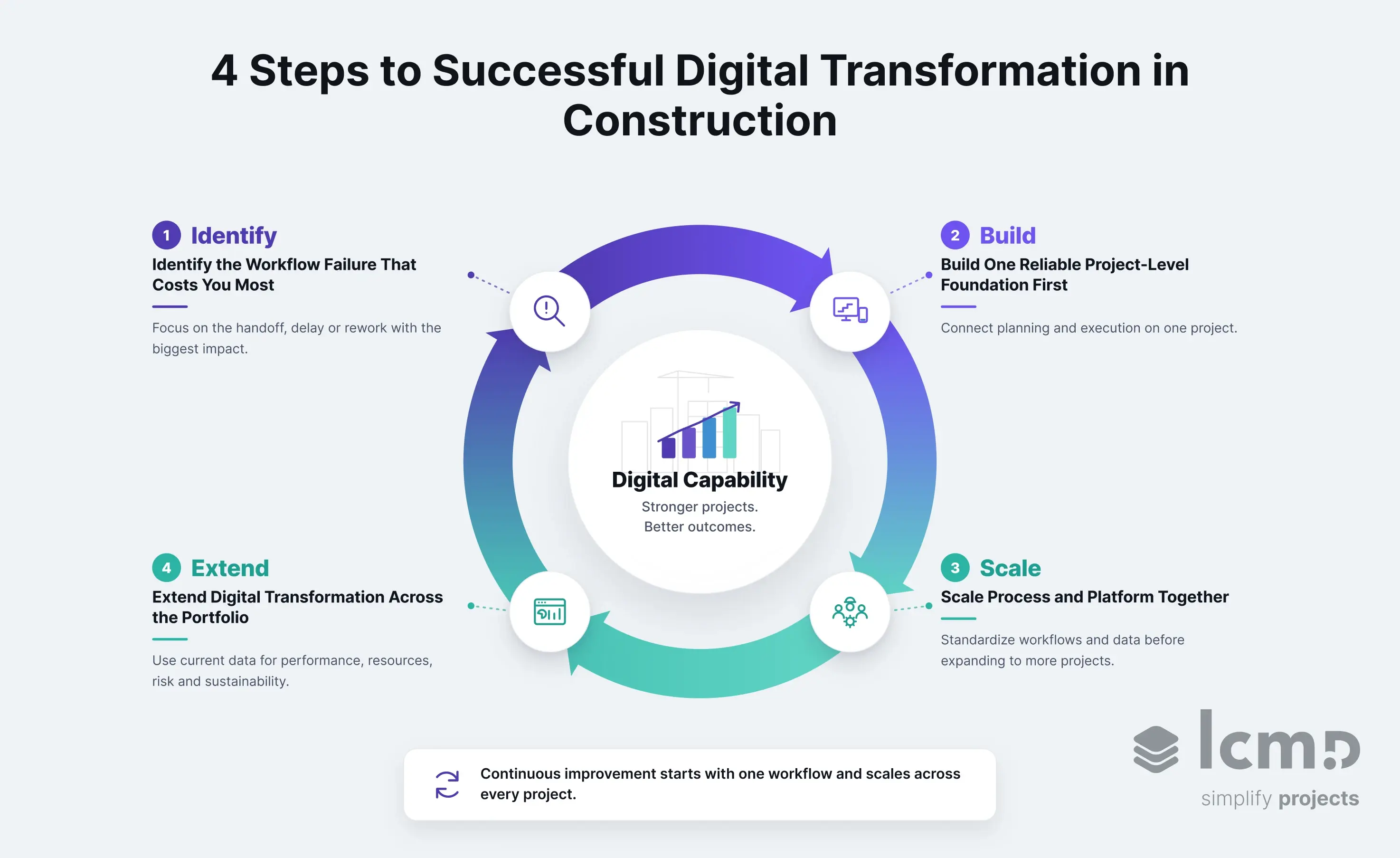
4 Steps for a Successful Digital Transformation in Construction
This is how construction companies actually build digital capability in sequence: a structured progression from project-level control to portfolio scale.
- Identify the workflow failure that costs you the most
- Build one reliable project-level foundation
- Scale process and platform together
- Extend digital transformation across the portfolio
Step 1: Identify the Workflow Failure That Costs You Most
Most construction professionals already know where their projects lose the most time. The strongest starting point is the friction point with the clearest cost.
48% of project managers feel overwhelmed by how quickly technology is changing their profession. Yet 69% believe it will help them deliver greater value. Starting with one well-defined problem makes transformation achievable.
The Best Starting Points Are Already Visible
The highest-friction points tend to cluster around the same areas on most construction projects:
- The planning-to-site handoff, where the schedule stops reflecting reality
- Subcontractor coordination gaps that create weekly firefighting
- Reporting delays that mean problems reach decision-makers too late
- Data living in separate systems that nobody can reconcile in real time
| Friction Point in the Construction Project | How to Recognize It | Why It Is a Good Starting Point |
|---|---|---|
| Planning-to-Site Handoff | The schedule no longer reflects what is actually happening on site | Time losses become visible quickly and can be measured clearly |
| Subcontractor Coordination | Teams wait for preceding work, approvals, or missing information | Recurring coordination problems show where digital processes can reduce friction |
| Delayed Reporting | Decisions are based on information that is already outdated | Current project data creates immediate value for project managers and executive leadership |
| Disconnected Data Systems | Data cannot be brought together in real time | Better integration creates the foundation for scaling across more construction projects |
Only 35% of digital transformation projects across industries reach their stated goals. The ones that do share a starting point: a specific operational problem with a measurable cost.
For construction companies, that problem is rarely hard to find. It usually sits inside the existing processes that everyone already works around. Starting there keeps initial costs tied to a problem the business can measure.
Step 2: Build One Reliable Project-Level Foundation
Successful digital transformation becomes easier to scale when one construction project proves the operating model first. That means connecting short-term planning, site execution, constraint tracking, and reporting in one reliable project layer.
This layer gives project managers current information from the place where the work actually happens. Plans updated with site feedback. Constraints enter the same rhythm as the schedule. Progress reporting reaches the people who need it when it still matters.
When that rhythm works on one project, it becomes the foundation for everything that follows.
Step 3: Scale Process and Platform Together
The scaling moment is where most construction transformation efforts run into their most persistent challenge. A tool that worked well on one project gets rolled out across ten projects with mixed outcomes.
Research with German construction companies points to a missing holistic implementation process as one reason digital technologies remain difficult to scale. Isolated tools may function well inside one team, while data exchange, data quality, and system integration become harder across multiple projects.
Construction companies advancing digital transformation across the business ask a consistent question before expanding: are the repeatable routines, role clarity, shared data rules, and reporting logic strong enough to replicate?
For construction firms driving digital transformation at scale, the implementation strategy becomes as important as the platform decision. Business operations, project controls, and data standards have to move together.
Step 4: Extend Digital Transformation Across the Portfolio
Portfolio-level transformation is where the investment across the previous stages compounds. Project managers and executive leadership work from the same live data. Resource conflicts across multiple construction projects surface before they create delivery problems. Key metrics on project performance are available without anyone having to request them.
Construction risk management improves at this stage because pattern recognition becomes possible across projects rather than within them. A risk that appeared on three previous projects becomes a flag on the fourth before it escalates.
When Digital Transformation Compounds Across Projects
Better resource allocation and material coordination at the portfolio level also reduce waste and support environmental sustainability targets. That matters for construction businesses operating under tighter regulatory and ESG frameworks, particularly on infrastructure projects where material volumes and carbon targets are most visible.
For construction companies ready to build that capability, Lcmd's construction project management software connects project-level execution across the full project lifecycle in one environment. BIM and digital twin integration can extend that control further into later project and asset phases.
How Artificial Intelligence Amplifies Digital Transformation in the Construction Industry
The four steps above build the operating layer that artificial intelligence needs in construction: connected project data, stable workflows, and a reliable signal between planning, execution, and portfolio control.
Once that operating layer is in place, AI strengthens the decisions construction teams already need to make every day. Machine learning models can identify patterns across project progress, constraints, resource allocation, and schedule movement because the underlying information is structured enough to be trusted.
What AI Delivers in Construction When Project Data Is Clean
With the right foundation in place, advanced tools create value in three areas that matter most to construction organizations:
- Forecasting: Machine learning models improve as clean, consistent project data accumulates across projects. Predictions become more accurate with every completed cycle.
- Risk detection: Deviations from stable sequences become meaningful signals. Digital platforms surface them early enough for teams to act while the outcome can still change.
- Decision-making: Data analytics across the portfolio gives project managers and executive leadership current, structured information instead of manually assembled summaries.
AI in construction delivers its strongest results inside a project environment that runs with clear responsibilities, current data, and repeatable control routines. Advanced technologies create the most value when clean, connected project data is already flowing through the organization.
For construction teams ready to explore this next stage, the AI in construction guide covers the full implementation picture: the 12-month roadmap, role-specific benefits, and the ROI case for construction organizations at different stages of digital maturity.
{{cta}}
10 Things to Look for in a Digital Platform for Construction
Not all project management software is built for construction. These ten criteria help construction businesses identify solutions that actually fit construction.
- Construction-specific workflows: trades, zones, dependencies, constraints, lookaheads, and handoffs
- Connected planning and execution: one operational layer for plans, site updates, and project progress
- Lean construction support: takt planning, pull planning, and Last Planner System integrated into the process
- BIM integration: model information connected to live construction management
- Mobile access: fast access on site for project managers and site teams
- Conflict and dependency control: constraints and sequence conflicts visible before they affect the schedule
- CPM and schedule integration: existing schedules connected to short-term planning
- Data integrity: reliable data across reports, dashboards, and integrations
- Security and GDPR compliance: access control, secure infrastructure, and compliance-ready data handling
- Readiness for new technologies: advanced tools such as machine learning, augmented reality, and virtual reality built on structured project data
A strong digital solution helps construction firms control daily work today and build the data foundation for tomorrow. Lcmd's transformation platform is built to deliver both.
Conclusion
The construction companies leading digital transformation share one quality that budget alone cannot buy: they have changed how they think about project information.
For years, that information often arrived too late, lived in the wrong place, or reached the right person days after the window to act had closed.
Digital transformation changes when information arrives, where it lives, and who can use it while decisions still matter. Plans stay closer to what is happening on site. Risks surface early. Teams coordinate with more confidence. Leaders make decisions as the project is moving.
That clarity changes how construction teams operate. Project teams that work from current information make fewer decisions that they later regret. They build more trust in the plan, in the data, and in each other.
That is what digital transformation is ultimately delivering to construction.
FAQs
How Long Does Digital Transformation Take in Construction?
Most construction companies see meaningful project-level results within six to twelve months when they start with one well-defined operational problem. Scaling digital transformation across multiple projects typically takes two to four years, depending on organizational complexity, process maturity, and platform adoption. Companies that start focused and expand deliberately move faster than those that attempt a company-wide rollout from the beginning.
What Does Digital Transformation Cost for a Construction Company?
The cost of digital transformation in construction depends on company size, project complexity, platform scope, and the number of teams involved. Starting with one project and one clearly defined operational problem keeps initial costs tied to measurable returns.
The more relevant financial question is what the current state costs: McKinsey estimates that construction inefficiencies driven by fragmented information cost the global industry $1.6 trillion annually.
What Is the ROI of Digital Transformation in Construction?
McKinsey research puts the potential payoff for construction companies that execute digital transformation well at 14% to 15% productivity gains and 4% to 6% cost reductions. Published case studies on takt planning alone document project duration reductions of 24% to 50%. The best returns come from companies that pair process discipline with platform investment rather than treating transformation as a software procurement decision.
How Do You Measure the Success of Digital Transformation in Construction?
The clearest indicators of successful digital transformation in construction at the project level are plan reliability measured by Percent Plan Complete, deviation frequency and resolution time, and the reduction in rework rates. At portfolio level, the key signal is whether project managers and executive leadership are working from current data without manual report assembly. The shift from reactive problem-solving to earlier intervention is one of the most reliable signs that transformation is delivering real value.
What Is the Difference Between Digitization and Digital Transformation in Construction?
Digitization means converting existing processes into digital formats: moving schedules into software or storing site reports in a cloud folder. Digital transformation goes further by changing how information moves through the project, who has access to it, and when decisions get made. A company that digitizes its existing workflows gets faster access to the same processes. A company that transforms those workflows changes how planning connects to execution across the full project organization.
How Does Digital Transformation Affect Subcontractors and Trade Companies?
Digital transformation gives subcontractors and trade companies clearer information about what is expected, when work should start, and which conditions must be confirmed before they arrive on site. This reduces common sources of lost time, such as incomplete preceding work, last-minute schedule changes, and missing information. Construction companies that include subcontractors in digital coordination create faster constraint resolution and more reliable trade handoffs across the full project sequence.
What Are the Most Common Mistakes Construction Companies Make When Starting Digital Transformation?
The most common mistake construction companies make when starting digital transformation is selecting a platform before identifying the specific workflow failure it needs to solve. The second is scaling too fast: rolling a tool out across multiple projects before the process surrounding it is stable enough to replicate. Research with German construction companies identifies a missing holistic implementation strategy as the dominant reason digital technologies remain difficult to scale. Starting with one specific operational problem, proving the model on one project, and expanding deliberately produces significantly better outcomes.