

Share this article:
.svg)


.svg)
.svg)

Key Takeaways from this article
- A digital twin in construction turns project data into a living source of delivery intelligence.
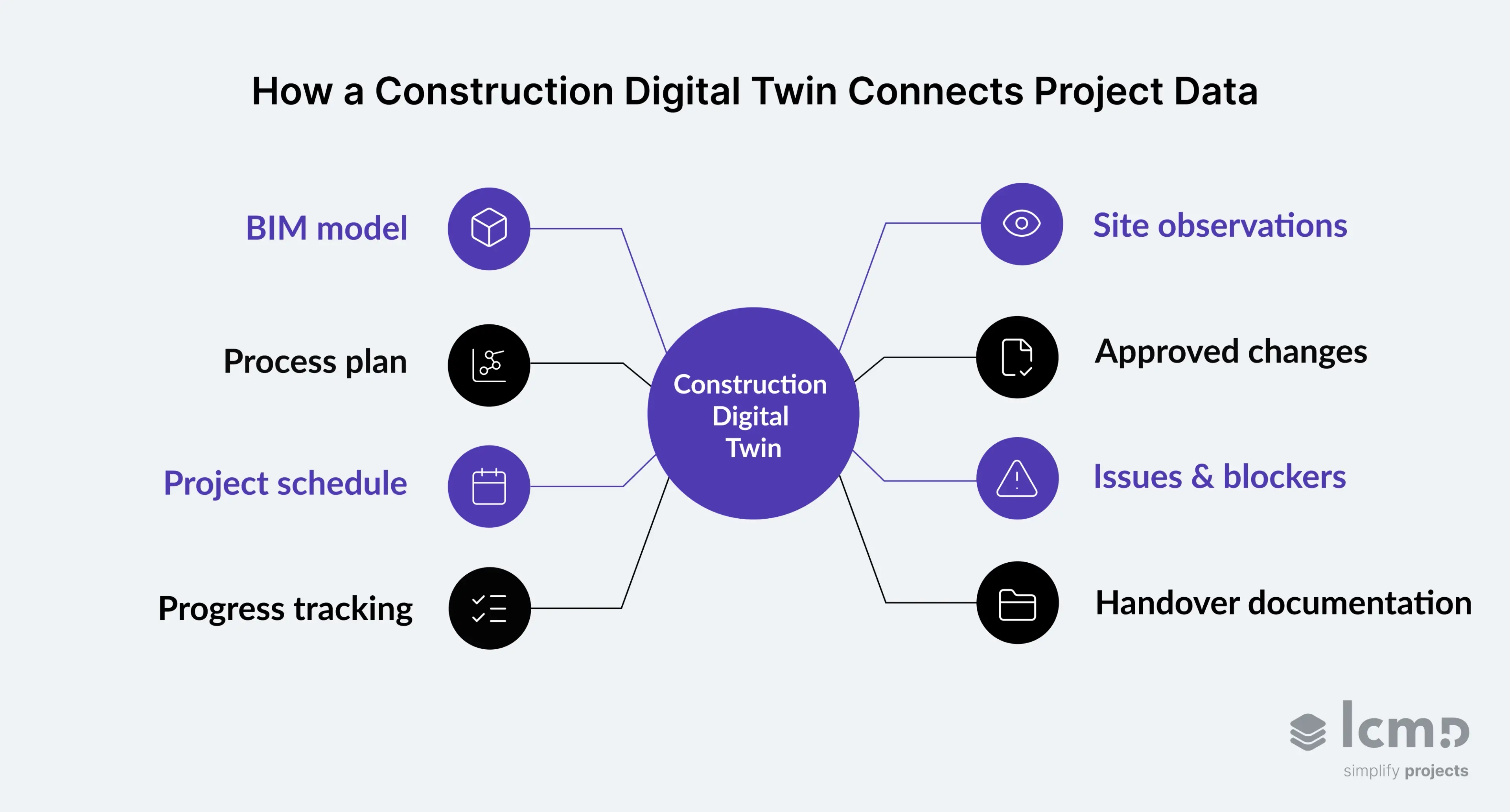
- The strongest digital twins connect BIM, planning, progress, changes, issues, and handover information into one usable project view.
- BIM creates the digital foundation, and the digital twin keeps that foundation active throughout project delivery.
- A construction digital twin creates value when teams understand project change early enough to act.
- For complex projects, digital twins make control more transparent, decisions more grounded, and handover information more reliable.
Some ideas survive because they keep proving their worth. The digital twin is one of them.
The concept behind the digital twin is older than many people assume. NASA traces it back to the Apollo era, describing a “living model” used to understand complex systems from a distance and support critical decisions under pressure.
That is precisely why the idea has found a place in construction. Live projects generate a fast-changing mix of model data, site progress, planning input, and coordination signals.
In that context, a digital twin becomes a practical construction tool for understanding what is happening on site, what is changing, and where project teams may need to act before delays become visible in the schedule.
Digital Twin in Construction, Simply Explained
A digital twin in construction is an up-to-date digital representation of a building, infrastructure asset, or construction process that reflects how the real project is changing over time. It connects the project model with current data from planning, progress tracking, site observations, and approved changes, giving teams a clearer view of how the real project compares with the planned one.
NIST describes a digital twin as:
...a particular type of computer model of a physical system.
It also notes that:
Forecasting is a foundational element across all functions of digital twins.
This expands the definition beyond visual representation. In construction, digital twin technology becomes useful when it reflects real-world conditions closely enough to support interpretation, anticipation, and decision-making as the project evolves.
| Concept | Simple distinction |
|---|---|
| BIM | A structured digital model of the asset |
| Digital twin | A connected, data-fed representation of an asset, process, or system |
| Construction digital twin | A live project view across design, schedule, execution, progress, risks, and handover information |
The strongest signal comes from how project teams are already using digital twins:
- 53% of owners using or mandating digital twins consider them essential to their role.
- Among highly data-centric owners, that rises to 72%.
Together, these signals point in the same direction: construction delivery increasingly depends on connected, reliable project information.
Benefits of Digital Twins in Construction Projects
The benefits of digital twins in construction projects show up in the moments where delivery usually slows down: unclear progress, weak coordination, late issue discovery, and scattered handover records.
The scale of the problem is significant. Autodesk and FMI estimated that poor data may have cost the global construction industry $1.84 trillion in 2020, with poor decisions and rework among the major consequences.
How Digital Twins Improve Project Delivery
1. Clearer construction progress tracking
A digital twin makes planned vs actual progress easier to read. Teams can see which areas are moving as expected, where work is slowing down, and which activities may need attention.
2. Model, schedule, and site data tell one story
When schedule logic, spatial information, and field updates are viewed together, coordination becomes more concrete. Teams can discuss work packages, locations, responsibilities, and dependencies with the same project picture in mind.
3. Blockers become visible before they become delays
Digital twins can make blockers more visible before they become delays. Missing prerequisites, blocked areas, late tasks, or sequencing conflicts are easier to identify when they appear in relation to the plan.
4. Handover becomes asset memory
A digital twin can support a clearer record of what was built, changed, checked, and completed. That gives owners a more reliable information base for handover, operation, and future maintenance.
5. Earlier decisions across project delivery
For owners and delivery teams, the value is better judgment under changing conditions. A digital twin can support sequencing, resource planning, quality control, safety, and later questions around energy consumption or asset performance.
Digital Twin vs BIM: How Are They Different?
BIM is the foundation. The digital twin is the live project view.
BIM organizes the design and asset information. A digital twin connects that information with current project data, making it usable during live execution.
{{comparison}}
The National Institute of Building Sciences points out that the industry still struggles with ambiguity between BIM and digital twins. It explains that BIM provides the foundational digital structure, while a digital twin builds on it with synchronized, dynamic data.
From Design Model to Delivery Intelligence
In practice, BIM captures the intended design. A digital twin reflects how that design evolves during project delivery. It connects the model with planning, field updates, progress information, and delivery data so construction teams can understand the project in context.
BIM’s Measurable Impact on Construction Delivery
The 2021 Dodge SmartMarket report shows the measurable delivery value of BIM. Contractors using BIM reported strong impact in several delivery-related areas:
- 64% reported high or very high impact on reducing constructability issues.
- 64% reported high or very high impact on reducing rework during construction.
- 50% reported high or very high impact on improving the handover experience.
- 51% reported high or very high impact on reducing defects at handover.
A digital twin extends that value by keeping model-based information active as delivery progresses.
Not Every Digital Twin Works at the Same Level
Digital twins vary in depth and capability. Project teams do not always need the most complex version to get value.
At a basic level, a digital twin may show the current state of a building, zone, or asset. At a more advanced level, it can combine model, schedule, progress, sensor, and performance data to support analysis or prediction. Some twins are used mainly to visualize status. Others help teams test scenarios, understand risks, or plan future operations.
How Digital Twins Grow in Capability
The maturity spectrum is usually described in four levels:
- Descriptive: shows what exists or what has been built.
- Informative: adds project or operational data to the model.
- Predictive: uses analytics to anticipate risks, delays, failures, or performance issues.
- Comprehensive: supports scenario testing across a wider asset or project system.
For construction project delivery, the most useful twin connects model, schedule, progress, and issue data well enough to support daily coordination and earlier decisions.
How Does a Digital Twin Work in a Live Construction Project?
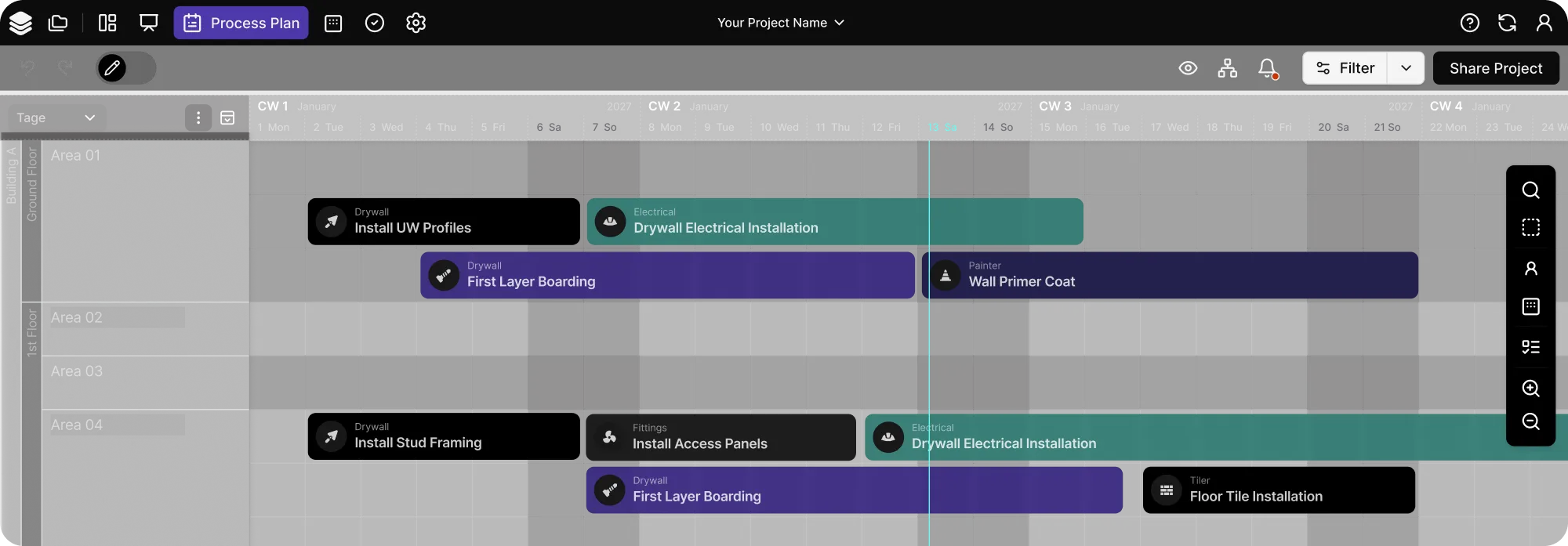
A useful way to understand a BIM digital twin is to look at what it connects during an actual build. The Lcmd example shows what a practical, delivery-focused BIM digital twin can look like in live construction: a connected project view where planning, BIM data, progress, coordination, and decisions come together.
This becomes visible in projects such as Daiichi Sankyo Europe’s expansion of its production and development site in Pfaffenhofen an der Ilm into an international innovation center, with an investment of around €1 billion. The project includes the BioDS building, a key milestone for producing antibody-drug conjugates for innovative cancer therapies.
How Lcmd Connects Planning, BIM, and Delivery Data
For the Daiichi Sankyo Europe project, Lcmd is used as the central construction management platform for digital takt planning and integrates with the Common Data Environment big®. The setup connects process planning, BIM coordination, documents, BCF tasks, schedule processes, and 3D model elements through bidirectional interfaces and automatic mapping.
In practice, this means the digital project plan and the model no longer sit in separate systems. Construction activities can be linked to the relevant model elements, while project teams work from a shared, transparent data basis.
The setup supports:
- visualized construction meetings
- faster decision-making
- successful replanning without disrupting other trades
- earlier conflict detection
- more precise forecasting
- improved schedule reliability
- cost transparency through integrated reporting
Wolfgang Bayer, Head of Construction at Daiichi Sankyo Europe, summarizes the effect clearly: Lcmd and big® connection creates a major gain in knowledge, a shared information base, and better-founded decisions. In his words, transparency “creates trust and enables genuine collaboration.”
This is what a BIM digital twin can look like in practice: planning, model information, coordination, and execution brought into one usable project view.
{{cta}}
Conclusion
A digital twin in construction extends digital models into active use within the physical world. It gives project teams a digital representation that stays relevant as construction processes move forward.
This shift changes how information is used. Models are no longer static references. They become part of resource management, coordination, and decision-making during execution. That creates a foundation where emerging technologies such as artificial intelligence algorithms can build on structured project data instead of fragmented inputs.
The same logic scales beyond individual projects. Connected digital twins will support infrastructure networks, complex assets, and smart city environments where multiple systems interact.
For construction teams, the value shows up in everyday delivery: clearer project control, better stakeholder alignment, and construction processes that remain visible as they evolve. A well-maintained digital twin helps teams understand the project early enough to influence the outcome.
FAQs: About Digital Twins in Construction
When Should a Construction Team Start Building a Digital Twin?
The best time to start building a construction digital twin is during pre-construction. This allows the team to define the BIM baseline, phasing logic, data structure, responsibilities, and progress-tracking approach before work begins on site.
Starting early makes the digital twin more useful during project delivery because the model, schedule, and reporting structure are already aligned when construction starts.
How Large Does a Project Need to Be to Benefit From a Digital Twin?
A construction project does not have to be a megaproject to benefit from a digital twin. Medium-sized projects such as schools, offices, hospitals, industrial buildings, and infrastructure upgrades can gain value when coordination, progress tracking, handover, or stakeholder reporting are complex enough to require a clearer digital representation.
The decisive factor is the level of complexity, dependencies, and data flow that benefits from a connected project view.
Who Actually Uses a Digital Twin on a Construction Project?
Digital twins are used by project managers, construction managers, BIM leads, design managers, owners, and delivery teams. Each role uses the twin differently.
Project managers may use it for progress tracking and reporting. BIM teams may use it to connect model data with execution. Site teams may use it to understand locations, tasks, issues, and dependencies. Owners may use it for transparency, handover, and future asset information.
What Is the Biggest Mistake Teams Make With Digital Twins in Construction?
The biggest mistake is treating the digital twin as a one-time model instead of a living project resource. A construction digital twin loses value when it is not updated with current project data.
To stay useful, the twin needs clear data ownership, regular updates, integration with construction processes, and a practical purpose. With clear data ownership, regular updates, process integration, and a practical purpose, the twin stays relevant for project delivery.
Do You Need IoT Sensors to Create a Digital Twin in Construction?
No. A digital twin in construction does not always need IoT sensors. Many delivery-phase digital twins rely on BIM models, site scans, photos, schedule data, progress updates, and approved changes.
IoT sensors can add value for specific use cases, such as concrete curing, environmental monitoring, equipment tracking, or energy consumption. For many construction projects, however, the first practical step is connecting the model with reliable project and progress data.
BIM
- Structured digital model of the asset
- Strongest in design and coordination
- Shows what should be built
- Supports clash detection and planning
- Creates the digital foundation
Digital Twin
- Connected project view updated with current data
- Strongest in delivery, tracking, and decision support
- Shows how the project is evolving
- Supports progress tracking and earlier issue detection
- Builds on BIM with dynamic project data analytics