

Share this article:



Key Takeaways from this article
- Nearly a third of time on active construction sites is lost time that could be recovered.
- A construction schedule is only as reliable as the work crews are ready to start.
- One late delivery can change the plans, costs and commitments of several trades.
- The reasons behind missed commitments show where next week’s plan is likely to fail.
- The same project manager title can carry very different responsibilities, depending on the employer and contract.
US construction spending reached a seasonally adjusted annual rate of $2.2 trillion in August 2026, according to the Census Bureau. Behind that investment are thousands of projects where budgets, schedules and construction teams have to stay aligned. Construction project managers help turn that enormous flow of spending into progress on site.
What Is a Construction Project Manager?
A construction project manager is the professional who plans, coordinates and supervises a construction project through handover and answers for its cost, time and quality. Working for either the owner or the builder, the construction project manager connects designers, trades and suppliers and resolves constraints before they stop planned work.
Construction Project Manager Responsibilities and Duties
The Bureau of Labor Statistics (BLS) groups construction project managers with construction managers and notes that most of them work from field offices on site. Their work combines technical oversight, people management and commercial responsibilities such as cost control.
The six main duties of a construction project manager are:
- Planning and scheduling. Sequence construction activities, set milestones and plan labor and equipment for each project phase.
- Budget and cost control. Prepare cost estimates, track spending against the budget and flag cost deviations early.
- Subcontractor coordination. Select subcontractors, schedule their work and manage handoffs between trades.
- Site oversight and quality. Oversee site activities with the superintendent and check work against drawings, specifications and quality standards.
- Safety and compliance. Oversee site safety procedures and building code compliance within the manager’s assigned authority.
- Communication and reporting. Report construction progress and budget status to clients and resolve technical or contractual issues with designers and other stakeholders.
The BLS also identifies responding to work delays and emergencies as a typical duty. A single delay can require schedule changes, subcontractor coordination and commercial decisions at once.
How Does a Construction Project Manager Keep Work Moving on Site?
FMI, a construction consulting firm, reports that about 32% of time on active construction sites is recoverable lost time, based on two decades of field studies. A construction project manager’s weekly coordination helps address the conditions behind it.

Reviewing Upcoming Work and Its Constraints
Each week, the project manager and the superintendent use lookahead planning to review upcoming activities. The Lean Construction Institute describes lookahead windows of 3 to 12 weeks, depending on the project.
For each activity, the team checks whether:
- the preceding work is finished
- materials and equipment are available
- the crew can perform the work
- drawings, approvals and access are in place
Anything missing is a constraint, and each one gets an owner and a deadline. An activity counts as ready only once its constraints are cleared. Glenn Ballard, co-developer of the Last Planner System®, described lookahead planning as screening out work that should be done but cannot be.
Making Decisions When Plans Change
Take an illustrative case. A drywall crew is booked for Monday, but the boards will arrive on Wednesday. Moving the date in the schedule fixes nothing on site.
The project manager works through four questions:
- Dependencies. Which follow-on trades depend on this work?
- Alternatives. Can the crew do other ready work on Monday and Tuesday?
- Consequences. What does the delay cost, and who carries it under the contract?
- Authority. Who must approve a change to the sequence, and who needs to know?
If the crew can move to other ready work, the team updates the affected commitments. If not, the project manager raises the schedule and contract impact early, so the responsible parties still have room to decide.
Coordinating Weekly Commitments and Progress
Whatever the team decides feeds into next week’s plan. Under the Last Planner System, the trade foremen who lead the work make the weekly commitments, and the project manager helps make sure each promise rests on ready work.
At the end of the week, the team compares what was promised with what was finished. The reasons behind missed commitments shape the next lookahead. This weekly loop is a core part of progress tracking.
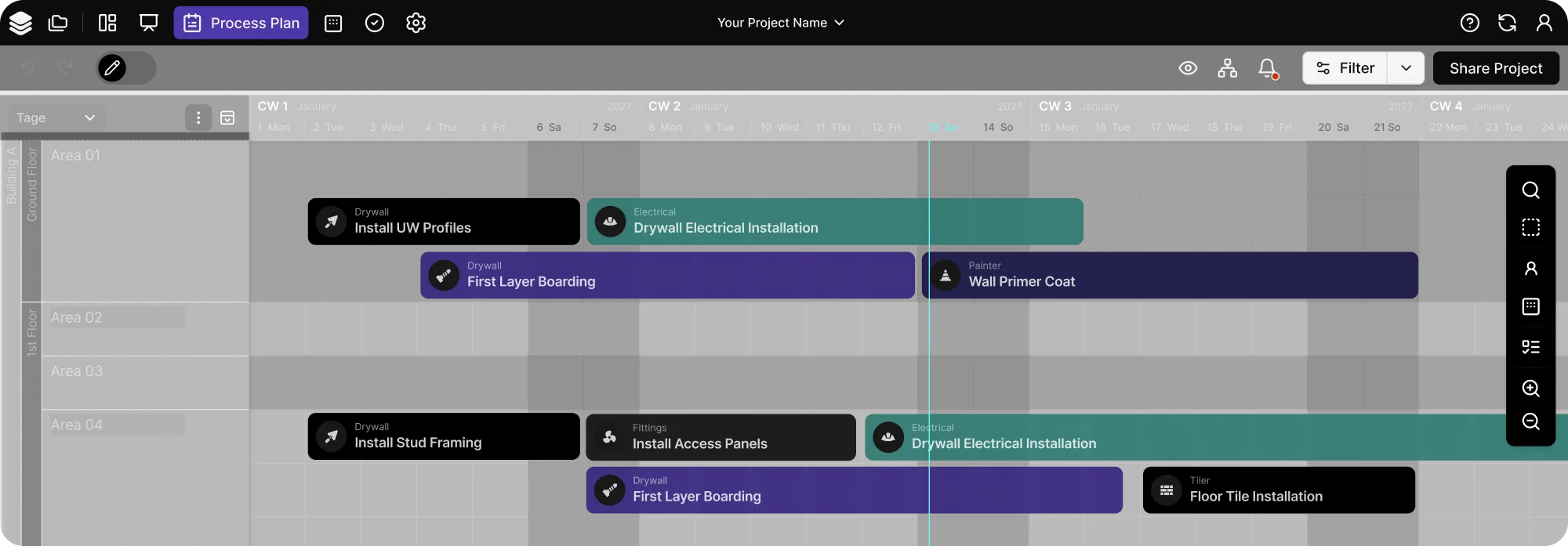
Software keeps the cycle visible when many trades share one plan. In Lcmd, the 4-week lookahead and conflict mode make clashes visible early, and the ToDo Hub shows who owns each task.
{{cta}}
Construction Project Manager, Superintendent and Construction Manager: Who Does What?
Even official US job classifications overlap on these titles. O*NET, the US Department of Labor’s occupation database, lists Construction Superintendent and Job Superintendent among the sample job titles for construction managers, and the BLS notes that construction managers are often called project managers. Many employers use the titles construction project manager and construction manager for the same position.
How the work is split depends on the employer, the contract and the delivery method. The table shows a common pattern in building companies.
On some projects, a separate construction manager sits on the owner’s side. The Construction Management Association of America describes this role as one that represents the owner’s interest and oversees the project directly for the owner.
Whatever the title, the role calls for the same core skills.
What Skills Does a Construction Project Manager Need?
O*NET rates building and construction knowledge at 93 out of 100 in importance for construction managers, the occupation that covers construction project managers. Judgment and decision making shares the top spot among its transferable skills, at 78. Together with the important qualities the BLS lists, these findings point to five essential skill groups:
- Technical construction knowledge. Reading drawings and specifications, understanding construction methods and evaluating work sequences.
- Planning and commercial awareness. Spotting dependencies, investigating cost variances and understanding contract implications.
- Leadership and communication. Delegating responsibilities, coordinating trades and explaining technical decisions to engineers and inspectors.
- Problem-solving and judgment. Weighing alternatives and their consequences when site conditions change.
- Digital information management. Keeping schedules, documents and project records reliable in shared project management software.
What Makes an Effective Construction Project Manager?
An effective construction project manager checks readiness every week, long before crews depend on it. Every constraint cleared in the lookahead window is one less reason for the crew to stop. Project managers who track why commitments slip build more reliable plans on every project they run. A construction project manager’s most valuable output is a plan the site team can build.
FAQ
What Qualifications Does a Construction Project Manager Need?
The typical entry-level education for construction managers, including project managers, is a bachelor’s degree in construction, business, engineering or a related field, according to the BLS. Experienced tradespeople may also qualify after many years in carpentry, masonry or another construction specialty. Some states require a license, and professional certification is optional.
How Much Does a Construction Project Manager Earn?
Construction managers, the BLS category that includes construction project managers, earned a median annual wage of $114,990 in May 2025. The lowest 10% earned less than $69,690, and the highest 10% earned more than $189,440.
What Is the Job Outlook for Construction Project Managers?
Employment of construction managers, including project managers, is projected to grow 9% from 2025 to 2035, much faster than the average for all occupations. The BLS expects about 49,700 openings a year, many of them created as managers retire or move into other occupations.
Is a Construction Project Manager the Same as a General Contractor?
Not usually. The general contractor is typically the company that holds the construction contract, and the construction project manager runs the project for that company or for the owner. The picture changes when an owner hires a construction management firm. The Construction Management Association of America distinguishes two common arrangements:
- Construction management at-risk. The construction manager commits to a guaranteed maximum price and acts as the equivalent of a general contractor during construction.
- Agency construction management. The construction manager acts as the owner’s principal agent and provides management services without the builder’s construction obligations.