

Share this article:
.svg)


.svg)
.svg)

Key Takeaways from this article
- A construction schedule becomes valuable when it keeps guiding decisions long after work begins.
- Schedule reliability comes from the active connection between master planning, lookahead readiness, weekly commitments, and site progress.
- Baseline integrity gives a schedule its authority, protecting the project record through formal approvals and traceable changes.
- Missed commitments and unresolved constraints become early warnings when the schedule stays connected to what happens on site.
- Schedule health reporting gives every stakeholder the level of truth they need to act with confidence.
A construction schedule can be technically perfect and still be useless.
The activities are right. The durations make sense. The critical path is accurate. And still, the schedule may not prevent a single delay once work starts on site.
Most guidance on construction scheduling explains how to build the schedule. Far less attention goes to what comes after: how to keep it credible under change pressure, how to connect the master plan to what actually happens on site every week, and how to make schedule health visible to the people who need to act on it.
That discipline is construction schedule management. Getting it right is what keeps the schedule from slowly becoming a record of what went wrong.
What Is Construction Schedule Management?
Construction schedule management is the ongoing discipline of keeping a construction schedule accurate, credible, actionable, and controlled throughout the full project lifecycle. It covers baseline schedule creation, schedule updates based on actual progress, constraint identification and removal, and schedule health communication for project managers, site teams, and owners. Its purpose is to show where the project stands, what has changed, and what needs to happen next.
Where Construction Scheduling Ends and Construction Schedule Management Begins
Construction scheduling creates the plan. Construction schedule management keeps it useful.
| Construction Scheduling | Construction Schedule Management | |
|---|---|---|
| Focus | Building and structuring the construction schedule | Keeping the schedule accurate, credible, and controlled during execution |
| When it happens | During project planning and early schedule development | Continuously, from kickoff to handover |
| Primary output | Baseline schedule, Gantt chart, CPM network, or project timeline | Updated schedule, constraint log, schedule health reports, and decision-ready updates |
| Key question | What needs to happen, in what sequence, and by when? | Does the schedule still reflect what is happening on site? |
Key Components of a Construction Schedule
The components of a construction schedule determine how manageable it will be once work begins. Define them precisely and the plan can absorb change. Define them loosely and every site problem becomes a schedule problem.
Work breakdown structure
The work breakdown structure divides the construction project into defined packages of work. A high-rise might break down into structural work, facade, MEP, and interior fit-out, each split further into floors or zones. Too broad, and project managers lose visibility. Too detailed, and the schedule becomes difficult to maintain.
Activity sequencing and dependencies
Sequencing defines the order in which project tasks happen. Dependencies define why that order matters. Drywall cannot close before MEP rough-in passes inspection. Screed needs time to dry before flooring starts. A schedule that misses these task dependencies may still look complete in a Gantt chart. Site execution will prove otherwise.
Durations, milestones, and float
Durations need to come from production rates and crew sizes rather than optimism. Project milestones mark the dates that matter contractually, such as weathertight, handover of areas, or commissioning. Float shows how much time an activity can slip without delaying project completion. Knowing the amount and location of float tells a project manager which delays are absorbable.
Resource allocation
A construction schedule is only achievable if crews, equipment, and materials are available when it needs them. Resource allocation checks the schedule against site reality, where resource availability is rarely as clean as the plan assumes: two trades cannot occupy the same shaft, and a single crane cannot serve every zone at once. Contingency plans for critical resources belong here, defined before they are needed.
Baseline schedule
The baseline schedule is the approved version, fixed at a point in time. It is the reference against which actual progress is measured. The working schedule changes continuously. The baseline changes only through a formal, approved process, typically after a major change in project scope. Without a stable baseline, the project team cannot clearly say whether the project is recovering, slipping, or simply being re-planned. Baseline integrity is covered in depth later in this article.
Defining these components is the part of the construction scheduling process most teams know well. Keeping them accurate once the project is underway is what the rest of this article covers.
Types of Construction Schedules
Construction schedules exist at different levels of detail and serve different planning horizons. Some of the types below work together on the same project: the master schedule sets the frame, the lookahead prepares the work, and the weekly work plan commits to it. Others, like CPM, takt, and Line of Balance, differ in the scheduling logic they use to structure the work. The next section covers those scheduling methods in detail.
| Schedule type | What it is | Best used for |
|---|---|---|
| Master schedule | High-level milestones and phases across the full construction project | Executive reporting and contract alignment |
| Lookahead schedule | 4 to 6 week rolling window of upcoming work | Field coordination and constraint removal |
| Weekly work plan | Task-level commitments for the coming week | Trade coordination and daily accountability |
| CPM schedule | Network of activities defining the critical path | Complex projects and contractual requirements |
| Takt schedule | Rhythm-based flow of trades through defined work zones | Repetitive work and lean construction |
| Line of Balance | Output-based scheduling for repetitive activities | Infrastructure, fit-out, and repetitive residential work |
3 Construction Scheduling Methods That Matter Most for Project Control
Construction scheduling methods define the logic behind the schedule. A takt schedule is the output of takt planning, just as a CPM schedule is the output of the Critical Path Method. Beyond the three below, the program evaluation and review technique (PERT) helps estimate uncertain durations, and Earned Value Management combines schedule and cost analysis.
For day-to-day project control, these three methods shape the decisions that keep the schedule usable once work begins.
1. Critical Path Method
The Critical Path Method (CPM) maps every activity and its dependencies into a network, then calculates the longest chain through the project. That chain is the critical path, and any delay on it delays project completion. Most contractual schedules and Gantt charts are built on CPM logic.
- Works best for: complex projects with heavy dependencies and contractual milestone requirements
- What it gives you: a clear view of which activities drive the completion date and where float exists
- Where it struggles: activity-driven by design, CPM says little about trade capacity or workflow. Resource oriented scheduling approaches add visibility into crew flow, capacity, and work continuity.
2. Takt Planning
Takt planning divides the project into zones and moves trades through them in a fixed rhythm, one trade per zone per takt. The result is a steady flow of work instead of crews crowding and waiting on each other.
- Works best for: projects involving repetitive tasks, such as floors, rooms, or modules
- What it gives you: predictable trade flow, early visibility of bottlenecks, stable crew utilization
- Where it struggles: unique one-off work that resists a set rhythm
3. Last Planner System
The Last Planner System (LPS) brings the people who execute the work into the planning process. Trades commit to weekly work plans, and plan reliability is measured through PPC, the share of committed tasks actually completed. Research behind the Last Planner System links higher reliability directly to productivity gains.
- Works best for: projects where coordination between trades decides the pace
- What it gives you: reliable weekly commitments, measured plan reliability, fewer broken handoffs
- Where it struggles: without consistent follow-through on constraint removal, it decays into a meeting routine
PPC could be 100%, productivity excellent, and a project still be falling behind schedule.
Glenn Ballard and Iris Tommelein, Current Process Benchmark for the Last Planner System
That warning makes the point this article is built on: no method manages a schedule on its own. What happens when teams assume it does is the subject of the next section.
Common Challenges in Construction Schedule Management
The scale of the problem is well documented. A McKinsey analysis of more than 500 large construction projects found delays averaging 52 percent beyond the original timeframes. Projects of that scale usually have schedules. The failure often sits in the management process around them.
Research points in the same direction. An empirical study of 195 completed construction projects found that project timeliness depended significantly on management functions such as schedule control, while project complexity and design document quality did not explain the outcomes. Delays usually trace back to gaps in the management process, even on projects that look impossible from the outside.
In day-to-day project control, these gaps often show up in five familiar ways.
- The schedule is updated but not trusted
Updates are treated as reporting tasks, not as planning decisions. - Lookahead plans do not match site reality
Constraints are not identified and removed early enough. - Weekly plans fail repeatedly
Teams commit to work that is not ready, sequenced, or resourced. - The baseline loses meaning
Approved changes and informal re-planning are mixed together. - Stakeholders receive different versions of the truth
Schedule data, field status, and reporting live in separate tools.
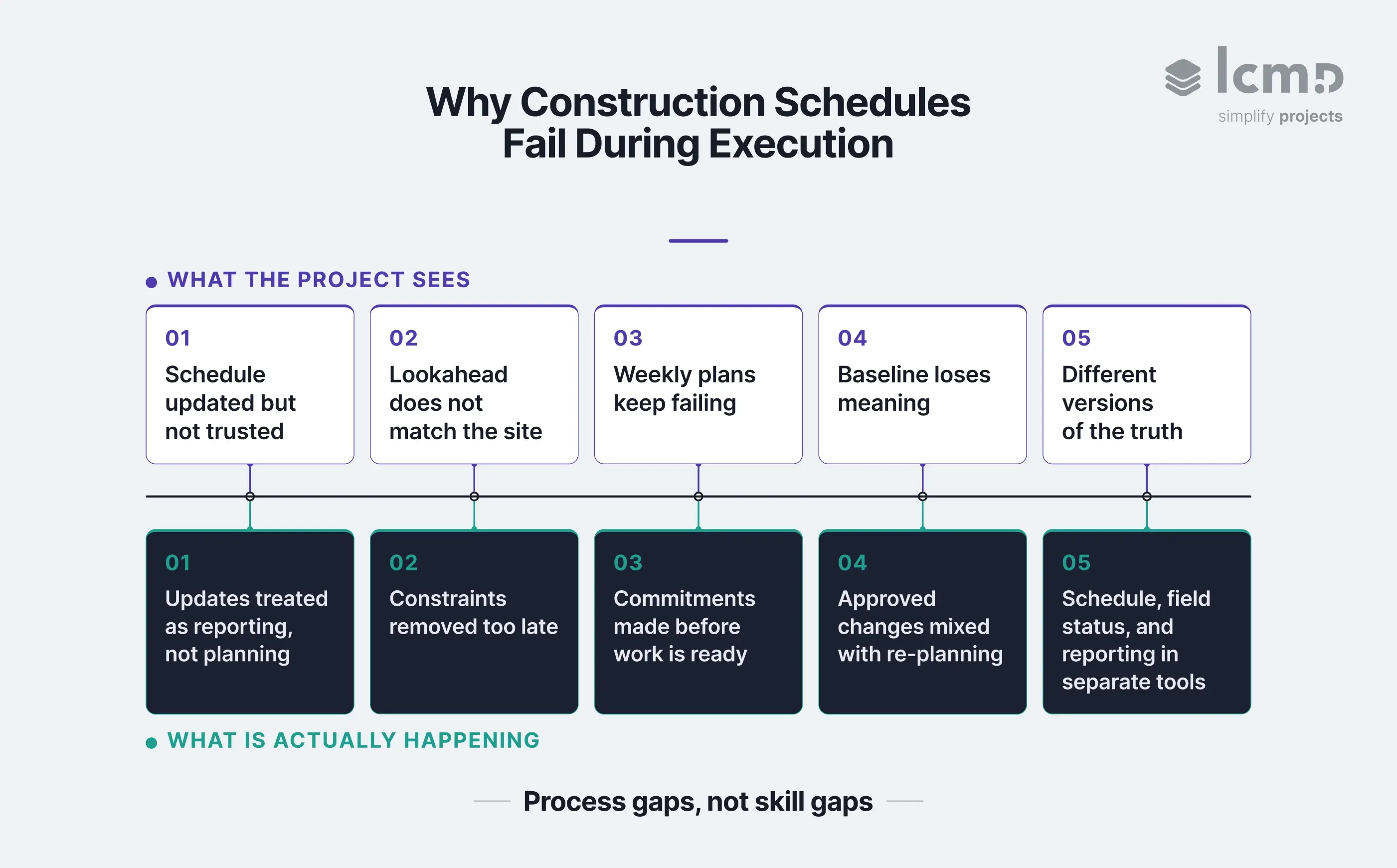
Each root cause points to a weak link in the management process. The next three sections show where that process needs control: across the three schedule levels, in baseline integrity, and in schedule health reporting.
3 Levels of Construction Schedule Management
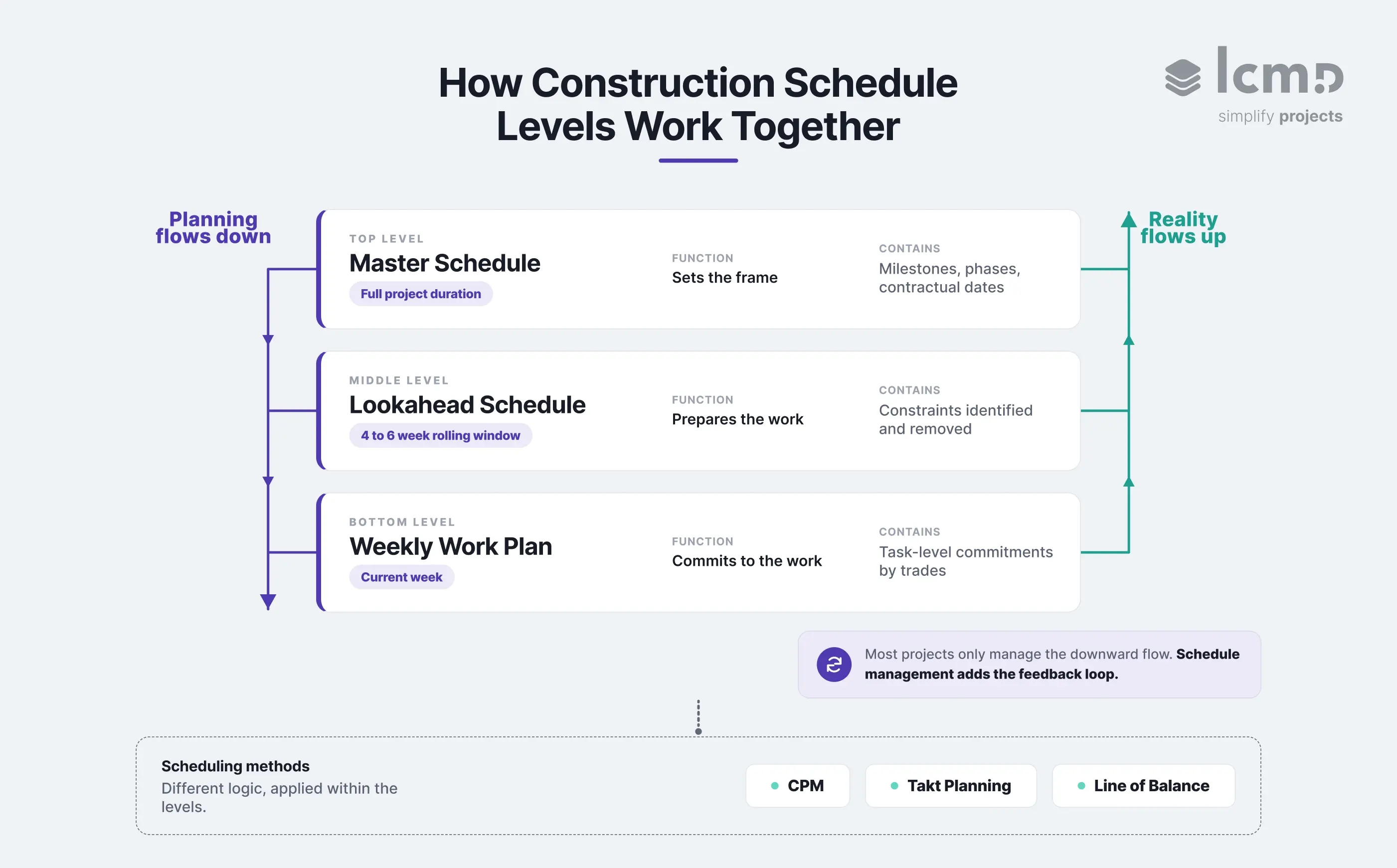
Construction schedule management works across three connected levels. Each one answers a different question, runs on a different cadence, and belongs to a different owner. When the three stay connected, the schedule keeps reflecting the project. When they drift apart, the gaps from the previous section start to appear.
Level 1 - Master Schedule Control
The master schedule sets the frame for the whole project. It holds the milestones, the phases, and the contractual dates, and it is the version executives and project owners look at when they ask whether the project is on track. It does not change week to week. It changes when something significant changes, such as an approved scope change or a major milestone shift, and every change is deliberate.
Master schedule control is mostly about protecting that frame. The job is to keep the master schedule accurate enough to trust without letting it absorb every small fluctuation from the site.
Level 2 - Lookahead Planning
The lookahead schedule is where construction schedule management becomes active work. It covers a rolling four to six week window and its purpose is to make the upcoming work ready. That means working ahead of every task due to start and clearing the constraints that would stop it: missing information, undelivered materials, resource constraints, incomplete predecessor work, or a permit still in progress. Identifying and removing these constraints early, before they become preventable delays, is what keeps the schedule reliable.
The lookahead function is well defined in lean construction research. It links the master schedule to the weekly work plan, shields downstream work from upstream uncertainty, and screens tasks so that only ready work moves forward. This is the level where most delays are either caught or missed.
Level 3 - Weekly Work Planning
The weekly work plan is where the schedule meets the trades. It translates the lookahead into specific commitments for the coming week, made by the trades and field teams who will do the work. Reliability at this level is measured with PPC, or Percent Plan Complete, the share of planned tasks actually finished.
A consistently low PPC is a signal that work is being committed before it is ready, which points straight back to the lookahead level.
Who Owns Each Schedule Level
| Level | Owner | Cadence | Key decision |
|---|---|---|---|
| Master schedule | Project director or lead planner | Monthly or at milestones | Does anything on site change the contractual end date? |
| Lookahead schedule | Construction manager or site manager | Weekly | What must be cleared now so next month's work can start? |
| Weekly work plan | Trade leads and site team | Weekly, tracked daily | What can the trades commit to with confidence this week? |
How Information Moves Between the 3 Schedule Levels
This system works when information moves in both directions. Plans flow down from master to lookahead to weekly. Progress and constraints flow back up. On most projects the downward flow exists and the upward flow does not, which is why the master schedule slowly loses touch with the site.
This is where digital construction management software earns its place. Bringing all three levels into one connected view means a missed commitment at the weekly level is visible at the master level without anyone rebuilding a report. Office and field teams then work from the same live information.
Schedule Management in Practice: Free Evangelical School Dresden
The Free Evangelical School Dresden project, a 30 million euro school build delivered by general contractor OTTO QUAST, shows the three levels working under pressure. Project manager Michael Boss had run the analog Last Planner System for six years before using Lcmd on this project from the planning phase through to completion.
Across the three levels, that looked like:
- Master level: cycle planning structured across the separate building sections
- Lookahead and weekly level: weekly meetings with 8 to 10 trades, with six-week exports used as meeting minutes
- Under disruption: when the building permit was delayed, the affected cycles were re-planned rather than left to cascade
The project was completed on schedule despite the permit delay. This case shows what schedule management is meant to do: absorb a real disruption through active replanning before the delay spreads across the project.
{{cta}}
Baseline Integrity in Construction Schedule Management
A baseline that loses meaning takes the whole project record with it. That starts with what a baseline is actually meant to do.
A baseline schedule does three jobs at once:
- The plan: the approved version of how the construction project was meant to unfold
- The proof: the reference that shows what changed, when, and why
- The shield: the documentation that supports the project team if delays lead to claims
A baseline schedule only does these jobs while it stays intact. Once it is changed to match every fluctuation on site, it loses its value as a fixed reference. Baseline integrity is the discipline of changing the baseline schedule only for a legitimate reason and only through a controlled process.
Legitimate Reasons to Rebaseline a Construction Schedule
Some changes are significant enough that the original baseline no longer reflects a realistic project schedule. In those cases, rebaselining is the correct response.
Legitimate triggers include:
- An approved change in project scope
- A formal time extension under the construction contract
- Major resequencing of the work
- A disruption outside the project team's control, such as force majeure
Formal Change Control Keeps the Baseline Clean
The principle that keeps a rebaseline clean is formal change control. Professional scheduling guidance, including AACE International's recommended practice on documenting the schedule basis, treats the schedule basis as a life-cycle document that is referenced and updated through the project's change management process. It may also be used in claims situations to illustrate a change of scope.
In practice, that means the change is approved before the baseline moves, the reason is documented, and the original baseline is never deleted. It is superseded and kept on record, so the project always has a traceable history of how the plan evolved.
Baseline Changes That Damage Schedule Trust
The more common risk is changing the baseline when it should stay fixed. A baseline must not be moved to absorb ordinary slippage, make a delayed project look on track, or adjust completion dates informally without approval. Each of these weakens the baseline's value.
The cost shows up later. A baseline that has been altered to hide delay cannot show what was originally planned, and it offers little protection when a claim arises. Project owners lose trust in a schedule that keeps shifting underneath them.
The discipline is simple to state and harder to hold: the working schedule changes as often as site reality demands, and the baseline changes only when project scope, contract requirements, or approved completion dates formally change.
How to Report Schedule Health to Different Stakeholders
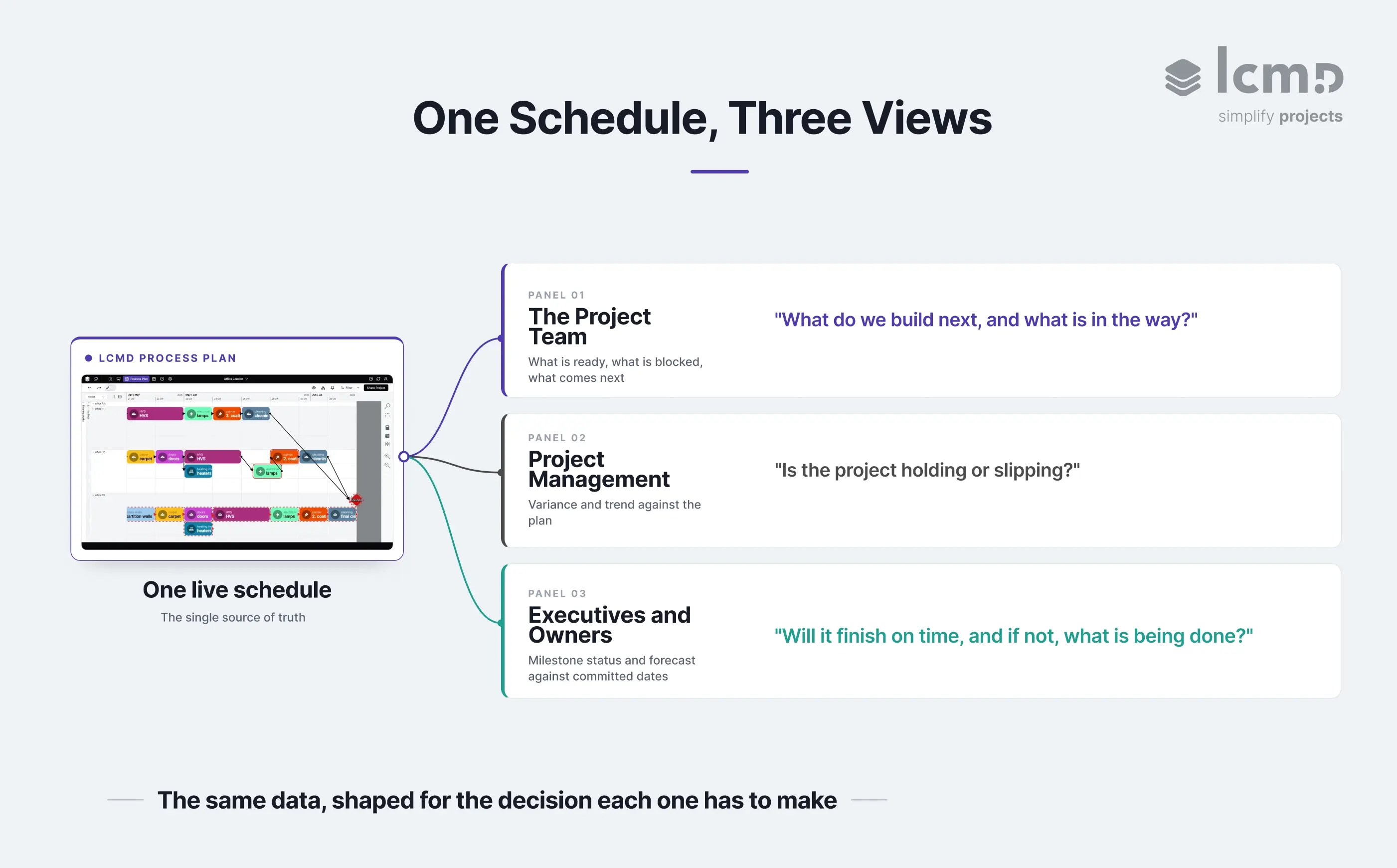
One schedule has to become usable information for each stakeholder group. A site team needs to know what to build next. An owner needs to know whether the handover date is still safe. Reporting schedule health means translating one schedule into the view each audience can actually act on.
Sending everyone the same Gantt chart is the most common reporting mistake. The foreman drowns in milestones that do not affect this week, and the owner cannot find the one date they care about in a wall of activities.
For the Project Team: Which Schedule Tasks Are Ready and What Is Blocking Them?
For the project team, schedule health is practical. It shows which tasks are ready, which constraints still block work, where trades conflict, and what has changed since the last coordination meeting.
This level of reporting supports daily and weekly coordination. Site teams need to know what can start, what must wait, and which handoffs need attention. Office and field teams also have to stay aligned when updated drawings, material deliveries, inspections, or access conditions affect the weekly work plan. Too much detail slows this group down. What they need is clear task status, blockers, responsibilities, and short-term priorities.
For Project Managers: Where Is the Schedule Drifting From the Plan?
Project management reporting shows how actual progress compares with the plan, and whether the project is trending toward its dates or away from them.
This includes variance against the baseline, critical path movement, lookahead readiness, and trends that may affect completion dates. A single missed task may not matter. A repeated pattern of missed commitments, delayed handoffs, or unresolved constraints does. Project managers need reporting that shows where the schedule is becoming unstable and where intervention is required, whether that means resequencing work, clearing constraints, reallocating resources, or escalating a decision before the overall project timeline is affected.
For Project Owners and Executives: Does the Schedule Still Protect the Handover Date?
As a project owner or executive, you do not need raw scheduling data. You need decision-ready summaries.
At this level, schedule health should show milestone status, forecast against the baseline, major risk signals, and what is needed to protect key project goals. The most useful reports do not overwhelm project owners with every activity in the schedule. They show whether committed dates remain realistic, what has changed, and where management attention is required. For executive management, the question is whether the project is still on course, which risks need action, and whether the current forecast can be trusted.
This is where connected construction management software strengthens schedule communication. When schedule data, site updates, constraints, and reporting live in one system, the same live schedule becomes easier to read at every level of responsibility. For teams with established analytics workflows, a Power BI connection can extend that schedule-health view into their existing analytics stack.
Conclusion
Every project has a schedule. The ones that hold their dates are the ones where that schedule keeps shaping decisions long after the work begins.
Construction schedule management is what keeps it doing that. It gives the master schedule, the lookahead, the weekly work plan, the baseline, and reporting a single shared purpose: helping the project see where it stands with enough time left to act. The plan describes the intended path. Managing it is how a team knows, early enough to matter, when that path has to change.
Schedule reliability is built in that management discipline, week after week. It runs from the site meeting all the way to the owner report.
FAQs
What Is the Difference Between a Construction Schedule and a Construction Program?
A construction schedule is the detailed timeline of project activities, task durations, dependencies, milestones, and completion dates. A construction program is the broader delivery plan that organizes project phases, procurement, resources, and overall strategy. The two terms are sometimes used interchangeably, but the schedule is usually the more detailed project control document used to manage sequencing, progress, and timing.
How Often Should a Construction Schedule Be Updated?
A construction schedule should usually be updated weekly during active execution. Lookahead planning and weekly work planning are typically refreshed every week, while the master schedule is reviewed monthly or at key milestones. Critical site activities may need daily tracking. The schedule should also be updated whenever actual progress, resource constraints, or project decisions require current information.
What Is Float and Why Does It Matter in Construction Schedule Management?
Float is the amount of time an activity can be delayed without delaying project completion or a key milestone. In construction schedule management, float shows where the project has scheduling flexibility. Project managers use float to identify which delays can be absorbed, which tasks affect the critical path, and where intervention is needed to protect completion dates.
What Does PPC Mean in the Last Planner System?
PPC means Percent Plan Complete. In the Last Planner System, PPC measures the share of planned tasks completed as promised during a planning period, usually one week. For example, if a project team commits to 20 tasks and finishes 16, the PPC is 80 percent. PPC helps measure plan reliability and shows whether weekly commitments are realistic, ready, and coordinated.
How Does BIM Connect to Construction Schedule Management?
BIM connects to construction schedule management by linking model information with time, sequencing, and project planning. When schedule data is connected to a building model, project teams can visualize construction phases, identify sequencing conflicts, and communicate planned work more clearly. This is often called 4D BIM. Its value depends on keeping the model, schedule, and site updates aligned.
What Is the Role of the Schedule in Construction Claims?
The schedule supports construction claims by showing what was planned, what changed, and how delays affected the project timeline. A reliable baseline schedule, regular updates, and documented changes help project teams explain delay events, time extensions, resequencing, and impacts on completion dates. The schedule is strongest in claims when it has been managed consistently as a traceable project record.
What Makes a Construction Schedule Reliable?
A construction schedule is reliable when it reflects real project conditions, uses realistic task durations, includes clear dependencies, and is updated through a controlled process. Reliability also depends on constraint removal, resource availability, baseline integrity, and honest reporting of actual progress. A reliable schedule helps project managers, site teams, and project owners understand what is ready, blocked, and needs attention next.