

Share this article:
.svg)


.svg)
.svg)

Key Takeaways from this article
- Pull Planning changed construction planning by making coordination, commitments, and flow reliability more collaborative and more visible in daily work.
- Sticky note boards start to lose strength when planning has to remain traceable, connected, and reliable across more teams, timelines, and projects.
- Digital Pull Planning proves its value when it preserves planning logic and keeps coordination current after the workshop ends.
- As Pull Planning scales, software quality starts to shape execution directly by determining how well commitments, dependencies, and updates stay connected.
- Reliable project delivery depends on more than strong planning sessions. It depends on a planning system that carries alignment into daily execution and keeps project flow intact.
A wall full of sticky notes can look productive. For many teams, it signals progress.
Pull planning changed how construction teams coordinate work. It brought trade partners into the conversation, aligned commitments, and made Lean construction more visible in day-to-day planning.
Yet many general contractors still run into the same scheduling problems even after a strong pull planning session.
The workshop may get teams onto the same page in the moment, but keeping that shared plan intact through execution is often where things become harder. To understand where that tension comes from, it helps to look at what pull planning changed in the first place.
How Pull Planning Reshaped Lean Construction
The shift from traditional scheduling to Lean construction changed planning behavior.
Traditional CPM planning focuses on logic networks and durations. Lean construction puts more weight on commitments, coordination, and flow reliability.
The Last Planner System® gave this shift a practical structure. Teams moved away from centralized scheduling toward collaborative planning. In practice, a typical pull planning session asks teams to:
- Define a milestone
- Work backward
- Identify dependencies
- Clarify handoffs
- Commit to deliverables
How the Last Planner System Supports the Collaborative Planning Process
This structure supports:
- Lookahead planning
- Weekly work planning
- Tracking Percent Plan Complete (PPC)
- Basic constraint management
The wall becomes a shared reference point. Field teams gain ownership. Coordination improves.
That collaborative strength is exactly why pull planning became such an important part of Lean construction. At the same time, many teams discover that what works well in the session becomes harder to manage once the plan has to stay usable across weeks, teams, and projects.
Why Sticky Notes Limit Pull Planning at Scale
Sticky notes work well for building alignment in the room, but they are harder to rely on once planning has to hold up over time, across teams, and across projects.
As projects grow, the distance between a successful workshop and reliable day-to-day control becomes more noticeable. That is where avoidable friction starts to build in construction planning.
Where Sticky Notes Create Friction in Construction Planning
Physical boards create visibility in one location, but they are much harder to maintain as a reliable construction planning system over time.
The friction tends to appear in five predictable areas:
- Planning history disappears
Sticky notes move or get replaced. Teams lose traceability, and leaders can no longer review how decisions were made. - Integration gaps grow
Physical boards rarely connect cleanly to the master schedule, so teams often end up managing parallel planning systems. - Manual updates consume time
Boards need to be rewritten and adjusted regularly, which adds avoidable work to the planning process. - Scale becomes harder to manage
One wall may work for one team in one place, but it does not support multi-project planning or broader portfolio visibility very well. - Collaboration stays local
Anyone outside the room has limited access to the plan, which makes wider coordination harder to maintain.
In the end, the result is usually the same: coordination weakens, teams fall back into reactive planning, and the structure built in the workshop starts to fade.
How Digital Pull Planning Extends Planning Beyond the Workshop
Sticky notes still support strong pull planning sessions. The harder part is maintaining that alignment once execution begins.
What Analog Boards Do Well in Pull Planning
Physical boards increase participation, make the sequence easier to discuss, and encourage stronger trade involvement. They help teams work backward from shared milestones and build ownership early in the planning process.
That is why pull planning works so well in the room. The limitation appears later, when the plan has to stay current, accessible, and reliable over time.
{{comparison}}
As projects become more complex, teams need a way to keep planning connected beyond the workshop. That is where digital pull planning starts to prove its value.
Why Digital Pull Planning Strengthens Collaborative Construction Planning
Digital pull planning adds structure that helps teams keep the plan aligned during execution.
In practice, digital pull planning helps teams by:
- Preserving planning history
- Connecting lookahead planning to the master schedule
- Giving distributed teams one central, up-to-date planning source
- Making commitments visible in real time
- Maintaining structured dependencies across tasks and teams
- Keeping planning logic visible
These benefits strengthen collaborative construction planning across field teams, project managers, and leadership. They also make it easier to respond when one task slips, because downstream impacts are more visible and coordination can happen earlier.
With that structure in place, teams can carry pull planning into day-to-day execution with more consistency and less manual coordination.
Connecting the Last Planner System to a Digital Last Planner System
The Last Planner System gives teams a practical framework for commitments, coordination, and follow-through. A digital version helps keep that framework usable when planning has to stay current across teams, timelines, and reporting layers.
Linked lookahead plans, structured constraint tracking, and more reliable percent plan complete make it easier to see where flow is holding and where risk is starting to build. Superintendents gain clearer visibility into current commitments, project managers spend less time consolidating updates, and leadership can spot patterns across projects earlier.
A digital Last Planner System does not change the method. It helps teams apply it with more consistency once the wall is no longer enough.
Signs Your Projects Have Outgrown Sticky Note Pull Planning
Most teams notice the shift through repeated patterns rather than one obvious breaking point.
Boards need to be rebuilt more often. Lookahead plans begin to drift from the master schedule. Portfolio visibility depends on manual reporting. Trade coordination requires repeated clarification, and performance reviews rely on incomplete planning data.
When those patterns start to stack up, they usually point to a planning environment that is no longer strong enough to support the method at the scale the project now requires.
What It Takes to Support Pull Planning at Scale
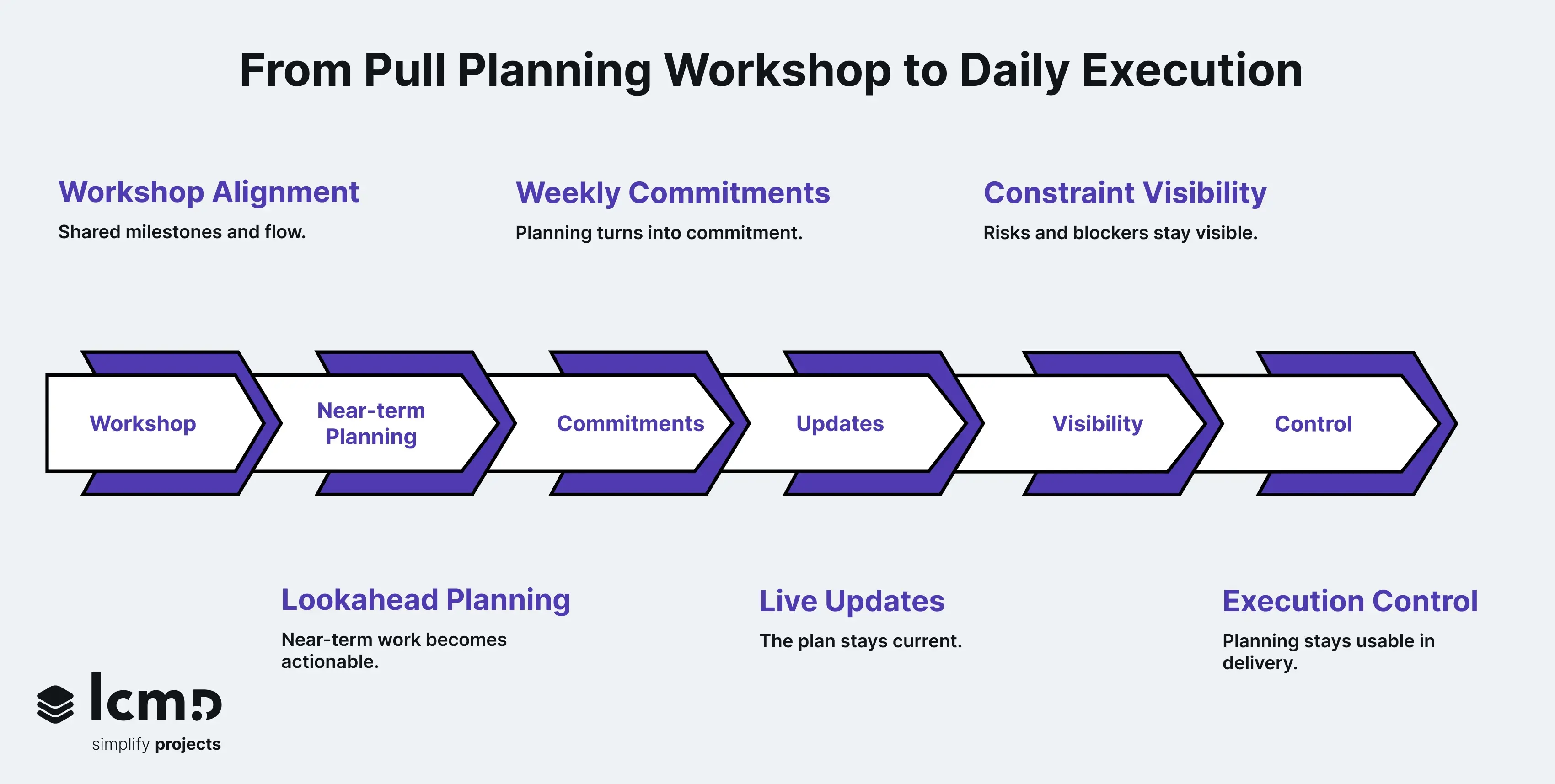
Once pull planning has to hold up across more teams, timelines, and projects, the quality of the software starts to influence execution much more directly. At that point, the real test is whether the system helps teams keep the planning process clear, connected, and reliable during execution.
What Lean Construction Software Needs to Support
Strong Lean construction software should support the planning logic behind the process. That includes the ability to:
- Mirror backward planning logic
- Connect lookahead plans to weekly commitments
- Track reliability through measurable indicators
- Preserve decision history over time
Where Pull Planning Software Proves Its Value
Reliable pull planning software should make coordination easier to maintain once more teams, updates, and dependencies are involved. That means helping teams:
- Work from shared visual boards
- Manage milestone tracking in one connected environment
- Respond through real-time updates
- Maintain visibility as oversight needs to scale
When software supports the method well, construction teams spend less time maintaining the planning system and more time acting on current information. That matters because effective pull planning depends on more than initial alignment. In complex projects, teams need digital tools that keep communication active, schedule logic connected, and coordination reliable as work moves forward.
Why Digital Planning Depends on More Than Visibility
Moving planning off the wall does not automatically make it more effective. In construction management, the real challenge is keeping commitments, dependencies, and updates connected between planning sessions and daily execution. Strong project outcomes require more than early alignment. They require a planning process that stays usable through project delivery.
But not every digital layer solves that problem equally well.
Why Excel Still Falls Short in Construction Planning
Many teams move from sticky notes to spreadsheets expecting a practical upgrade. In reality, Excel often changes the format more than the planning process itself. It can document tasks, dates, and ownership, but it does little to support the live coordination pull planning depends on once work starts shifting across trades and handoffs.
The limits usually become visible in three areas:
- Dependencies stay weak when changes in one task do not clearly reshape the work around it.
- Updates stay manual when teams have to rebuild logic instead of working from one connected plan.
- Visibility stays limited when project managers and field teams cannot rely on the same current view of project progress.
Excel can support documentation, but it rarely supports the kind of active construction management needed between planning sessions. That is why it often falls short not at the moment of planning, but in the daily work that follows.
Why CPM and Pull Planning Need to Stay Connected
CPM and pull planning serve different functions, but they lose value quickly when they stop working together.
In construction management, CPM provides a stable view of major milestones, sequencing, and overall schedule logic. Pull planning helps manage the near-term commitments, coordination, and adjustments that shape day-to-day execution.
The real risk appears when those layers drift apart. A master schedule may still look stable while the actual pull planning process is already absorbing repeated changes, workarounds, and missed handoffs in the field.
When CPM and pull planning stay connected, teams gain much more than cleaner reporting:
- Lookahead planning stays tied to major milestones
- Project progress is easier to interpret in context
- Teams can respond earlier to potential delays
- Project outcomes improve because coordination supports the schedule instead of competing with it
That connection is what helps digital planning contribute to lean project delivery rather than become another disconnected planning layer.
Bringing Digital Pull Planning into Daily Execution
If your organization already runs pull planning sessions but still faces recurring construction planning problems, the issue may not be the workshop itself. It may be the planning environment around it.
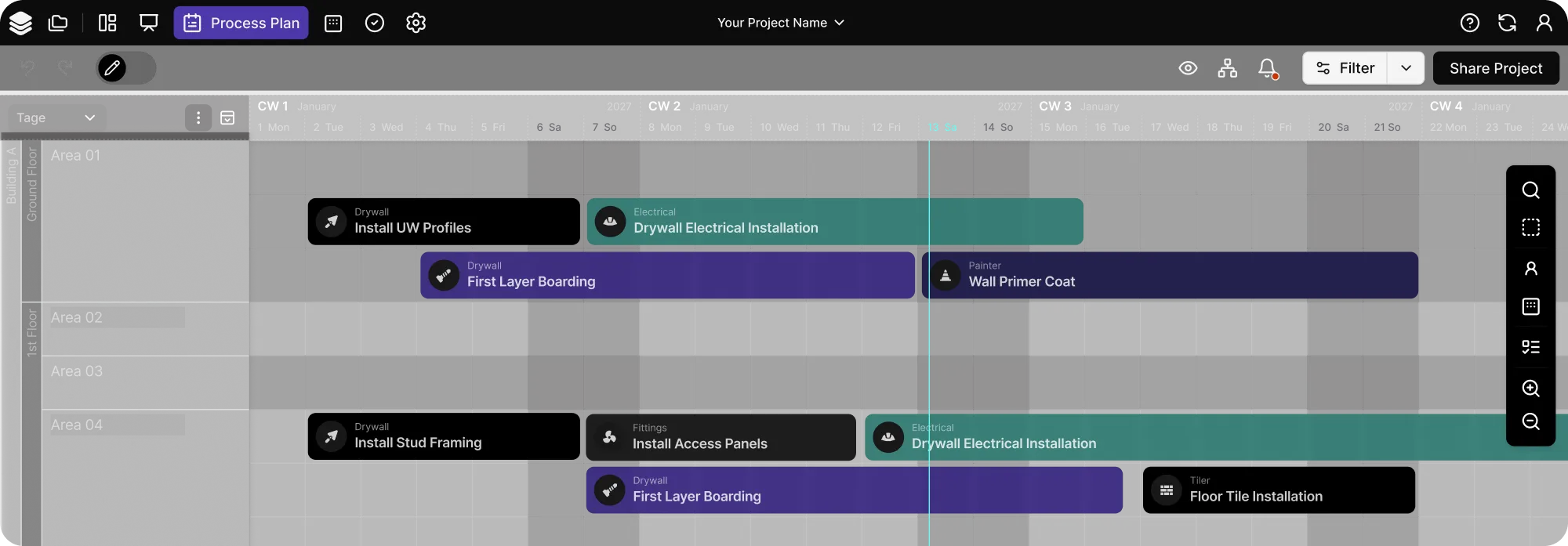
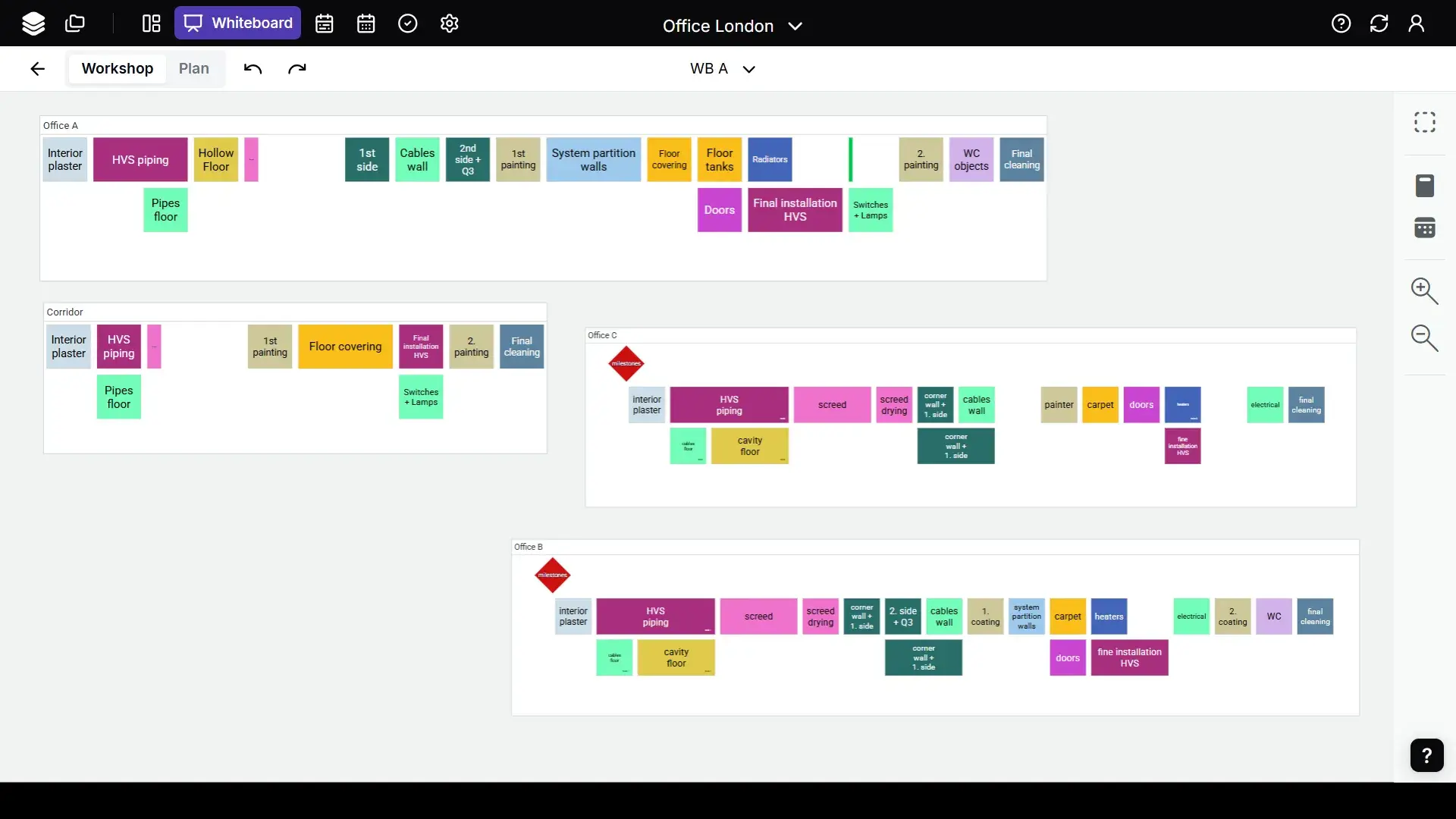
That is where Lcmd can support the process more effectively. It connects lookahead plans to weekly commitments, keeps planning and control visible in real time, and supports coordination across distributed teams. That helps teams carry pull planning into daily execution rather than leaving it behind in the workshop.
Conclusion
Pull planning changed construction planning by bringing coordination closer to the people who actually shape the work. It made planning more collaborative, more visible, and more grounded in real handoffs, commitments, and short-term decisions.
The limits of sticky notes appear when that planning has to stay usable beyond the session itself. As projects become more complex, planning quality shows up in how well commitments hold, how clearly handoffs remain connected, and how reliably teams can respond as work starts to shift.
That is why the real value of pull planning is not exhausted in the workshop. It continues in the quality of execution that follows. Good workshops create momentum. Strong planning systems decide how far that momentum goes.
{{cta}}
FAQs
How Do You Run a Successful Pull Planning Session?
A successful pull planning session starts with clear project milestones, the right team members, and a shared view of dependencies. It works best when trade partners build the sequence together and leave with reliable commitments, not loose assumptions.
How Does Pull Planning Support Project Milestones and Project Completion?
Pull planning supports project milestones by working backward from key dates and connecting them to real handoffs and near-term commitments. That makes project completion more predictable because teams can spot gaps before they affect delivery.
How Does Pull Planning Connect to Lean Construction Principles and Continuous Improvement?
Pull planning supports lean construction principles by improving collaboration, visibility, and commitment reliability. It also supports continuous improvement because teams can review what was planned, what was completed, and where the process needs adjustment.
How Do You Measure Success in Pull Planning?
Success in pull planning is measured by how reliably teams turn planning sessions into completed work. Common indicators include Percent Plan Complete, planning stability, clearer project status, and fewer disruptions between weekly meetings.
Why Does Pull Planning Matter for Problem Solving and Day-to-Day Construction Management?
Pull planning matters because it helps teams identify conflicts, missed handoffs, and coordination gaps before they grow into delays. In daily construction management, these practices improve problem-solving, keep workflows more stable, and support better decision-making.
Analog Boards
Best for workshop alignment
- increase participation
- improve planning clarity in the room
- encourage trade involvement
- help teams build early ownership
Digital Systems
Best for execution continuity
- preserve planning history
- connect lookahead and master schedules
- support distributed coordination
- enable live updates across teams