
Share this article:
.svg)


.svg)
.svg)

Key Takeaways from this article
- Project controls preserve the time in which a construction outcome can still be influenced by making deviations visible early enough to act.
- Schedule, cost, risk, and change create a reliable project outlook when they stay connected to the same controlled baseline and current project data.
- Key performance indicators become useful when their movement changes the forecast, triggers investigation, or informs the next project decision.
- A strong controls cycle keeps current performance, the forecast, and corrective action connected from one update to the next.
- AI and automation can accelerate project controls by reducing manual handling and surfacing patterns, while reliable data and clear ownership keep the resulting decisions grounded.
An approved plan gives a construction project its reference point. From the first day of execution, new evidence changes the picture around it. Project controls keep that changing position measurable while there is still time to influence the outcome.
What Is Project Controls in Construction?
Construction project controls are the practices that measure a project against its baseline and combine schedule, cost, risk, and change data into a forecast of the likely outcome. They guide corrective action before deviations become costly.
Where Project Controls Sit Within Project Management
Project controls are the analytical processes within project management, described by APM as a specialization of core project management skills.
Project management covers the whole of delivery. Alongside that analytical work, it also carries:
- Contracts and commercial agreements
- The project team and the people doing the work
- Resources, procurement, and site logistics
- Stakeholders and client expectations
- The decision itself, and responsibility for its consequences
Project controls produce the evidence. The wider project management function weighs it against everything on that list and decides what happens next.
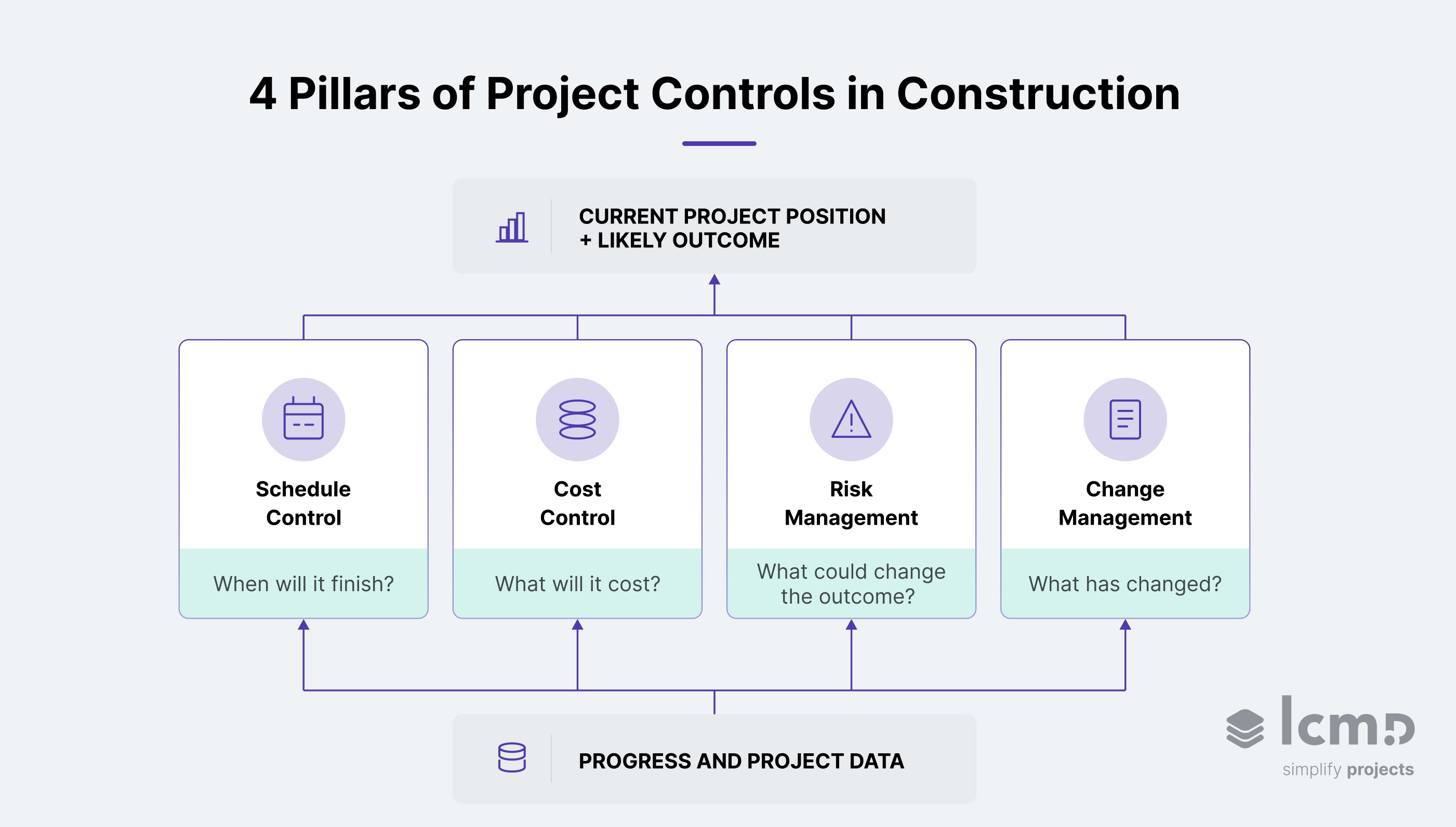
Core Pillars of Construction Project Controls
A construction project generates cost and schedule data from several disciplines at once, and none of it shows the full picture on its own. A site delay can shift cost exposure and risk before the next schedule update even records it. Effective project controls exist to catch that shift while it's still small enough to manage.
Schedule Control
Schedule control measures current progress against the baseline schedule and forecasts how that performance is likely to affect the finish date. When an activity slips, what matters is how far that slip travels through the rest of the project schedule, whether the available float absorbs it or the critical path itself moves.
Paperwork status and site status don't always match, and that mismatch is a common source of drift in day-to-day schedule management. It can stay hidden until dependent work has already moved off schedule.
Cost Control
Cost control compares current spending and forecast costs against the approved budget, so the team can see where the final number is heading. Cost performance index, drawn from earned value management, measures cost efficiency by dividing earned value by actual cost. A CPI below 1.0 means the work completed has cost more than its budgeted value.
That early signal is what gives a team room to act before the number becomes fixed. It only holds up when the underlying cost data stays complete and current, with direct and indirect costs reconciled against the budget and cash flow as work proceeds.
Risk Management
Risk management identifies, assesses, and manages uncertainty that could alter project objectives, whether that's the schedule, the budget, or safety on site. As new project data arrives, those assumptions need revisiting, since a risk that looked minor at kickoff can grow once work is underway.
45% of construction firms still manage risk one project at a time, and over 60% rely on Excel alone or combined with other tools to do it, according to Lumivero's 2025 Global State of Risk Report.
Change Management
Change management controls how a departure from the approved project scope gets assessed, approved, and carried into the project's cost and schedule data. A design revision or an unexpected site condition can shift several of those numbers at once.
Work often starts before the paperwork catches up. In Dodge Construction Network's 2026 research on change order processes, 97% of trade contractors reported beginning work on some change orders before they were approved.
What matters for project controls is that every approved change reaches the baseline, the budget, and the schedule. Without that connection, the controls picture no longer reflects the work the project has formally accepted.
Key Performance Indicators in Project Controls
Key performance indicators in project controls are a small set of recurring measures that track cost, schedule, risk, and change performance against the baseline. Each answers a narrow question well, and each has a blind spot worth knowing before it reaches a report.
| Indicator | What it measures | Blind spot |
|---|---|---|
| Schedule performance index | Whether earned progress keeps pace with the plan | Weights all activities equally, so non-critical progress can mask a critical path delay |
| Cost performance index | Cost efficiency on work completed | Says nothing about how the remaining work will behave |
| Estimate at completion | Expected final cost if performance continues | Assumes today's rate holds, which an approved change breaks |
| Total float | How far an activity can slip before a milestone moves | Only as sound as the schedule logic beneath it |
| Percent complete | How much scope has been delivered | Rarely defined the same way twice |
| Risk exposure | How the severity of open risks is moving | Silent on risks nobody has registered |
| Change exposure | Cost and schedule effect of logged changes | Work often starts before approval |
An indicator earns attention when its movement triggers a predefined response. No single one carries a project on its own. They are read together, on a repeating cadence, which is what the controls cycle exists to do.
The Project Controls Lifecycle
Once the baseline is approved, project controls run as a repeating cycle, and each of those four disciplines feeds it. Every step below repeats on a set cadence throughout the project lifecycle.
- Capture actual performance. What the work has produced since the last cycle, across progress, cost, risk, and change.
- Compare it against the baseline. Where current performance has moved away from the approved plan, and by how much.
- Analyze what the variance means. Whether it is growing or closing since the last cycle, and what it puts at risk next.
- Update the forecast. What today's performance means for the finish date and the final cost if it continues.
- Decide and act. The variance goes to whoever owns the decision, with the options attached: correct it, escalate it, or accept the new outlook.
- Feed the result back. Corrective actions and approved changes both enter the next cycle. Where an approved change alters the baseline, the authorized revision stays traceable to the version it replaced.
Step six keeps the comparison current without losing its history. The next cycle tests what happened after the decision against the controlled project position.
What that cycle produces, turn after turn, is the one thing a construction project cannot buy back later.
Why Project Controls in Construction Matter
Why project controls are important in a construction project comes down to one thing: the time they create between detecting a deviation and absorbing its consequences. A schedule slip caught in week two can still be resequenced. By week six, the same slip has already reshaped project costs, resource allocation, and the completion date. In CMiC and Dodge Construction Network's 2026 Project Controls Study, 41% of contractors said they can identify a potential overrun while it is still manageable on at least half of their projects.
That decision time is one of the key benefits of effective project controls. They help project managers protect project objectives by turning current project performance into three practical advantages:
- Early warning. A cost or schedule variance surfaces while corrective action can still influence the project outcome, before the delay or overspend becomes embedded in the plan.
- One shared reference point. Cost and schedule data, risk information, and current progress trace back to the same baseline, giving project teams and project stakeholders a consistent basis for decisions.
- A forecast worth trusting. Forecasts built from tracked, up-to-date project data give teams a clearer view of likely project outcomes and enough confidence in them to commit resources towards successful project delivery.
Getting that visibility to the right person at the right time is what reporting does inside a project controls system.
How Reporting Fits Into Project Controls
Project controls and reporting are two connected functions. One measures and interprets project performance. The other, reporting, turns it into something specific for each audience, a weekly variance summary for the site team, a monthly forecast for the client. The two functions work together like this:
| Function within project controls | What it does |
|---|---|
| Measurement and analysis | Tracks performance, variance, risk, change, and forecast outcomes |
| Reporting | Packages the relevant controls information for the people who need to understand or act on it |
Cadence, format, and audience decide how much of that early-warning window a project team can still use.
Common Challenges in Project Controls
A project controls system can exist on paper and still fail in practice, and a recurring reason is data silos. Schedule updates live in one tool, cost tracking in another, and progress photos in a third, so a project can report on-track progress while its budget drifts out of control, with nobody positioned to see both pictures at once until the gap is too large to close.
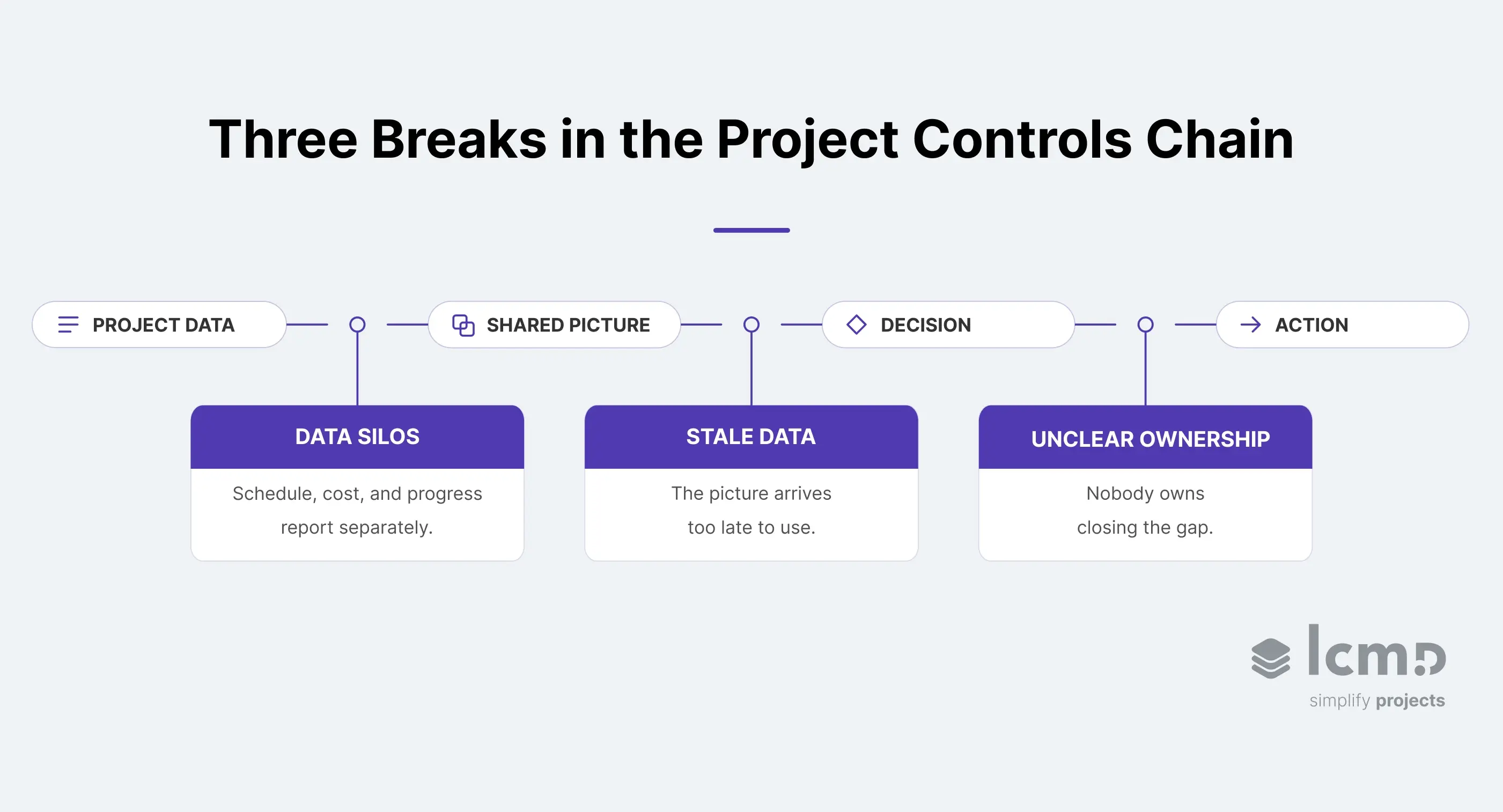
That gap is measurable, and it's bigger than most teams assume. In Autodesk and FMI's 2021 study of more than 3,900 construction professionals, 30% said more than half of their project data was bad enough to produce poor decisions. Each handoff between the site, the schedule, commercial teams, and the controls function creates another opportunity for information to arrive late or lose context, and delayed data loses its value before anyone acts on it.
Even with a process in place, unclear responsibility can weaken the system. A baseline that's never formally reviewed, an update cadence nobody enforces, a report nobody is required to turn into a decision, each looks like a small gap on its own, but nobody actually owns closing any of them. Together, they explain why a fully built system can still miss the deviation it was meant to surface.
Which raises the next question directly: who is actually responsible for keeping a project controls system working?
Who Manages Construction Project Controls?
Construction project controls span several roles, with a controls lead or equivalent keeping schedule, cost, risk, and change responsibilities aligned across the disciplines that own them. Titles differ from company to company.
A typical division of responsibility looks like this:
| Role | Main responsibility within project controls |
|---|---|
| Project controls manager | The controls approach, update cycle, and consistency across disciplines |
| Project controller | Data integration, variance tracking, and the consolidated forecast |
| Scheduler or planning engineer | Schedule logic, progress updates, float, and critical path |
| Cost controller or commercial team | Budget, actual and forecast cost, cash flow, and the cost of change |
| Risk manager or risk owner | The risk register, and reassessment as conditions change |
| Project manager | Delivery decisions, coordination of corrective action, and confirming it is closed out |
Every point where information passes between these roles needs an owner. Controls information only earns its place when someone keeps it current, someone tests what it means, and someone is accountable for the action that follows.
AI and Automation in Project Controls
Automation is reaching the repeatable handling inside the controls cycle first, importing progress updates, recalculating metrics, and refreshing reports that used to be assembled by hand. AI extends that by searching larger volumes of project data for patterns and anomalies.
Adoption is running behind the conversation. In CMiC and Dodge's 2026 study, only 19% of contractors rated AI a high priority, and only 6% reported a fully connected project controls environment.
Those two numbers belong together. AI becomes more useful as the project data underneath it becomes connected, current, and consistent enough to support reliable analysis.
What to Look for in a Project Controls Solution
AI and automation can shorten the cycle. The solution underneath still decides how quickly reliable project data reaches the people who can act on it. Seven questions are worth asking when evaluating construction project controls software.
- How early does a deviation surface? Key performance indicators, variance thresholds, and alerts earn their place when they draw on current data and surface a problem while project managers still have room to respond. Ask what triggers a warning and what has to happen before it fires.
- Where does current progress come from? Information recorded by the people doing the work is the shortest route into the plan. Each handling step it passes through on the way can add age before it reaches the plan.
- Can current performance be compared with the baseline without rebuilding the comparison each cycle? Rebuilding that comparison by hand makes frequent updates harder to sustain.
- Does the wider project data connect? Schedule, cost, risk, change, and field information usually start in different systems. A controls solution should bring the relevant parts together while the specialist tools keep doing what they were built for.
- Can you trace what changed and why? Recording that a date moved is only part of it. The reason, the supporting evidence, and the previous position should all stay traceable.
- Does a control signal reach an owner? A variance has limited value until someone reviews it and takes responsibility for what happens next. Ownership, corrective action, and close-out should stay visible from the moment it surfaces.
- Does automation reduce handling without weakening control? Data transfers, recurring calculations, and report assembly are strong candidates. AI can then search connected project data for patterns that deserve attention, provided the information underneath stays reliable.
Every one of these asks whether the system ends in a decision. Connected construction management software earns its place by shortening the path to that decision. That is the test that survives the demo.
{{cta}}
The Real Measure of Project Controls
A construction project becomes less changeable every week it runs. Project controls preserve the window in which the outcome can still be influenced.
Maintenance is the hard part. Maintaining a controlled baseline produces nothing visible when it succeeds, so a controls system that is working looks like a project where nothing has gone wrong. That is what makes it easy to stop doing. Reports keep arriving on time long after they have stopped describing the project, and the gap only shows when a forecast is challenged and nobody can reconstruct how it was reached.
Automation moves the information faster. Whether it deserves trust is still a judgment someone makes.
A project controls system is worth what it can still change. Everything it reports after that point is history.
Construction Project Controls FAQs
What is a project controls baseline?
A project controls baseline is the approved reference that actual project performance is measured against. It brings together the approved scope, budget, and baseline schedule for the work being controlled. A formal change can revise it, and each revision stays traceable to the version it replaced. Without a controlled baseline, variance has no stable point of comparison.
What is a project controls plan?
A project controls plan defines how a construction project will be measured, forecast, and governed. It sets the baselines the work is tracked against, the update cycle, and who is responsible for acting when a deviation appears. Agreeing those rules early gives every discipline the same reference points before performance data starts driving decisions.
When do project controls start on a construction project?
Project controls should start during design or pre-construction, as soon as scope, cost, and schedule information is defined enough to establish baselines. Those baselines give later measurements a reference point, so waiting until site work is underway can leave the project's earliest performance harder to evaluate reliably.
Do project controls apply to smaller construction projects?
Project controls apply to smaller construction projects at a reduced scale. One person may maintain the schedule, review cost information, and coordinate updates without a dedicated controls function. What stays the same is the discipline: a controlled baseline, a consistent update cycle, and clear responsibility for acting on deviations.