
Share this article:
.svg)


.svg)
.svg)

Key Takeaways from this article
- Construction project reporting earns its place in project control when every report carries a clear responsibility, cadence, and decision path.
- Late field reports reduce the lead time teams need to protect the sequence, the handoffs, and the people waiting to start.
- Effective construction reporting gives project managers the early pattern recognition needed to spot schedule pressure, cost drift, resource strain, and unresolved constraints while intervention is still possible.
- Owner and executive reporting builds delivery confidence by making milestone realism, budget exposure, risk signals, and pending approvals visible when decisions carry the most weight.
- Connected reporting transforms project data into a live evidence system — the foundation for accountability, informed decisions, and successful project outcomes.
Construction projects generate reports at every level: daily logs, progress updates, cost reports, safety records, inspection notes, and management summaries. The challenge is knowing which of those reports actually helps someone make the next decision.
Which report matters to whom, when should it be reviewed, and what decision does it drive? If that question keeps resurfacing in your projects, you are in the right place.
What Is Construction Project Reporting?
Construction project reporting is the structured translation of accurate project data into decision-ready information for construction project stakeholders. It gives project teams, project managers, owners, and executives a clear view of the project’s current status at the cadence, format, and level of detail their role requires. Effective construction reports connect progress, schedule, cost, safety, quality, risk, and resource information so each stakeholder can see what has changed, what needs attention, and what action comes next.
Construction Reporting as a Project Control Discipline
Project management research has linked effective communication with stronger schedule and budget performance. A separate global construction study of more than 3,900 professionals estimated that inaccurate, incomplete, inaccessible, inconsistent, or untimely project data may have cost the industry $1.85 trillion in 2020, including $88.69 billion in avoidable rework.
As projects become more complex, distributed, and fast-moving, reporting has less room for delay, gaps, or ambiguity.
Timely, accurate construction reporting is therefore a core project control discipline. It depends on progress data that is current, specific, and trusted.
How Progress Tracking Feeds the Construction Project Reporting Process
Construction progress tracking captures what is happening on site. Construction project reporting turns that into the information stakeholders use to decide what happens next.
| Aspect | Construction Progress Tracking | Construction Project Reporting |
|---|---|---|
| Key question | What has happened, what is blocked, and what changed? | What does the latest project data mean, and what needs a decision? |
| Role | Captures current site activity and task status | Organizes project data into decision-ready information |
| Typical information | Completed work, open tasks, blockers, handoffs, crew updates, material status | Project status, schedule variance, cost movement, risk flags, safety notes, quality issues, decisions needed |
| Main users | Field teams, site managers, construction managers | Project managers, project owners, executives, key stakeholders |
| Output | Daily reports, Lookahead updates, progress updates | Construction reports, Dashboards, progress reports, cost reports, management summaries |
Safety personnel document incidents, inspection findings, and compliance information on site. That data feeds into the broader construction reporting process where it becomes part of the project's current status and risk picture.
Construction Project Reporting Across the Project Team
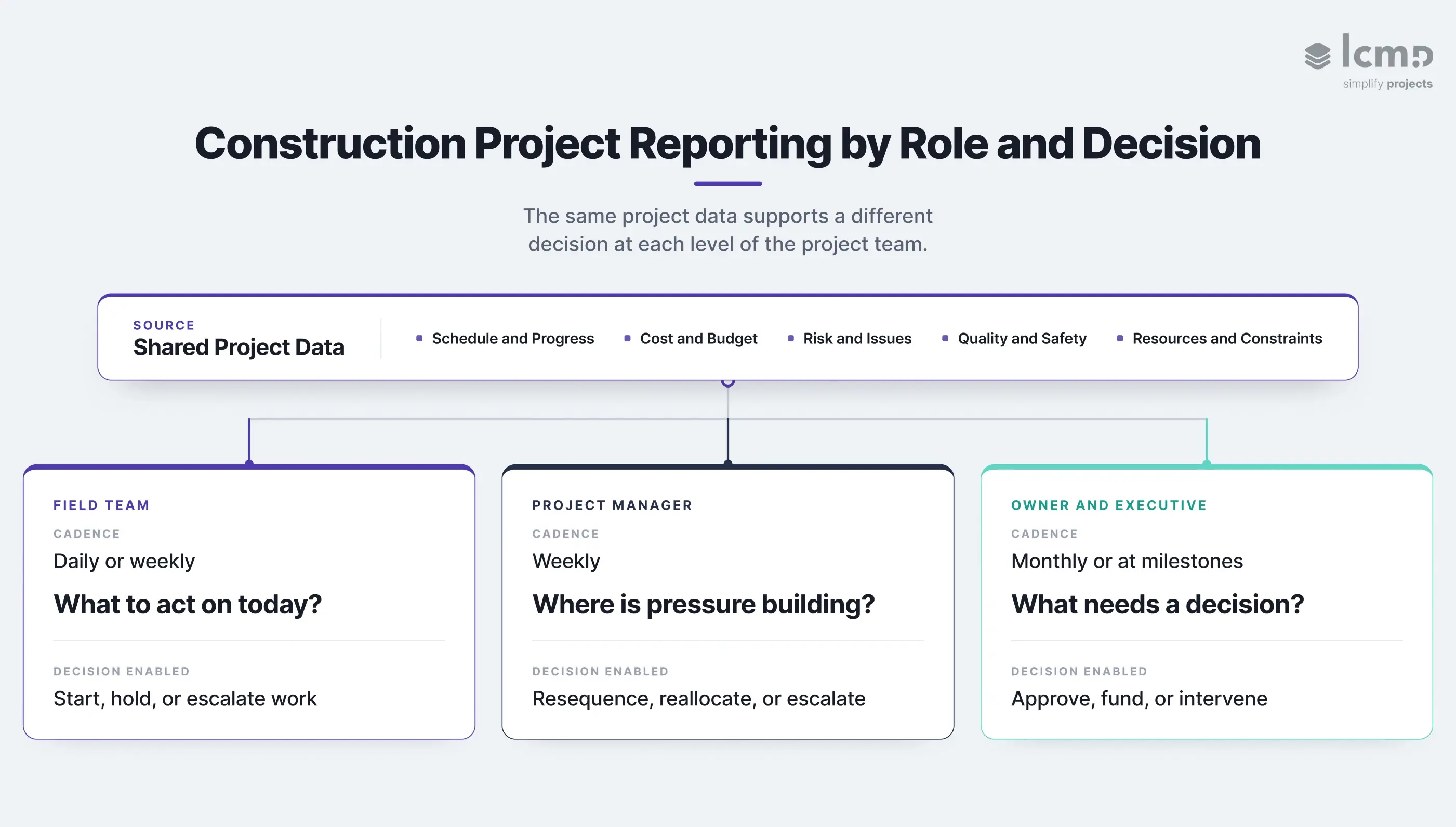
A construction report is only as useful as the responsibility it serves. The same update lands differently depending on who receives it, when they need to act, and what decision it has to support. The real work is deciding what deserves attention now, for this reader, at this review cycle. That is what turns project data into control.
Field Team: Reporting at the Point of Work
What to act on today?
Construction managers and site teams need to know what to start, what is blocked, and what needs a handoff before the day begins.
At field level, information that no longer matches the site is what actually slows work down. Daily reports that are time-consuming to produce and incomplete by the time they are read leave crews working from yesterday's picture of a construction site that moved overnight. A field report that arrives late is already wrong.
Useful field reporting is tight, current, and task-specific. It should show:
- What the lookahead confirms as ready to start
- Where constraints around crews, equipment, construction materials, site safety, or access are blocking progress
- Which coordination issue needs resolving before it disrupts the sequence
- What has changed since the last plan update
If it does not help someone decide what to start, hold, or escalate today, it adds overhead at the point of work.
Project Manager: Reporting Against the Plan
Where is pressure building?
Project managers need to see whether the project is becoming less stable — and early enough to act. On most projects the data exists. It lives across schedules, updates, meetings, and daily reports, but reaches the project manager too late or in fragments. When reporting does not surface the right signals, coordination meetings multiply to fill the gap.
Useful reporting for project managers shows trend and variance against the plan. It should make these signals visible:
- Schedule movement and missed dates
- Cost drift and budget variance
- Recurring blockers and unresolved constraints
- Resource allocation issues affecting delivery
- Risk flags that are building rather than resolving
- Key performance indicators that reflect actual project performance
A single missed commitment may be noise. A pattern of missed commitments across two or three weeks is a control signal. Reporting that shows where pressure is building gives project managers the lead time to act while the problem is still small enough to contain.
Owner and Executive: Reporting That Arrives Before Risk Escalates
What needs a decision?
Project owners and executives need to know whether committed milestones are still realistic, where budget exposure is growing, and which risks require attention or approval before they affect delivery.
At this level, delayed or incomplete management reports create uncertainty at exactly the wrong moment. When updates arrive late or in fragments, change requests lose context, risks become harder to absorb. The financial consequences can reach far beyond the project team — delayed revenue, budget overruns, and missed delivery commitments.
Useful owner and executive reporting compresses project complexity into decisions. It should show:
- Milestone status against the baseline and committed dates
- Budget variance, cost exposure, forecast to completion, and approved changes
- Change requests and their impact on schedule and budget
- Risk flags that require owner or executive attention
- Pending approvals and decisions needed for informed decision making
- Portfolio-level visibility across multiple active projects
For construction companies, this level of reporting builds confidence that committed dates, financial exposure, and critical decisions are visible before they affect delivery.
Knowing what each audience expects from reporting does not guarantee the process behind it can keep pace.
From Manually Compiled Reports to Connected Construction Reporting
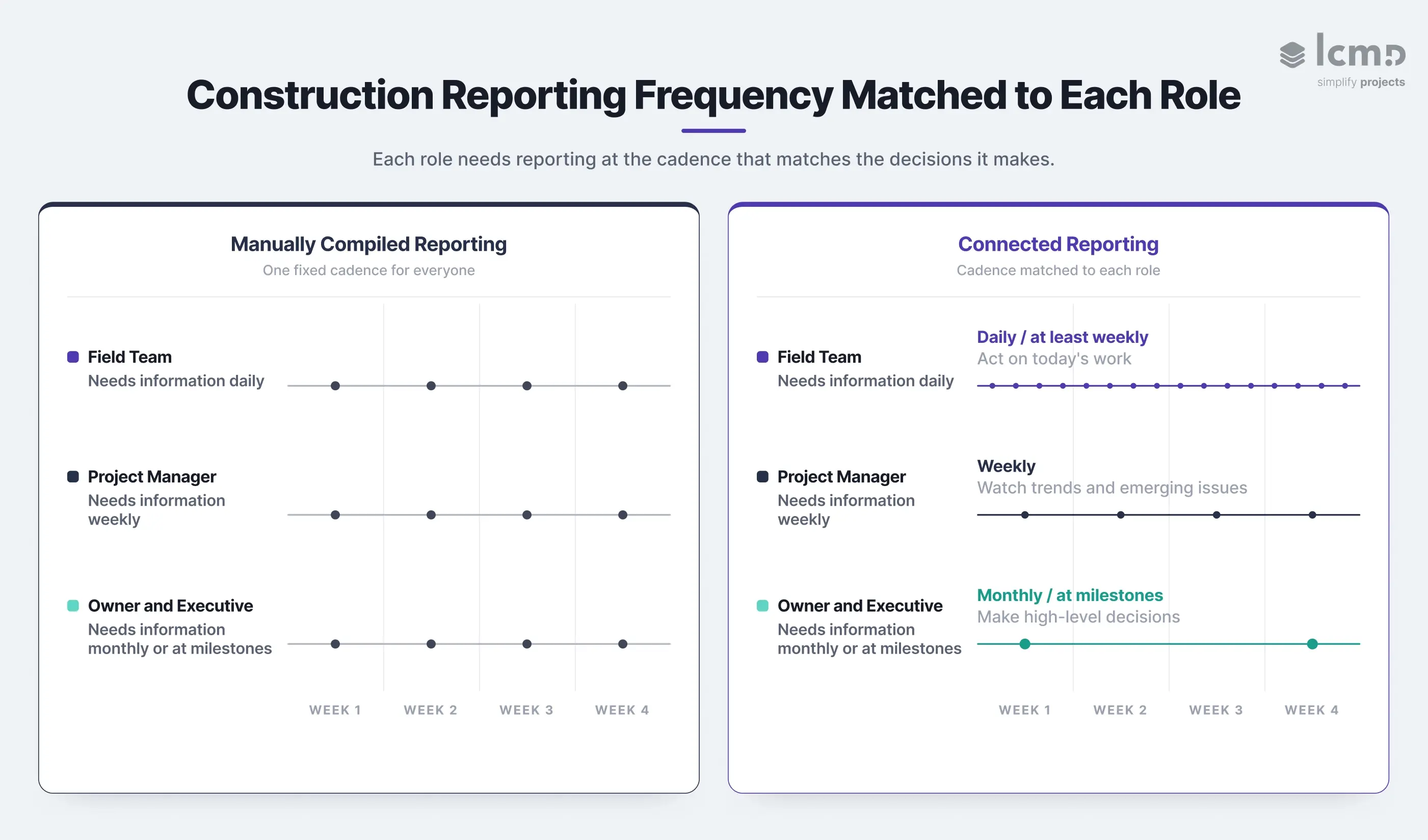
Most construction teams already have a reporting process. Recurring status updates are compiled by hand, pulled from schedules, spreadsheets, meeting notes, daily reports, cost data, and risk logs, then formatted and sent on a fixed cadence. That workflow creates a delay between what the project knows and what the report can show. A study of nearly 600 construction leaders found that miscommunication and poor project data account for 48% of all rework on US construction jobsites, costing the industry more than $31 billion annually.
3 Gaps in Manual Construction Reporting
Even well-intentioned manual reporting creates three consistent problems:
- Reports arrive stale. Compiled from data that is already days old, the report reflects a project that has already moved on.
- Inconsistency erodes trust. Different reporters emphasize different things. Owners cannot compare management reports across weeks, projects, or teams. Without a standard, the report becomes a personal interpretation rather than a shared picture of project reality.
- Live data is missing. When a construction report cannot be verified against the current schedule, budget, constraint log, or risk register, the reader cannot act on it with confidence.
What Connected Reporting With Lcmd Makes Possible
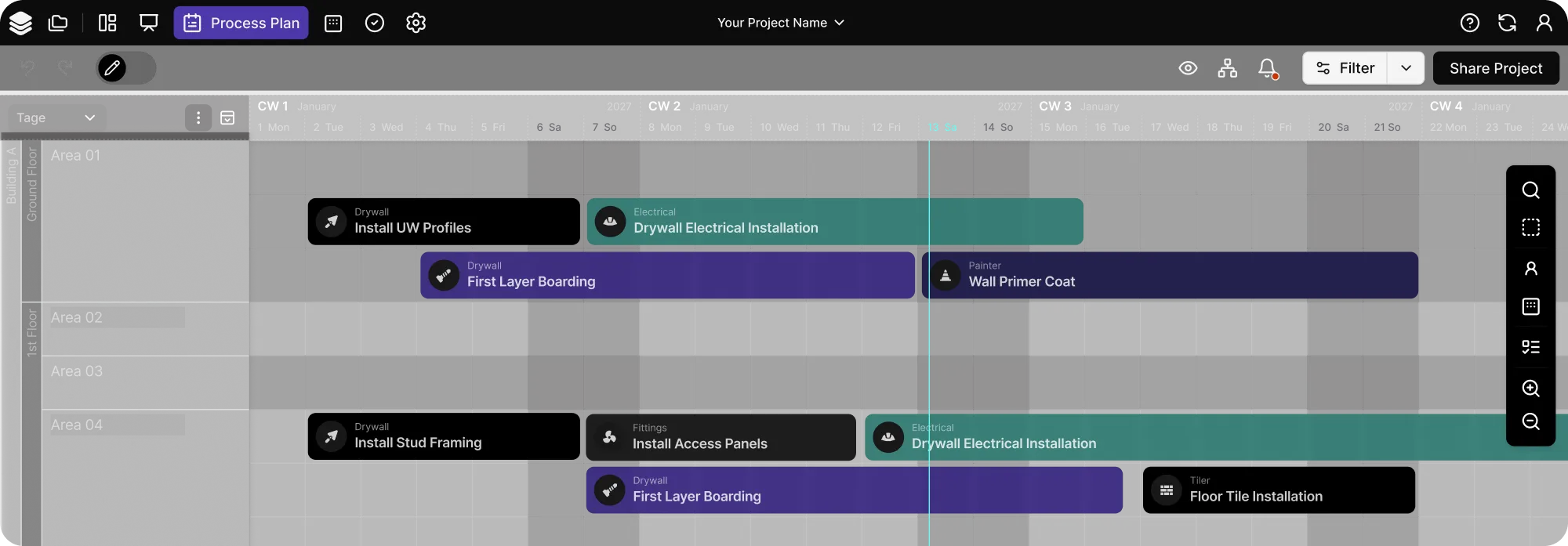
Project management software built around a live project plan can change this. Lcmd is a construction project management platform built this way. It automates the reporting cycle and updates dashboards automatically as conditions change on site, so each audience sees current, role-specific information without anyone building a report by hand.
Aggregating schedule, cost, quality, and risk data into one reporting layer eliminates parallel spreadsheets, version conflicts, and outdated snapshots, giving each audience role-specific visibility from the same single source of truth.
Lcmd supports this shift as a digital construction management software platform built around live project data:
- Field teams work from a live task view that updates as conditions change on site
- Project managers catch schedule pressure and cost drift before it reaches the master schedule
- Project owners receive milestone and delivery risk signals without chasing status updates
- Executives maintain portfolio visibility across all active projects from one connected platform
Automated reporting tools reduce the manual reporting cycle and keep project information current and easier to verify. For construction companies with existing analytics workflows, Power BI integration extends that visibility across projects and portfolios - without anyone rebuilding a report from scratch.
{{cta}}
Conclusion
Construction reporting is the evidence system behind the project. Long after a meeting is over or a site decision has been made, the report is what remains.
Regular construction reports create the rhythm that keeps stakeholders aligned — combining quantitative data with visual clarity so that progress, cost, and risk stay visible, and teams have the real-time access they need to resolve issues while resolution is still straightforward.
That record, sustained across every reporting cycle, is what keeps a project in control when complexity and pressure are highest.
FAQs
What Is the Difference Between a Construction Progress Report and a Project Status Report?
A construction progress report captures field-level activity such as completed work, active tasks, blockers, labor, equipment, weather conditions, and daily logs. A project status report turns that information into a management view of project status, schedule variance, budget exposure, risks, and decisions needed. The progress report feeds the status report.
What Should a Construction Project Report Include?
A construction project report should include project identification, current project status, work progress, resource management, weather and site conditions, schedule variance, financial position, risk flags, safety notes, quality issues, and decisions needed. Standardized reporting protects data integrity because each audience can find the headline, detail, and action points in the same place every reporting cycle.
How Often Should Construction Reports Be Sent to Project Owners?
Project owners usually review construction reports monthly or at major milestones, with additional updates during critical phases, active change decisions, or rising delivery risk. The reporting cadence should match the decision cycle so owners can approve changes, release funds, monitor milestone progress, and understand whether committed dates and budgets remain realistic.
How Does Construction Reporting Support Accountability, Claims, and Disputes?
Construction reporting creates a timestamped official record of work progress, delays, incidents, decisions, approvals, and changes. Accurate reports, inspection reports, safety reports, construction incident reports, and archived reports help show what happened, when it happened, who was responsible, and which project information was available at the time. Reports generated from a live connected system with a clear audit trail are easier to defend in claims situations than manually compiled documents.
What Is the Role of Dashboards in Construction Project Reporting?
Dashboards give project managers, owners, and key stakeholders a live view between formal reporting cycles. Visual dashboards or traffic-light systems can show project performance, schedule movement, cost exposure, risks, and open decisions at a glance, as long as the underlying data is current, complete, and role-appropriate.
What Should Construction Reporting Software Do?
Construction reporting software should connect reports to live project data, reduce manual data collection, and give each audience a role-specific view without rebuilding reports from spreadsheets. Strong construction management software supports automated reporting tools, digital documentation, dashboards, data aggregation, Power BI integration, and a single source of truth for informed decision-making across the full project team.