

Share this article:
.svg)


.svg)
.svg)

Key Takeaways from this article
- Closeout reliability is built at item level. Every issue needs enough precision, ownership, and visibility to remain actionable until the correction is verified.
- Early punch listing gives teams more time to resolve issues while the relevant work, access, and trades are still available on site.
- Completed work can still become punch work when it fails to conform to the Contract Documents, making specification compliance as important as physical completion.
- A vague location turns a simple correction into a search, and the time spent finding the problem is time not spent fixing it.
- The finished punch list becomes a quality signal for the project, revealing where recurring problems traveled too far through delivery before they were caught.
A construction project rarely finishes all at once. As it nears completion, a walkthrough of the site turns up small things still needing attention: a scratched countertop, a light switch that doesn't work, a wall that was never painted. Construction teams have a name for tracking all of it.
What Is a Construction Punch List?
A construction punch list tracks remaining work, workmanship defects, and completed work that does not conform to the Contract Documents before project closeout.
AIA Document A201-2017 gives the concept more precise contractual meaning. Once the contractor considers the work substantially complete, they submit "a comprehensive list of items to be completed or corrected prior to final payment." Leaving an item off the list does not remove the obligation to complete the work under the Contract Documents.
Most punch list items are minor, but unresolved work can still stand between substantial completion and final payment.
What Belongs on a Construction Punch List?
Punch list items generally fall into five practical categories:
- Incomplete work, such as missing hardware, outlet covers, trim, sealant, or other required finishes.
- Workmanship defects or damage, including chipped tile, scratched surfaces, damaged doors, or uneven finishes.
- Nonconforming work that does not meet the drawings, specifications, or other Contract Documents, such as the wrong material, color, location, or dimension.
- Functional issues, including doors that do not close properly, lights that do not work, leaking fixtures, or equipment that still needs adjustment.
- Finishing and cleanup items, such as paint touch-ups, labels, protective coverings, construction debris, and final cleaning.
Common punch list items may take only minutes to correct. Across an entire job site, however, they can involve different rooms, trades, and responsible teams. Once an issue belongs on the list, the next challenge is documenting it precisely enough for someone to act on it.
Construction Punch List Example: What Every Entry Should Include
A punch list only works if each item can be found, understood, and verified without a follow-up conversation. Six fields give every entry the information it needs:
- Location: Where exactly is the issue?
- Issue: What is wrong or incomplete?
- Trade: Which discipline does it belong to?
- Responsible: Who owns the correction?
- Status: Where does the item currently stand?
- Deadline: By when should it be resolved?
Location is especially important when similar rooms, finishes, or fixtures repeat across a project. "Kitchen" may still leave several surfaces to choose from. "Room 214, north wall" tells the responsible trade exactly where to look.
Here is what those six fields look like in a construction punch list example:
Photos can add useful location details and document the condition that needs attention, particularly in repetitive rooms or finished areas. An exact location, clear task assignment, current status, and realistic deadline make each item easier to correct and later verify.
When Is a Construction Punch List Created?
A construction punch list typically takes shape as a project nears substantial completion, around the final walkthrough or punch walk. At this stage, the remaining open items are consolidated for closeout as project handover approaches.
Punch listing can also start much earlier. Teams can log issues as individual areas, systems, or trades reach completion, building a rolling list well before the final walkthrough. Autodesk and Dodge Data & Analytics found that 44% of general contractors reported using "punchlist-as-you-go" on at least half of their projects.
Starting earlier gives teams more time to correct issues while the relevant work is still active on site. It can also keep the final walkthrough focused on the items that remain open, with earlier issues already documented and often resolved.
Construction Punch List Process: 6 Steps to Closeout
Once an issue enters the list, the construction punch list process gives it a clear path from discovery to verified closure.
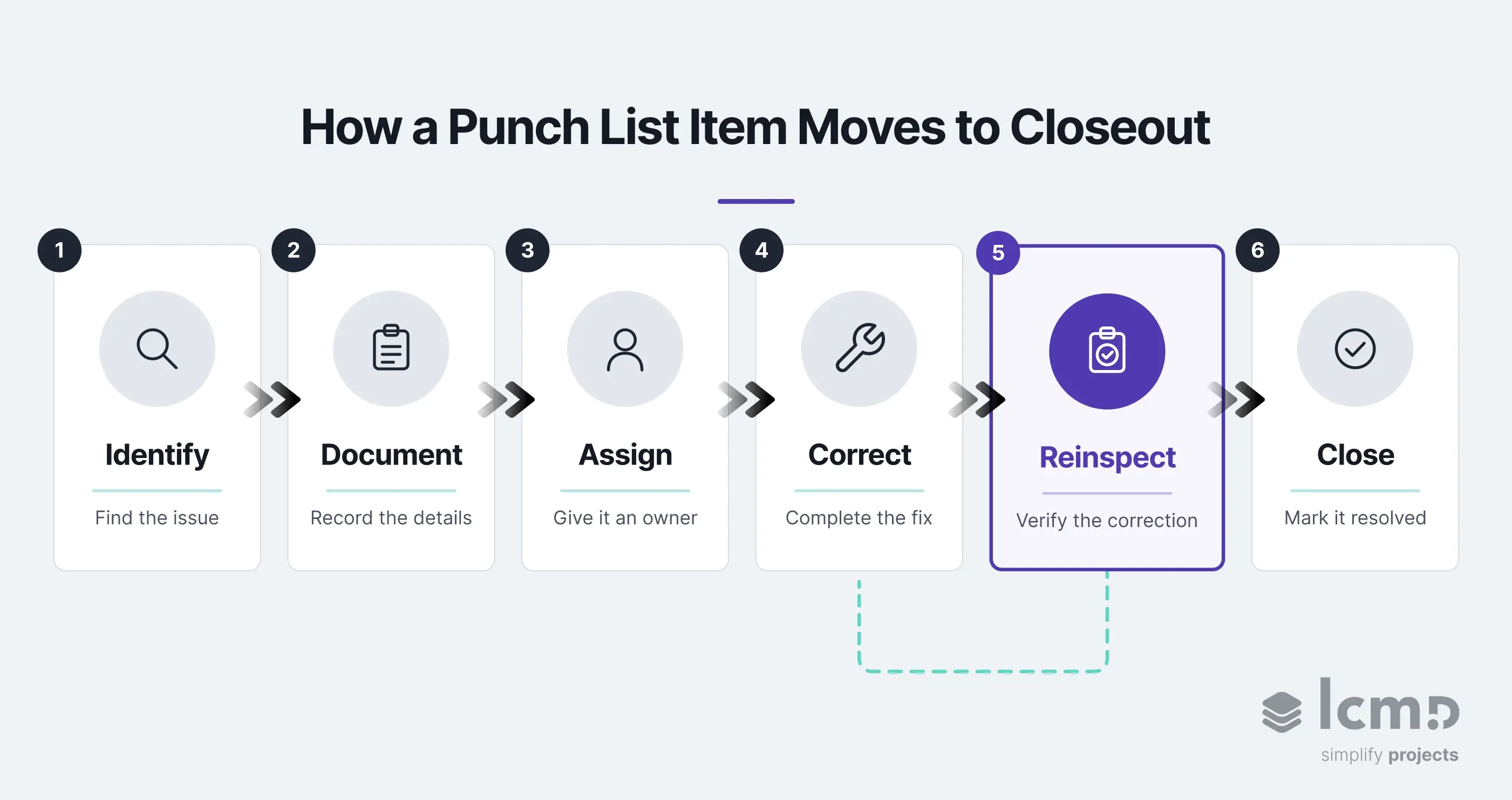
- Identify: Walk the site and note anything unfinished, damaged, defective, or not conforming to the Contract Documents.
- Document: Add the issue to one current punch list with a precise location, clear description, and supporting photo where useful.
- Assign: Route the item to the responsible trade or subcontractor with a realistic deadline attached.
- Correct: The assigned party completes the required repair, replacement, adjustment, cleanup, or missing installation.
- Reinspect: Check the correction against the original drawings, specifications, or other Contract Documents before closing the item. Reinspection confirms that the correction actually meets the original requirement.
- Close: Once the correction has been reinspected and accepted, mark the item closed and retain the record for project closeout.
Skipped reinspection can allow an incorrect fix to move into closed status. If it resurfaces closer to final acceptance or project handover, less time remains to correct it.
Punch list items typically close in batches as trades cycle back through the site. Tracking each item's status keeps the punch list process moving, protects project timelines, and prevents unresolved work from accumulating late in the closeout process.
Who Is Responsible for a Construction Punch List?
The process above assigns each item to a responsible trade, but the assignment itself follows a defined sequence under standard construction contracts.
AIA Document G704-2017, the Certificate of Substantial Completion, provides a useful framework for that division of responsibility. Under G704, the contractor prepares the list of work to be completed or corrected, while the architect verifies and may amend it. The certificate is then signed by the owner, architect, and contractor.
On larger construction projects, a project manager may handle day-to-day task assignment, track open items, and help set deadlines across the trades. That coordination keeps the punch list moving without changing the responsibilities established by the contract.
Running a Construction Punch List Without a Spreadsheet
On projects with many trades, punch list management depends on keeping field teams and office teams working from the same current information. Digital tools, including digital punch lists, can support that coordination. In AGC's 2025 Construction Hiring and Business Outlook, 46% of responding firms selected punch lists as a use for mobile software.
When a punch list starts on paper or in a shared Excel file, teams may walk the site room by room and type the findings up later. Every handoff creates another opportunity for an item to get lost, duplicated, or assigned incorrectly.
How Lcmd Connects Punch List Items to the Schedule
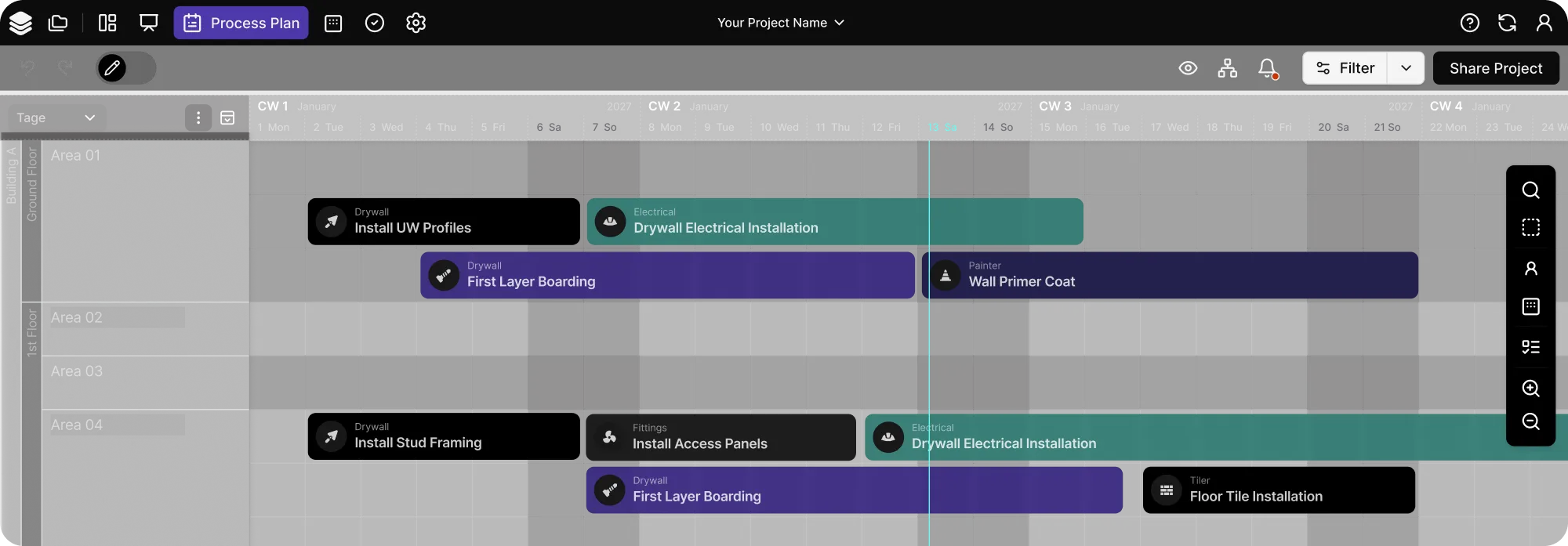
In Lcmd, the same walkthrough works differently. Each issue can be captured directly on site through the Lcmd onsite app, by voice, photo, or text. It becomes a Ticket, assigned to the responsible person and linked to the relevant process in the schedule. Tickets then move through the ToDo Hub as work progresses, giving field and office teams one current list to track progress and completion status.
If a client or inspector still needs a spreadsheet, the Ticket list exports to Excel in one step. The site walk and the list stay the same. Only the retyping disappears.
{{cta}}
What the Punch List Reveals About the Project
A punch list succeeds when every remaining issue has a clear owner and stays visible until the correction is verified.
The list becomes a quality signal, evidence of how reliably the project turned its requirements into finished work. Recurring corrections can show where problems traveled too far through the construction process before they were caught.
That gives closeout value beyond the project itself. The most useful lesson may be identifying which issues could have been caught before they ever reached the punch list.
FAQs
What's the Difference Between a Punch List and a Checklist?
A checklist defines what should be inspected. A punch list records the specific problems found during that inspection that require correction. A construction checklist might include doors, finishes, and fixtures. The punch list then identifies individual issues such as damaged surfaces, missing hardware, or paint touch-ups and tracks them through completion.
What's the Difference Between a Punch List and a Change Order?
A punch list covers incomplete, defective, or nonconforming work already required by the Contract Documents. A change order records an agreed modification to the Contract Documents, such as a change in scope, cost, schedule, materials, or design requirements. Work that fails to meet an existing requirement remains a correction issue unless the underlying requirement is formally changed.
Can Punch List Items Delay Final Payment?
Yes. Unresolved punch list items can delay final payment when the construction contract requires outstanding work to be completed or corrected before payment is released. Under AIA A201-2017, the contractor submits a list of items to be completed or corrected prior to final payment. The contract determines how unresolved work affects payment and when the project reaches final completion.
Do Residential Projects Need a Punch List?
Residential projects can use punch lists to identify incomplete work, defects, damaged finishes, faulty fixtures, missing items, and work that does not meet the project specifications. Whether a punch list is formally required depends on the project and its Contract Documents. In practice, it gives the contractor and project owner a clear record of corrections to complete and verify before handover.
Can Punch List Items Delay Project Delivery?
Yes. Punch list items can delay project delivery when unresolved work blocks required inspections, occupancy, final acceptance, or other key milestones. Minor cosmetic touch-ups may have little effect on project timelines. Safety, functional, or nonconforming issues can contribute to project delays when they remain unresolved as project handover approaches.


.jpg)