

Share this article:
.svg)


.svg)
.svg)

Key Takeaways from this article
- Quality assurance and quality control in construction create the most value before defects appear, when requirements, responsibilities, and inspection points are still controllable.
- Many quality issues are created upstream, long before the construction site reveals them through defects, blocked work, or disputed handovers.
- The most expensive quality failures often happen at transitions, where one unresolved issue can disturb the next trade, the schedule, and the project margin.
- Construction quality control becomes more effective when inspection findings are connected to responsible parties, deadlines, evidence, and the live project workflow.
- Quality becomes part of project control when quality assurance, quality control, documentation, and progress tracking share the same workflow and the same visibility.
By the time a defect appears on site, the project has already paid for it.
Not always in money yet. Sometimes first in waiting time, blocked areas, lost schedule confidence, and the slow erosion of trust between teams who all believed someone else had it covered.
The Construction Industry Institute studied nine industrial construction projects and found that design changes, errors, and omissions accounted for 78% of deviations and 79% of deviation costs. Site execution errors? Just 16% of deviations and 17% of deviation costs. The problem was upstream all along.
That changes how quality assurance and quality control in construction should be understood. QA/QC creates control before the defect exists, shaping the conditions that allow quality work to happen on site.
So what does quality control/quality assurance mean in construction when it is treated as project control?
What Are Quality Assurance and Quality Control in Construction?
Quality assurance and quality control in construction are two distinct but connected quality processes that work together throughout a construction project to prevent defects, verify completed work, and protect the project from avoidable quality issues.
Quality assurance (QA) in construction defines the conditions that need to be in place before actual construction begins: quality requirements, acceptance criteria, approved materials, coordinated drawings, method statements, and pre-installation meetings. Construction QA is proactive by design.
Quality control (QC) in construction verifies that ongoing or completed work on site meets project specifications, drawings, quality standards, and the client’s requirements. This includes site inspections, inspection reports, testing, defect documentation, and correcting non-conforming work.
QA vs QC in Construction
The key difference between QA and QC in construction is timing. Quality assurance starts before actual construction begins and continues throughout the construction process, addressing the conditions that cause defects before they reach the construction site. Quality control acts during and after execution to verify work against the required standard and correct what does not meet it.
| Aspect | Quality assurance in construction | Quality control in construction |
|---|---|---|
| Main purpose | Prevent defects | Detect and correct defects |
| Timing | Before and during work | During and after work |
| Focus | Processes, standards, readiness | Inspections, tests, verification |
| Typical tools | QA plan, checklists, training, pre-installation meetings | Site inspections, punch lists, test reports, acceptance checks |
| Main question | Are we set up to build it correctly? | Has the work been built correctly? |
When QA and QC are managed as a connected quality process, construction teams catch quality issues earlier, protect follow-on work from disruption, and reduce the rework that erodes schedule and margin.
Quality Assurance and Quality Control Examples in Construction
Quality assurance and quality control in construction are most visible at the transitions: when one trade finishes and another begins, when a drawing is superseded, or when one unresolved defect decides whether the next activity can start on time.
Following QA and QC through the construction process stage by stage shows how prevention, verification, and correction support each other in practice.
Before Work Starts
This is where quality assurance has the greatest influence. Before a trade begins, the conditions for correct execution need to be confirmed.
QA at this stage means verifying that drawings are at the correct revision, materials are approved, acceptance criteria are defined, and construction methods match the design intent. A pre-installation meeting is one of the most effective QA tools available. It aligns the trade, the project manager, and the site team on the expected standard before work begins.
QC at this stage means preparing the inspection schedules, test requirements, documentation protocols, and quality control checklist the team will use to verify compliance once work is underway.
During Execution
During execution, quality assurance keeps the construction process aligned with the agreed quality requirements. Standardized QA procedures, clear responsibilities, and consistent communication help every team member understand the expected standard before carrying out the work.
Quality control checks the work while it is still visible and accessible. Site inspections, material checks, and inspection reports help construction professionals identify errors before they are covered, repeated, or passed to the next trade.
For QC, timing matters. A defect found during execution is usually easier to correct than one found after the next trade has already built over it.
Before Follow-On Work
This is where QA and QC failures often become expensive. When one trade finishes and the next is ready to move in, the project reaches a critical transition point that many teams handle too casually.
At this stage, QA confirms that the area is genuinely ready and that any open quality issues have clear owners before another trade begins. Not assumed ready. Confirmed ready.
QC verifies that defects have been corrected and closed before the area is released. If non-conforming work is passed downstream, rework becomes more expensive and harder to coordinate. A documented defect that has not been corrected is a deferred problem waiting for the next trade.
Before Handover
Before handover, quality assurance looks beyond individual defects. It reviews recurring quality issues and asks where the process failed: unclear requirements, weak coordination, late checks, missing responsibilities, or incomplete documentation.
Quality control confirms the final evidence. Corrections need to be complete, inspection reports documented, test results available, and the full quality record ready for the client.
Incomplete documentation at this stage is one of the most avoidable quality failures on construction projects.
Real Cost of Weak QA/QC in Construction
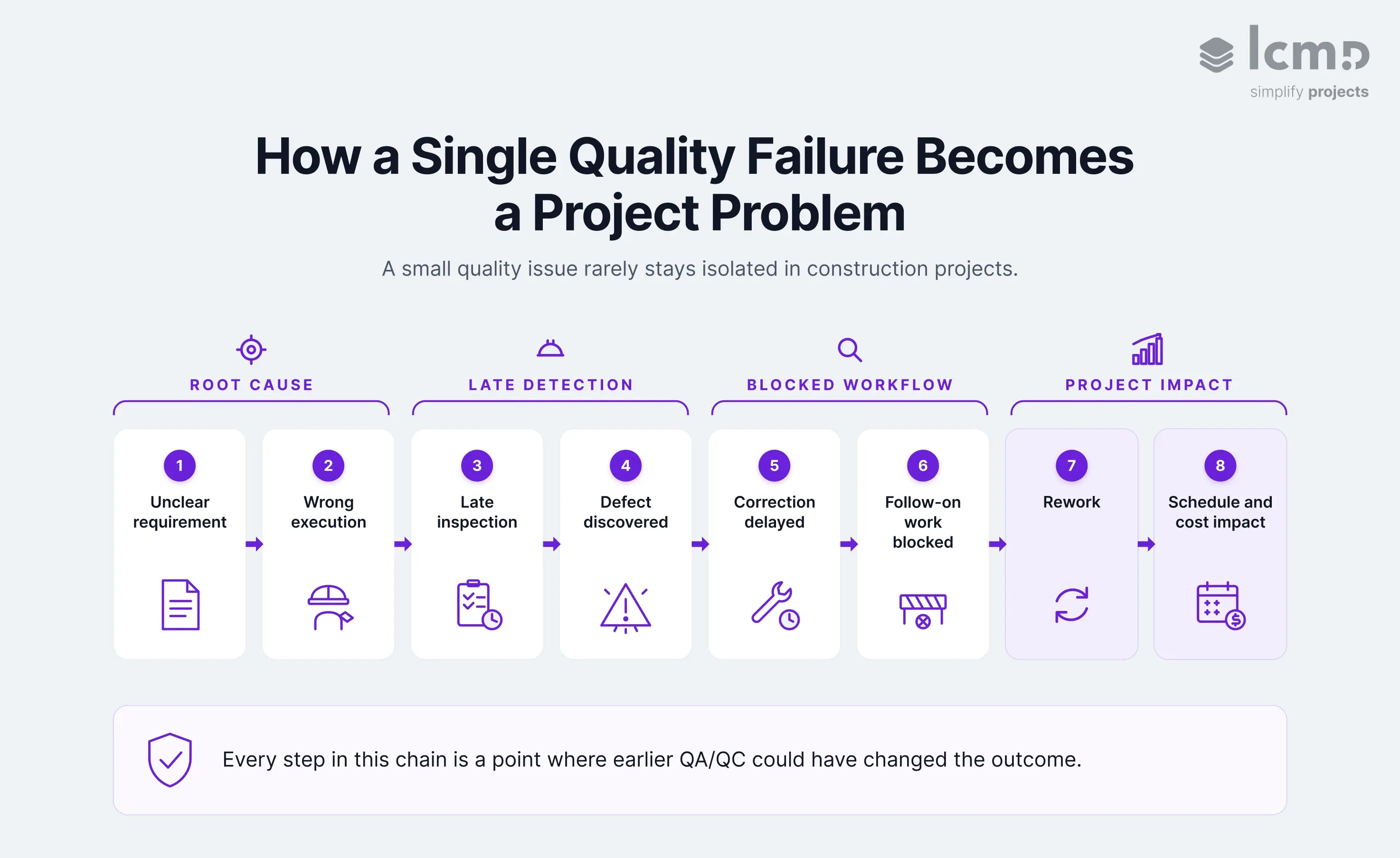
Most quality failures on construction projects do not arrive as single dramatic events. They build.
An unclear requirement leads to wrong execution. A late inspection finds the defect after work has already moved forward. Correction takes longer than expected. Follow-on work is blocked. What started as a manageable quality issue becomes rework, a schedule conflict, and a cost problem that was entirely avoidable.
The scale is measurable:
- Average rework can cost between 7.25% and 10.89% of total construction cost when direct and indirect costs are included.
- Rework can increase the schedule by approximately 9.8% of planned project time.
- Globally, an average of 52% of rework was caused by poor project data and communication, representing $280 billion in 2018.
How Digital Project Control Strengthens Quality Control and Quality Assurance in Construction
For most construction firms, quality information sits separately from the work plan. Inspection findings in one place. Task ownership in another. Progress status somewhere else entirely.
That fragmentation is a quality risk. A documented issue only helps if the right team sees it, owns it, and understands what it affects next. Only 16% of construction executives say their organizations have fully integrated systems and tools. Research also suggests that up to 30% of initial data created during design and construction phases is lost by project closeout.
Construction management software strengthens QA/QC when it keeps quality processes connected to the operating rhythm of the construction project:
- Inspection points linked to scheduled activities
- Quality issues assigned to clear owners
- Photos, checklists, and inspection evidence stored where the work is tracked
- Unresolved findings visible in progress reporting
- Recurring quality issues reviewed across project phases
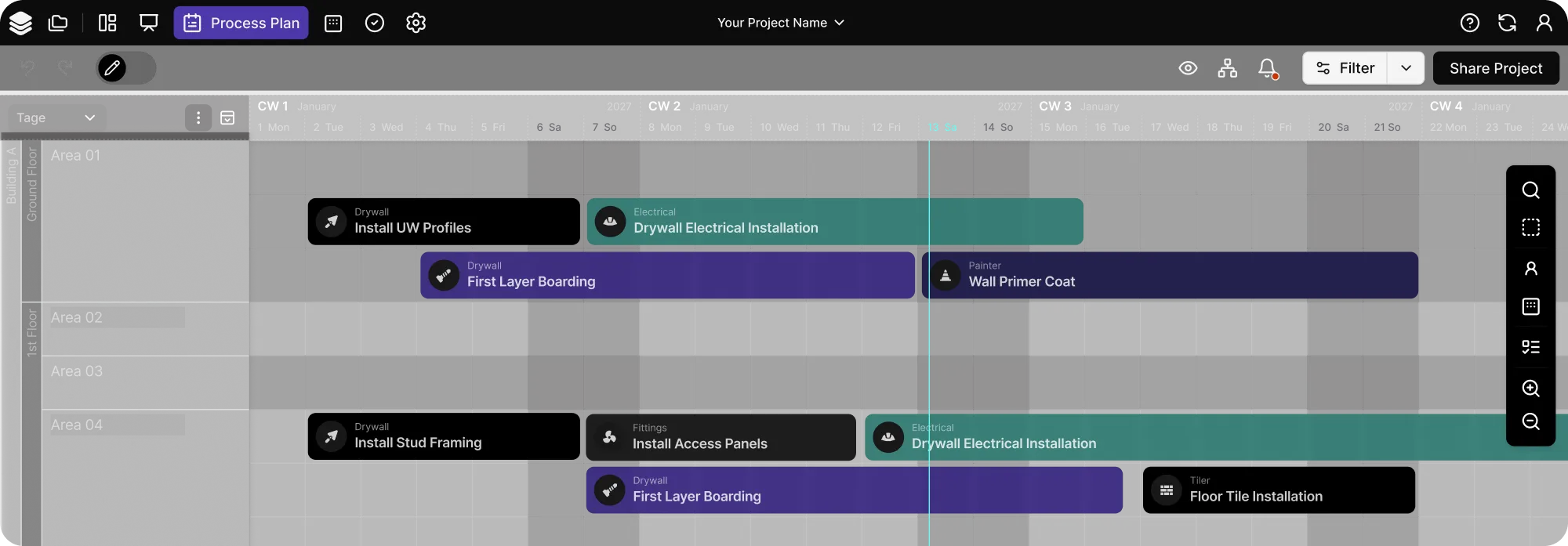
This is where Lcmd's digital project control approach fits naturally. Lcmd connects planning, execution, and site coordination in one construction management platform. Quality findings become part of how the project is controlled, connected to responsibilities, progress status, and schedule impact.
Clearer ownership, better evidence, and fewer hidden issues - quality data that helps project teams act before problems quietly enter the schedule.
QA/QC Readiness Check for Construction Projects
Before the next scope begins, these six questions can reveal whether your QA/QC process is connected to your project or running alongside it.
| Readiness question | Why it matters |
|---|---|
| Are quality requirements clear before work starts? | Prevents subjective checks later. |
| Are inspection points linked to the schedule? | Avoids late discovery of defects. |
| Are responsible teams assigned before issues appear? | Speeds up corrections. |
| Are current drawings and specifications easy to identify? | Reduces errors from outdated information. |
| Are defects connected to tasks and deadlines? | Turns findings into managed work. |
| Are recurring issues reviewed? | Helps QA improve, not just QC react. |
Unclear answers here tend to show up later as defects, delays, and disputed handovers.
What Construction Quality Management Adds to QA/QC
Quality assurance and quality control are the operational core of quality work on a construction project. They define how teams prevent defects, verify completed work, document findings, and close quality issues during delivery.
A broader construction quality management approach extends this into company - wide standards, roles, reporting structures, KPIs, and continuous improvement across projects.
For construction teams, the most effective starting point is connecting QA/QC to planning, ownership, checks, progress tracking, and reporting. That is where quality becomes more than inspection. It becomes part of project control.
That connection is what effective quality control and quality assurance in construction is actually building toward.
{{cta}}
Conclusion
The projects that finish on time, stay within budget, and reach handover without constant dispute usually have one thing in common: quality is built into how the work is planned and executed, not added at the inspection stage.
That starts with clear requirements before work begins. It continues with inspection points connected to the schedule and quality findings that reach the people responsible for acting on them.
That is what effective QA/QC looks like in practice. And it is worth building deliberately.
FAQs
Who Is Responsible for QA/QC in Construction?
QA/QC responsibility in construction is shared between project managers, quality control managers, site supervisors, and subcontractors, with exact roles defined by the contract and project structure. The quality control manager typically owns inspection activities and defect tracking. Subcontractors are responsible for correcting non-conforming work within their own scope. Clear role assignment before work starts is what makes QA/QC function as a system rather than a reaction.
What Should a Construction QA/QC Checklist Include?
A construction QA/QC checklist should include quality requirements, current drawings and specifications, approved materials, acceptance criteria, inspection points, test requirements, responsible teams, required documentation, and closure status for any non-conforming work. A good checklist confirms that work is ready, checked, corrected, and traceable.
How Does QA/QC Reduce Rework in Construction?
QA/QC reduces rework in construction by making quality risks visible before they become expensive to correct. Quality assurance creates the right conditions before work starts through clear requirements, coordinated drawings, and readiness checks. Quality control verifies completed work at defined inspection points while corrections are still straightforward. The earlier a defect is identified and assigned, the lower the cost of correction.
How Does Poor QA/QC Affect Construction Contracts and Handover?
Poor QA/QC in construction creates direct contractual risk, including defect liability obligations, potential liquidated damages, and handover complications if inspection documentation is incomplete. Most construction contracts require contractors to correct post-completion defects at their own cost. Clear quality records and closed inspection findings throughout the project are the most effective protection against contractual exposure.